I spent way too much time writing about “Wuthering Heights”, and I don’t think that because I think any of it was wrong, or because the movie doesn’t warrant it, but because it’s a waste of time to respond to all of the wrong things.
I spent so much time rejecting the most facile and close-minded takes on the movie, that by the time I started to hit on exactly why it had such a surprising impact on me, I was already tired of talking about it. Usually my rule of “respond to the thing, not to what people are saying about the thing” is so that my impressions of it are my own, instead of just being influenced by other people’s takes.
But I’d forgotten the most important corollary of that: the easier it is to explain why something is wrong or not useful, the less value there is in doing so. The Discourse is designed to feed on itself. Throwing more fuel into it is just a waste of energy.
As if on cue, YouTube offered me two videos today, side by side: One was this fun interview with Emerald Fennell on Josh Horowitz’s Happy Sad Confused podcast, talking about all of the influences that went into making “Wuthering Heights”, and wanting to make something additive to a book that was so transformative for her, and which has already been adapted, read, and analyzed so many times over so many years. The other was a video from an essayist that was titled “Heathcliff Isn’t White.”1It was from a year ago, so it was responding to the casting announcements for the movie, instead of being a review of the movie itself. And it was using the casting to launch into a discussion about a topic (white-washing in Hollywood) that they often discuss anyway, instead of simply capitalizing on the burst of popularity. So I don’t want to be too dismissive or accusatory. 2But then again, they did include a screenshot of the casting announcement set to the theme from Curb Your Enthusiasm, so maybe I do want to be at least a little bit dismissive.
I chose to listen to what the filmmaker actually had to say, and especially how her take on influences was so expansive and inclusive. She talks about how much she loved Baz Luhrmann’s Romeo + Juliet, Titanic, Bram Stoker’s Dracula, and even Dracula: Dead And Loving It, four movies that I’ve always been indifferent to at best, if not outright disliked.
It gave me the impression of someone most interested in engaging with art in terms of what it has to offer. Not in order to categorize it, to provide a definitive interpretation of it, or even to put much of a value judgment on it. Camp, gothic romance, horror, parody, open sentimentality, melodrama, all mixing together into this near-infinite well of stuff to draw from.
With that in mind, going back to engaging with YouTube videos or Letterboxd comments feels like even more of a waste of time. What are we even doing here?
It’s apt that this was sparked by Wuthering Heights, a book that I so closely associate with assigned reading. It helps explain why my gut reaction to so many of the reviews or video essays I’ve seen has been, “Shut up, nerd!” It takes me back to being in school again, and learning how to engage with literature and other art.
It feels like so many people are pointing and shouting “this is making a mockery of the sacred texts!” and declaring that the filmmaker clearly didn’t “understand” the book, because our most formative years were spent having this mindset drilled into us. There’s a pre-defined list of key ideas to take away from this book, and it’s your job to be able to find them. For probably 100 years, students have been writing papers that say roughly the same things about the novel Wuthering Heights, and teachers have been grading them according to how well they understood the ideas they were supposed to find.
A lot of the people making video essays now3Or writing long-winded reviews on their personal blogs probably did well in school, and were rewarded for reading books and watching movies in the correct way.
That fits pretty naturally into the internet and social media, which is designed not to reward insight, but engagement and consensus. You’re still rewarded for having the correct take on everything, even if it’s just with views and likes instead of a letter grade. That’s why you keep seeing the same things repeated over and over again.
It’s never really about “what is your take?” But “did you figure out the correct answer?”
It extends into the areas of nerd-dom that I’m more familiar with than gothic romances4Sorry, classic works of literature that were never intended to be about the romance, thank you very much with all of the fixation on “canon.” Every time a new MCU project comes out, there’s a host of “explainers” comparing it to the comics, listing all the references, explaining all the back story. Even though source material was often intended to be either ephemeral or self-contained, and even though the MCU rarely engages with the source material in any interesting way, there’s still this notion that you need all of the additional info to fully get it.
And for me, it’s kind of funny to read back over my own take on “Wuthering Heights” and see myself fall back into that. Early on, I seemed to get that a lot of the appeal of the movie for me was that it seemed to be so many contradictory things simultaneously. But the more I tried to explain it, and especially the more I tried to react to other people’s takes on it, the more reductive I got.
I thought that I’d found the key — a-ha! It’s subverting a teenage girl’s first impression of a classic novel! — and that explained everything. The movie was showing you that, but it was actually saying this. I said that one of my biggest complaints was that the ending seemed to want to have it both ways, presenting a subversion of a grand romance but still ending with a moment of romantic sentimentality.
The thing that I hadn’t considered: that shouldn’t have been a complaint. It does want to have it both ways, and probably a couple more ways that haven’t occurred to me yet. It’s not showing you something but subverting it; it’s showing you something and subverting it. It wants all of it. That’s probably a big part of why I was able to enjoy it, despite my complete lack of interest in period pieces and romantic novels, and despite its glaring lack of spaceships and ghosts.
It’s a movie devoted to maximalism, not just in its images and performances, but in everything. There’s a scene where Catherine is first seeing the dead body of her father, an abusive alcoholic who’d wasted the family’s entire fortune on booze and gambling. It’s framed with him lying on the floor, in between two mountains of empty glass bottles in the corners, piled up to the ceiling.
It’s an absurd enough image to get a laugh out of me, and Heathcliff has a line of dialogue that’s the closest he ever gets to being funny. But the scene isn’t camp, or black comedy. It’s that, plus grief, and anger, and tragedy, and poetic justice, and character development, and just the simple appreciation of such a distinctive visual image. Like so many of the scenes in the movie, it seems like its primary purpose isn’t to tell you something, but to make you feel something. Whatever that something is, is up to you.
It doesn’t seem particularly interested in hiding ideas below layers of meaning — I’m showing you this but I actually mean that — but instead letting them all float on the surface and mix together. “I know authors who use subtext, and they’re all cowards.”
And I’d said that it was never intended to be an adaptation of the book, but Fennell herself describes it as an adaptation. What I’d been assuming was wry subversion, was in fact completely earnest. The scare quotes around the title aren’t indicating some kind of ironic take on the source material. They’re an acknowledgment that her cinematic version would never be able to contain everything that makes the book so special to her. It’s an extremely personal take on the source material.5Which might help explain why people are being so weird about the movie and turning their criticisms into personal attacks. It doesn’t excuse it, but it does help explain it.
In Rain’s review of the movie, she describes it as Emerald Fennell wanting to make Margot Robbie and Jacob Elordi into “her own personal Barbie and Ken, acting out her teenage fantasy of Wuthering Heights,” and I thought that was a really good way of putting it. But I’d been thinking of it merely in terms of style and visuals. In other words: if it can have even me enraptured, as someone with no attachment to the novel and no interest in movies like this, then that’s reason enough.
But hearing Fennell talk even in brief about her thinking behind the movie, I’m realizing that it goes deeper than that. There are a lot of things that I had noticed, but considered them all distinct ideas and images, without thinking about how they’re all inter-related in an idea that carries across the movie.
Specifically: the character of Isabella as Fennell’s surrogate.
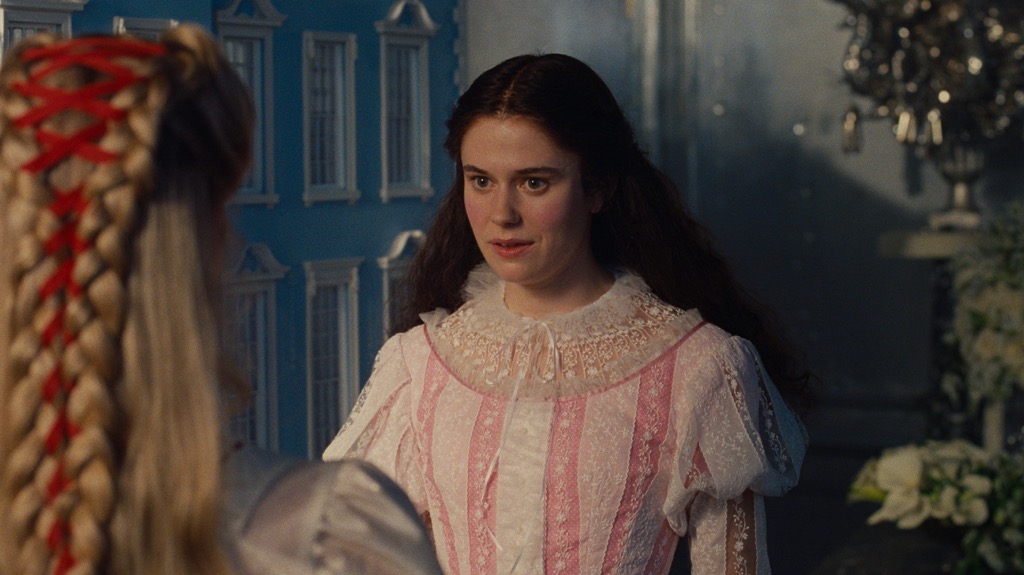
Again, none of it is particularly subtle; it’s all there on the surface. Maybe it’s just more difficult to put it all together if you’ve never been a teenage girl yourself. But Isabella’s introduction feels like a young girl reading a classic story and being swept up by all the adventure and romance in it. She recounts the story of Romeo and Juliet, in vivid detail, highlighting all the most shocking and tragic moments.6And emphasizing the misunderstanding that drives the drama, not at all unlike the (deliberately) crossed communication that separates Heathcliff and Catherine. She is, literally, trying to explain to an older man, who couldn’t be less interested, why she was so enraptured by this story.
And she dotes on Catherine, with charmingly creepy details like the flesh-colored walls of her bedroom. And the doll, which she emphasizes was made with Catherine’s real hair! In a fit of jealousy, she sets up a scene culminating with a bloody Catherine, much like the director is going to have play out in the final act.
And the title screen to the whole movie, which I’d taken to be just a whimsical flourish: a seemingly hand-made stop-motion title screen made from blonde hair.
I love it, but I’d been reading it as little more than a wry wink at the camera. What’s really most remarkable to me is that the movie has such a strong feeling of affection towards Isabella. She’s the source of almost all of the movie’s humor, but even at her extremes, you’re never really mocking her. She’s charmingly awkward, and naive, and spoiled, but even when she’s talking about having a room dedicated solely to her ribbons, it doesn’t come across as careless excess, so much as simply having no other frame of reference. (And she gives up her ribbon room, gladly, for Catherine).
The shorthand version of her story is “an innocent defiled,” but it’s never quite that, either. I still say that the most uncomfortably ambiguous scene in the movie is the one in which Heathcliff is repeatedly asking for — or demanding? — her consent, because it would be vile in the real world, but feels a little different in a movie that spends so much time in surreal fantasy. It’s a bit like the difference between imagining being kidnapped by a dashing and hyper-sexual pirate in a romance novel, vs how horrific that would be in reality.
Here, it feels as if Isabella is exerting some kind of agency in the kind of grand, tragic romance she’d always dreamed of. Almost as if it’s a lucid dream, and she’s now aware that she’s been elevated from quirky side character to major player. Because it’s not just that she wants Heathcliff; she wants to be part of Catherine and Heathcliff’s story. Even if it’s as the obstacle.
And Catherine and Heathcliff do feel like characters in a story, even though we follow them through their entire lifetimes, and we see them go through every single possible emotion. There’s always a feeling of distance from them, even when we’re seeing them at their most intimate. The movie is more sympathetic to them than I am, but even with that, it always seemed to be looking at them, instead of being present with them. They’re both too big, and too much. Even if you can relate to individual moments with them — gasp! he put his hand around her ankle! — they’re larger than life. Unlike Isabella, and Nelly, and even Linton.
So even though I liked the movie, I think my initial take was a little too reductive. I was describing it as being arch: it’s presenting this novel as she experienced it as a teenager reading it for the first time, and then subverting that, to comment on it now that she’s an adult. This is how she read it as a child, but now she’s put aside childish things.
But it’s too sincere for that. I’m not even sure if I’d stick with the claim that it “invites interpretation,” since that sounds too preoccupied with some kind of intellectual response instead of an emotional one. I called it deliberately provocative, but I’m not sure that it’s trying to provoke an argument so much as to provoke a feeling. To get swept up in all the excess and heartbreak and horniness — to experience it like that teenage girl and like that more experienced adult, at the same time.
It’s not intended to be a completely “faithful” and literal adaptation, but it is still an adaptation. It’s intended to contain as much as possible of what the filmmaker loves about the book. So it’s more like a personal, impressionistic interpretation.
Which goes back to my lengthy preamble about avoiding The Discourse, and un-learning everything that school and social media have taught us about how to engage with art and literature. The idea that there’s a correct answer that just needs to be understood, or that there are pre-determined and pre-approved lanes of discussion, and you’re rewarded for saying the right thing more than saying something insightful.
There are tons of adaptations of Wuthering Heights out there. At least one gets the ethnicity of Heathcliff “right,” and several are closer to the novel. One of them gets the ethnicity of Heathcliff shockingly wrong; how blasphemous! One of them inspired an iconic song.7And a dozen video essays, some of them actually telling me stuff I didn’t know already, about the lives of the Bronte sisters, or about Merle Oberon having to disguise her ethnicity for a career in movies.
But it’s hard to get enthused by accuracy alone. I have little doubt that each of them has some aspect that’s additive, to keep it from being nothing more than adding visuals and slimming things down, for people who don’t have time or patience to read. But also… so what?
I can pretty much guarantee that none of them are as personal as this version, because it’s rare to find any movie that feels as personal as this version. I compared it to Adaptation because it feels just as much like a personal account of an artist trying to express what they got out of a book, but without that movie’s distance or explicit self-awareness. “Wuthering Heights” is saying both “I want you to understand what’s in this book” and “I want you to understand just how much I love this book, for my entire life, ever since I was a teenager.”8Surprisingly, it also reminds me of The Mandalorian, if only because it has a similar feel of an adult having a fan-boy or -girl explosion over something they absolutely loved as a kid, and making something that feels like the undiluted essence of the source material.
And that means this version is the one that actually connected with me, a 54-year-old man, who has little frame of reference for being a boy or girl in England in the 1800s, or even being a teenage girl in England in the late 1990s. Because while I can relate intellectually to the universal ideas contained in a piece of classic literature, I can relate emotionally — profoundly emotionally — to the ideas that this specific book unlocked for this specific filmmaker.
I can look back on all the times I went batshit crazy nerding out over something (or someone), as well as the times I was either too eager or too afraid to grow up, and the bad decisions that sometimes resulted. For that matter, I can look back on times that I was carelessly selfish or unintentionally cruel, and extend myself some grace. And instead of my usual reaction of being embarrassed or ashamed, I can have genuine affection for those old versions of me. Instead of regretting my awkward naiveté, celebrating it. Or at least being charmed by it.
Every time I sit down to write something about a movie, I’m usually most concerned with picking it apart to make sure that I “got it,” meaning making sure that I fully understood what it had to say. This was one of the rare movies where “getting it” means I understand how it makes me feel.