Widow’s Bay has quickly become my favorite thing on television. I was already hooked after the first two episodes, where they proved that they’d found a way to make a horror mystery series genuinely funny.
But I was having trouble coming up with a good quick description of it, because all the obvious comparisons come up short. Not because it’s completely unique and original, but the opposite: it’s constantly reminding you of dozens of different familiar things, but it doesn’t quite work exactly like any of them.
Is it like The Fog plus Parks and Recreation? Or Twin Peaks if it had been more wry than surreal? Or Green Acres as a prestige horror series? Or maybe Salem’s Lot, or It but, you know, intentionally funny?
It doesn’t even feel quite right to call it a “horror comedy,” since it doesn’t really depend on jokes (except for when it does) and it’s also not a horror series with some comic relief (except for when it is). It’s more like everything is playing off everything else, constantly, each element coming to the forefront at exactly the right time.
The third episode is called “The Inaugural Swim,” and it’s about Mayor Tom encountering a woman on the island who seems to prey on lonely, widowed men. He still doesn’t believe in any of the island’s superstitions, and he’s convinced that the locals are just getting into his head, but he’s just spooked enough by it to go to Wyck for help.
My favorite detail in the episode is during a promotional video about Widow’s Bay created by the island’s historical society. As a narrator recounts the story of the island’s discovery, we see old seafarers’ maps. And we can just make out that all of them, just off the coast of Widow’s Bay, have included a DO NOT TRAVEL HERE warning.
The episode made me appreciate how, on top of having to balance horror and comedy, Widow’s Bay has thrown the requirements of a mystery series onto its collection of spinning plates. And it doesn’t take the approach that Lost and Battlestar Galactica became notorious for1Likely due to having open-ended runs and requirements for 20+ episodes per season: front-loading the series with a bunch of intriguing mysteries that may or may not be picked up at a later date.
Instead, ideas are interleaved throughout the episodes, never distracting from each episode’s main storyline, but quietly reminding us of the things that we should probably be keeping in mind. A conversation between the kids and some tourists who are surprised that they’ve never visited Boston reminded me: Is it actually true that natives can never leave the island? What does that say about Loftis and his son in the event that things really start to turn horrible? How is Reverend Bryce connected? What was that lurking in the multiple levels of underground caverns, anyway?
In the moment they’re introduced, they seem like off-hand, funny details that make the whole series so funny. The island is so ludicrously cursed, and it has been throughout history, that there is no shortage of horrible things that every islander knows about and just shrugs and takes for granted.
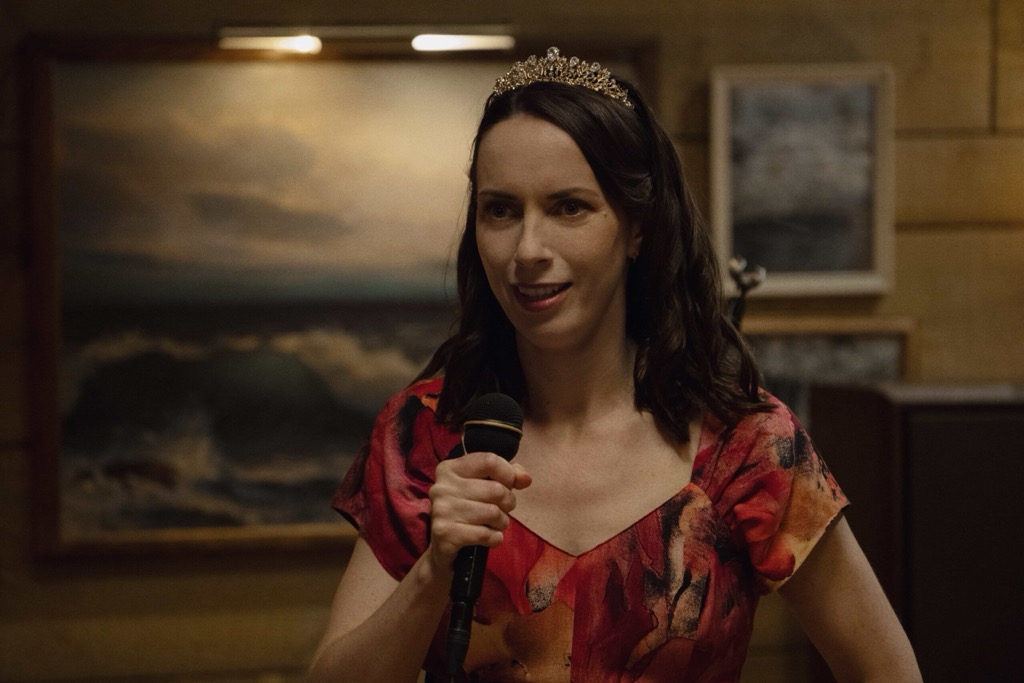
Episode four, “Beach Reads,” might be the strongest of the series so far. It switches focus from Tom Loftis — who has finally begun to take the island’s superstitions seriously — and goes back in time a couple of days to focus on Patricia, and her preparations for the city’s cocktail party we’d been hearing about.
And as an illustration of how the series is always interleaving and foreshadowing ideas: this episode was seeded by a conversation between Patricia and Loftis in the first episode, where she’s once again telling about her encounter with “the Boogeyman.” At the time, it just seemed like something incidental that was establishing these characters and the island. Patricia’s the eternal sad sack, Loftis is self-obsessed and insensitive, and Widow’s Bay has a long history of horrific events that are so common that people have gotten tired of hearing about them.
This episode was definitely the most horrific for me. I can usually shrug off stories of curses and monsters and sea hags, but stories about social anxiety are like a cold hand reaching into my chest and squeezing my heart. I was feeling such an enormous, mounting dread throughout — still able to recognize the funny and clever portents of doom, but miserably groaning at the same time. This is going to be so awful.
I could tell how deeply I’d gotten invested when I noticed I was mentally arguing with mean girl Kris the entire time on Patricia’s behalf, exactly as I have in showers of my past, coming up with the perfect retort I should’ve said in the moment, but was too upset and flustered to.
And I really appreciated how this episode would’ve been excellent even if they’d left Kris and the other women to be nothing more than high school bullies who’d never grown up. But they included a conversation to establish why Kris has always been such a c-word to Patricia, and how she justifies it to herself. She’s still clearly in the wrong, and obviously none of them ever processed the trauma they went through back then, but it keeps her from being just another two-dimensional town character.
The series started seeding the dread for this episode throughout the previous one, with increasingly annoyed or urgent messages on Loftis’s answering machine. (Not to mention Rosemary’s cryptic “Can’t do anything right today,” which has still not been resolved). And in this one, it builds so perfectly that it almost makes me weep. The book itself inexplicably attracts flies. It’s placed in the donation box so that it just obscures the cover of a Stephen King novel underneath, planting the idea of Carrie and other horrors in your mind. The mid-century illustrations all have a background of spattered ink that might just be part of the design, but might suggest blood spray.
And the “circle the parts of your body you don’t like” diagrams, complete with pubic hair and genitalia, were the chef’s kiss perfect detail that this series excels at. The series is gleefully drawing freely from a well of “every horror story ever,” and just like the creepy board games in episode two, it knows exactly how to suggest something that’s deeply wrong, but without going so far as to get more than a “huh, that’s odd,” reaction from the characters.
Finally, these two episodes have perfect examples of how brilliantly the series uses comedy and horror to work off of each other. But explaining them would require spoilers, so avoid them until you’ve watched them.
I was already giving the show my unreserved recommendation, but that’s now turned into a demand that you watch it, if you have any access to Apple TV. It’s the kind of confident, tonally perfect, brilliance that comes around very rarely.
So, episode four just had me filled with increasing dread for 30 straight minutes. The way-too-relatable social awkwardness, the cruelty of the women, Patricia’s mounting obsession, and the Stephen King reference plus panicked message from the Sheriff all planting the idea of a Carrie ending in our minds. Which the episode happily dragged out as long as possible.
Sheriff Bechir looking over the security footage, which we’d assumed was in daytime until we’re shown the timestamp, borrows from the best bit of Paranormal Activity and then executes on it 1000 times better.
And the masterful shot from the dance floor, as the camera is constantly circling to show everyone partying around Patricia, until we see the briefest glimpse of everyone standing stock still, their mouths open horrifically, had me audibly call out, “Oh no!” We had to rewind it to point out what I was worried about.
After the last episode, it had become clear that Widow’s Bay was finally dropping the ambiguity, and making it undeniable to the characters that horrible things were happening. I was dead convinced that with this episode, all the safety bumpers were down, and it was barreling towards full-on catastrophe.
So when Bechir comes in and looks alarmed, carefully places his hand on her shoulder, asks, “What the fuck are you doing?”, and we see the blood and decapitated birds and knives, building up to the slow reveal of the antler headdress she’d constructed for herself… it felt like the most absolutely horrific moment in a series that’s already shown us a murder clown and a sea hag. The tension was unbearable.
And then Patricia accusingly yells at Rosemary, “‘You had your qualms?!’” That moment should be the go-to example from now on whenever anyone’s trying to explain how horror and comedy are so closely related. It was the perfect release to 30 minutes of unrelenting tension, and the perfect punchline to an extended shaggy dog story.
In the previous episode, right as we’re feeling bad for Loftis for letting the locals’ stories get so far into his head that he’s missed out on a chance for happiness, and feeling bad for Marissa for the humiliation of being mistaken for a sea hag, the real sea hag attacks. And there’s the same build-up of tension, as we know that Loftis is helpless and defenseless (while we’re still thinking it could be rationally explained as infection from the scratches) and might just be imagining the hag climbing on top of him.
And the comedy inherent to the image of a sea hag sitting on your face until you die is undercut by the realization that it’s happening right now. But right as it’s about to happen, he pulls the handle on the reclining chair, causing her to somersault over his head and be dumped onto the floor. Another moment that’s simultaneously a relief of tension and a pitch-perfect punchline.
Which is probably why I think the term “horror comedy” doesn’t quite fit the series, because it doesn’t work quite like any other example I can think of. It doesn’t really use one as a counterpoint to the other, switching back and forth between scares and comic relief. It doesn’t really treat them as interchangeable, either, as if the horrific moments are inherently funny because they’re so horrific.
It feels more like it understands exactly how horror and suspense sequences and foreshadowing and jump scares are constructed, and how sight gags and punchlines are constructed, and how much of that process is identical. So it can, seemingly effortlessly, hand off from suspense to comedy, or vice versa, without either feeling like it’s undermining the other.
I’m inferring from imdb listings that the series will be at least 10 episodes, which means that they’re not even at the halfway point and they’re already acknowledging that no, really, something supernatural is most definitely going on. Other series would’ve milked the ambiguity for far longer, so I’m now very curious to see how — or even if — they maintain the balance of funny and dreadful. What I’m already convinced of is that this whole series is something really special.