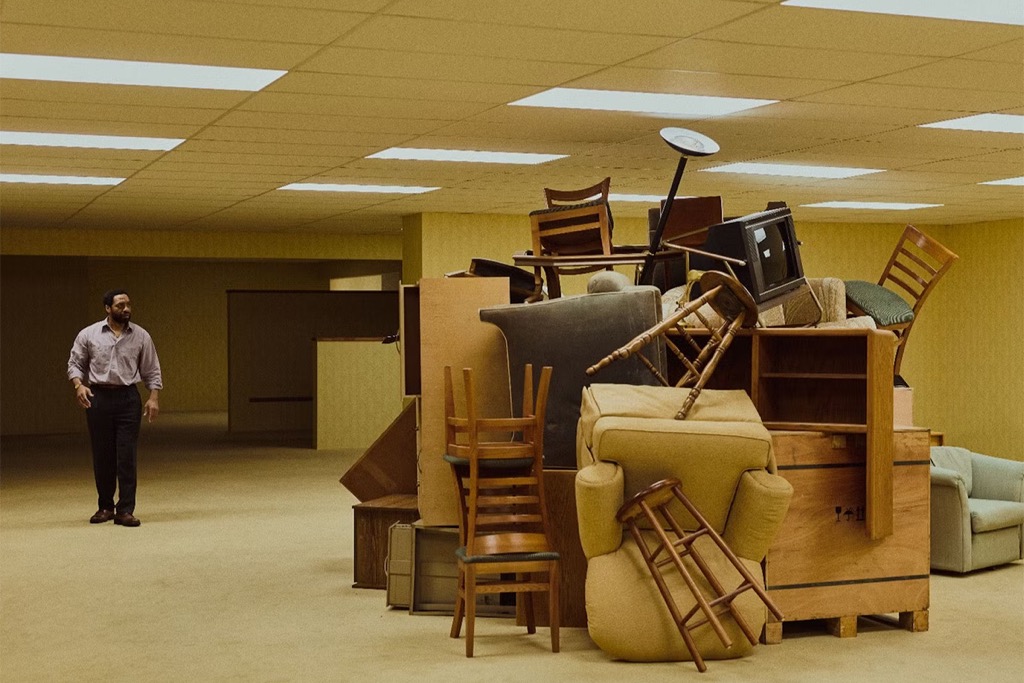
Here’s a tip for everyone: if you ever find yourself at the threshold of an inter-dimensional portal, where it seems like solid matter can pass through other solid matter, don’t stick your hand in there. No matter how tentatively. You don’t know what’s going to happen to it. Especially if you’re in a furniture store! Just stick a lamp or a coat rack in there or something.
I’m not just mentioning that for yuks, either. I’ve only ever seen one of Kane Parsons’s original Backrooms shorts, so I’m definitely not an expert. But there was so much that he did in that zero-budget short as a teenager that simply works better than a lot of the stuff in the feature film. Part of that is just having the main character fall through the world into the creepy Backrooms with no explanation or warning.
The feature’s instigating event is a little bit like that, as the protagonist (Chiwetel Ejiofor as a furniture store owner named Clark) stumbles into the Backrooms accidentally. But every single time afterwards, we see a person test the wall with their hand first, before committing to sticking an entire arm, then pulling it back in amazement.
On its own, it wouldn’t even be that remarkable, much less offensive. But in the context of a young filmmaker’s weird and original creation that became culturally resonant enough to make it into the mainstream, it feels like a disappointing step backwards. It’s such a conventional way to show the moment.
A similar choice is that there’s no music in the short film; it’s all diegetic audio, mostly the hum of fluorescent lights and buzz of the video camera. The feature has some kind of experimental electronic music playing throughout Clark’s initial exploration of the space, and to me it felt jarringly like someone trying to be creepy instead of just being creepy.
I could never quite shake the feeling that this could’ve been a breakthrough. The mainstream was finally giving resources to a new voice, instead of just repeatedly iterating on the same stuff that millennials and GenXers like. And instead, it just went back to The Old Ways. “That may fly on YouTube, kid, but here’s how The Grown-Ups make movies.”
And I do admit that I was a little biased, once I found out that A24 was doing the project, instead of somebody like Neon. I’ve been over-critical of A24, even though they deserve my infinite good will for making Everything Everywhere All At Once happen. And they’ve committed to treating the horror genre as something that can be successful without playing to the lowest common denominator. But that part has backfired, somewhat, to the point where it feels like everything either has to take the Blumhouse approach, where it’s all about turning fun horror movies into infinitely repeatable franchises; or to go the A24 route and make every horror movie a meditation on grief and psychological trauma.
Backrooms goes far enough into the latter that it almost feels like a self-parody of A24 horror. The inexplicably creepy infinitely expanding and self-reproducing liminal space becomes an all-but-literal metaphor for the failure to overcome past trauma. An idea that we’re reminded of, over and over again, via voice-overs and monologues.
I think a huge part of why the concept and the visual design resonates so much with people is that it suggests unsettling ideas, without really lingering on their explanations. It’s a nightmare, and nightmares always lose their impact when you analyze them or explain them. And significantly, it’s a modern nightmare, updating the imagery to where the 1990s are the time-long-ago, instead of drawing from whatever well people my age get their nightmares from.
So, probably unsurprisingly, the parts of Backrooms that I think are the most effective are the ones that work similar to how the shorts do. There’s a fairly lengthy sequence all done from the POV of a 1990s video camera, and I think it’s scary as hell. Not just for using the familiar found footage format, but for taking full advantage of the premise. It’s a confounding space that makes no sense and seems to stretch on infinitely, so you’re constantly being confronted with these bizarre copies of mundane things that seem like they shouldn’t be there, and you almost instantly feel completely lost.
And the camera has the very slow auto-exposure of a video camera from the period, so there’s always this unsettling feeling that you’re probably looking directly at something horrific, but you keep having to wait a few seconds to be able to make out what it is, exactly.
The second most effective sequence, just as unsurprisingly, has one of our main characters trying to escape the Backrooms as chaos is erupting around them. And again, it’s just a case of using the space and the characters to maximum effect: pursued through Alice in Wonderland-style nonsensical spaces, by a creature that is both unsettlingly eerie and immediately horrific. Desperately trying to make use of all of the elements that simply should not exist, instead of staring at them in wonder.
I liked those two sequences so much that it made me like the movie overall, even though I spent most of the rest of it focused on what it could have been. Maybe being more sparing with the music wouldn’t have actually worked in practice; I’ve only seen David Lynch projects really play with the idea of oppressive room tone and fluorescent hum, so maybe it would’ve felt derivative here. Maybe if they’d done more with the space itself, instead of building lore to suggest what it represents to the main characters, it would’ve resulted in complaints that the story and main characters felt shallow. Maybe seeing unsettling glimpses of some of the characters that inhabit the Backrooms, instead of an entire scene focused on them, would’ve left audiences confused.
As it was, I felt like it was showing a place that was supposed to be “every place there ever was,” and more often settled for showing us scenes that felt disappointingly conventional. There’s one brief shot, with a missing persons flyer on a telephone pole, that then has dozens of increasingly off-kilter duplicates, leaving you with the lingering reminder that the most horrifying aspect wasn’t a monster actively trying to kill you, but a place that dispassionately feeds off of your horror and makes copies of it. It was a perfect reminder of how this movie and this premise could result in some fantastic and genuinely novel imagery. There just wasn’t enough of it.
Finally, over the end credits there’s a track called “The Word Becomes Flesh” from the latest album by Boards of Canada. Its vocals are a woman and a computer voice describing the development of an embryo, but a lot of it sounds split into staccato phonemes, which suggest words, but are difficult to make out as more than just the components of words set to a rhythm — words trying only somewhat successfully to form themselves. It’s a fantastic counterpart to the visuals of Backrooms.
It not only made me eager to check out the band, but left me with positive vibes about the whole movie. So maybe that’s my second useful tip: if you’ve made a movie that might have audiences focusing on the parts that were disappointing instead of all the things that worked really well, just put a great piece of music over the end credits, and send everybody home in a good mood.
Comments
One response to “One Thing I Like About Backrooms”
I liked this movie a fair amount but I think two things held me back from loving it.
First: too much time was wasted getting people through the space in the wall. Absolutely it would be astonishing. I might have restructured the movie so we didn’t see any of Ejiofor’s first visit other than him entering (and not seeing him arriving). Then I’d keep when he brings his “camera crew” entrance. And then I would dramatically shorten or cut Reinsve’s entrance.
Second: I say I’d cut all of that because this movie has maybe too many ideas in it that are underexplored. Reinsve clearly has some emotional trauma from her childhood, but it’s so…. sketchy. Ejiofor’s “wife” only appears as her double (and as an imagined voice on the other side of his phone calls). I’d like something that establishes Ejiofor a little more as his pirate character — does that seep into his character? That sort of stuff felt missing to me.
That said, the whole scene where they’re talking in Ejiofor’s “kitchen” worked pretty well for me, though. Creepy idea, that you can just… eat the people. I think if the ideas had been integrated a little better, that would have moved this movie from good to great for me.