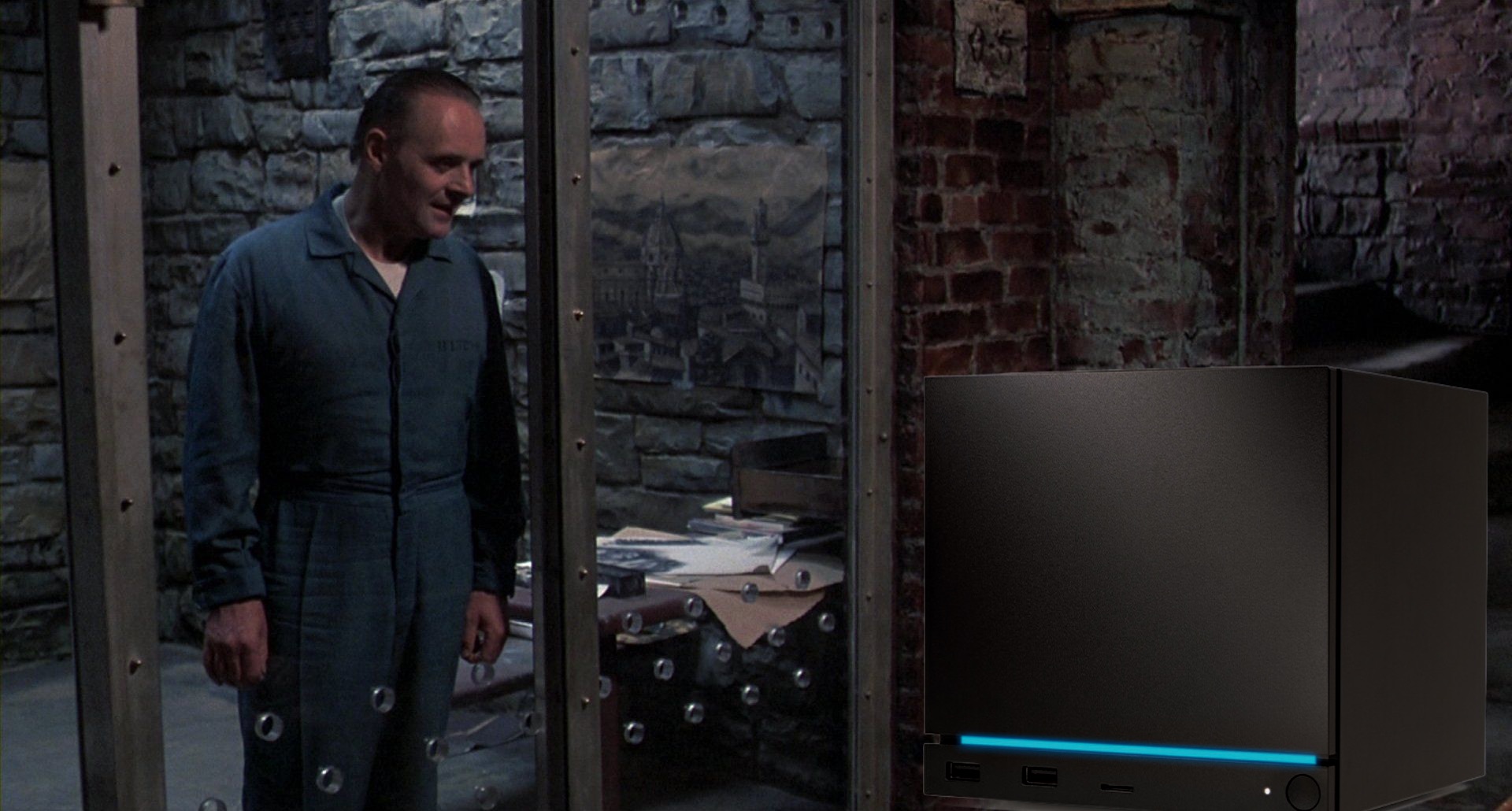
Valve finally ripped off the band-aid and announced the cost of the upcoming Steam Machine. It’s not cheap. Prices range from $1049 for the base model to $1428 for a 2TB version bundled with a Steam Controller.
The reason for the high price is that a bunch of ostensibly grown-ass adults refuse to just do their damn jobs or think for themselves, and would prefer to consolidate all the world’s wealth and resources into the hands of the worst people on the planet, relying on the most inefficient computing systems ever devised to regurgitate unreliable and inferior solutions to already-solved problems. But I’ll get back to that at the end of this post.
In any case, the most important part of the announcement is how it affects me, and I’m not happy. I don’t think anybody’s happy about it, including if not especially the people at Valve, but I’m not particularly worried about most of them since they’ve got more money than I do. I’d been imagining that the Steam Machine would sell for $800 worst case, in its maximum configuration. The only way it would approach $1500 is when it was bundled with the Steam Frame.
And even those were on the high end of estimates I was seeing. Ever since the Steam Hardware was announced, people have been flinging out ludicrously unrealistic price estimates, either setting themselves up for disappointment, or actively trying to undermine the product line. The actual price is probably less surprising to people more familiar with just how much the prices of RAM and storage have been inflated over the past year.
And whether you agree with Valve’s PR or not, they’ve at least been transparent: the price is higher than they wanted — they haven’t said the projected price at the time of launch, but have said enough to let us infer that it would’ve been in that $700-$800 range. The reason is out-of-control component pricing. And they don’t subsidize the hardware because within their business model, that would require them to lock it down instead of releasing it as an open, general-purpose PC.1For some reason, the people who talk about the price of the Playstation 5 or Switch 2 never think to mention the ongoing monthly cost to play games online, for instance.
We Have Steam Machine At Home
People online wasted absolutely no time with the wave of complaints. Most of them with some variation of “you could build your own computer that would be more powerful for less money.” Oddly, none of them posted a link to a parts list? Or an already-existing pre-built model? The only thing that surprised me about any of it was that even in the midst of my own sticker shock, I didn’t have any remaining patience for that nonsense. To anybody claiming that obviously you can get a better machine for less money, I say: prove it. Put up or shut up.
Or better yet: just shut up. The reason it was all so familiar was because I’ve been hearing similar for over twenty years now, since I switched to Macs as my main computers. People online have been constantly howling about how exorbitant Apple computers are priced, and how we’re all gullible suckers for paying “the Apple tax.”
The only time I’ve ever felt gullible is when I believed them. I wasted a lot of time over the years trying out alternatives — until just recently, Windows has been a necessity if you work in games or even want to stay on top of what’s happening in games — and invariably, they were always a waste of money.
For pre-built machines and laptops, the “huge” price disparity always vanished as soon as you started configuring a genuinely compatible machine, instead of just pointing at the base configuration. And even then, they always felt plasticky, hot, and above all, loud. I never would’ve named “runs quiet” as being high on my list of the advantages of the Mac, but trying out competing Windows machines2And the MacBooks at the end of the Intel era made me really appreciate it.
For build-your-own machines, no matter how easy component manufacturers tried to make the process, I would always reach a point where I realized that my time was more valuable than however much money I was saving. And no matter how good I got at putting a computer together, there would still inevitably be some lurking problem with it that would reveal itself over time. Problems that I never would’ve been able to diagnose if I hadn’t always happened to be working at places where my coworkers were IT people who knew what they were doing.
And the thing that makes me feel especially gullible is that the entire idea falls apart if you think about it for more than a few minutes. If it really were so easy, then someone would’ve already done it. You’d have to believe that Apple users were all simpletons with more money than common sense, who were wasting big money on nothing more than the Apple logo, simply because we didn’t know any better.
And you’d have to believe that perfectly viable and practical living room PCs have been out there all along, for those who have the eyes to see. And it’s just that all of us dimwits, who don’t have the latest model numbers of CPUs and GPUs committed to memory, needed the Half-Life company to tell us all what to give them money for.
Even Valve wasn’t able to make that approach work, back when they tried the “Steam Machine” the first time!
This morning I had insomnia, so I watched several videos claiming to have an alternative to the Steam Machine, willing to give them the benefit of the doubt. Most of them deliberately had misleading click-bait titles — my favorite was the guy who said “I can’t believe I beat Valve!” and then demonstrated his computer built with all used, untested, parts out of warranty; with a case built across his 2 3D printers and a separate workshop with a CNC machine; and despite all of that, it still came out bigger, louder, and more expensive! Even the channels I usually like weren’t able to come up with a true alternative at the same form factor and price.
Valve has more patience with all of this than I do, since along with the Steam Machine announcement, they announced that they’re officially releasing Steam OS to the public to install on any AMD hardware. If you feel like going through the process of building one yourself or finding a pre-built model, knock yourself out.
Have Fun With That
Y’all can have fun with that. I’m turning 55 this week, and I ain’t got time for that shit. I submitted myself for tribute to the Valve lottery, for the random chance to have the privilege of paying more than twice what I’d wanted to for a living room PC.
Because really, it doesn’t matter that it’s no longer anywhere near the realm of an impulse purchase like a console3Which are themselves priced so high that only a person of privilege can even think of them as an impulse purchase, of course, because this isn’t an impulse purchase. I’ve wanted one ever since before they were announced. Not last November. Before they were announced the first time.
I’ve been wanting to play games from my Steam library in my living room for almost as long as Steam has existed. I’ve tried so many times over the years, and none of them have been worth the hassle. Every time, I’ve eventually ended up saying, “fine, I’ll just get another Playstation.”
The PS5 has gone from being something I almost never use to something I actively resent having to turn on. The value proposition of the PS3 and PS4 days has all but disappeared. And even back when I liked the Playstation, buying a game for it (or Switch, or Xbox if I had one) meant that I had to play it on that device. With Steam, I’ve got at least four different machines I can be bad at playing DOOM on.
And all of my attempts at a living room PC — except for the ill-advised attempt running a Mac mini with Boot Camp — have been so loud. I like that Valve’s design is mostly heat sink, because it’ll be silent and unobtrusive. At this point, I’m willing to pay just for some peace and quiet. To not have to listen to the fans anymore: both the fans cooling the computer, and the fans of Windows who enjoy telling other people their business.
The Real Cost
So the question of buying a Steam Machine or building/buying a knock-off is pretty much a false choice. The actual choice is “try to buy a Steam Machine” or “don’t.”
It was always going to be a niche, luxury device; nobody needs a gaming PC hooked up to their living room TV.
For somebody who used to have all of the tech blogs bookmarked, I’ve been surprised by just how much tech journalism has become all but completely irrelevant to me. The repeated refrain that the Steam Machine is “underpowered” is meaningless as far as I’m concerned, because according to every review I’ve seen, it’ll do everything I want in a gaming PC. I don’t need to play the latest and greatest at 4K 60 fps, since I don’t do that anyway. I hardly ever play AAA games anymore, and when I do (Star Wars), it’s usually after it’s already been out a couple of years.
A clear sign that I have so little in common with “the common gamer” these days: I read a comment that the Steam Machine “won’t even be able to play GTA 6,” and it took me a minute to understand that they considered that a flaw, not a selling point.
I don’t need the machine to be future-proofed. But the most prominent tech sites have already gone so far into “enthusiast” territory that they almost never even bother to cater to the people who don’t care about specs or benchmarks.
An exception: I like the review of the Steam Machine from Dave2D. He mostly concentrates on how well the Steam Machine delivers on the claims from its first announcement last November, as a separate issue from the price. My takeaway from his video is that it does deliver on its claims, with one notable exception: there’s only 8 GB of video RAM. That’s the spec that I do tend to care about, because it’s the one area where my loyalty to Apple has been most tested.
Macs have long lived up to the promise of “it just works,” but they’re notorious for skimping on the included RAM (system RAM most often in the Mac’s case). And it’s always become noticeable over the life of the computer. For the Steam Machine, I don’t need maximum performance and high frame rates, but the kinds of strategy games and city builders I’m interested in do tend to have higher-resolution textures. I’m more likely to notice having to turn the texture quality down than the frame rate.
And practically, the idea of “future proofing” a Steam Machine might be overly optimistic. Am I even going to care about any of this nonsense when I’m in my 60s? I like to think so, at least. And while it wouldn’t have given me much pause around the $700 price point, I do feel obliged to consider it when it’s over $1000.
Which feels like a ripple effect, another way that the high price of components is undermining a computer that otherwise would’ve been perfect for me.
It also means that it’s going to severely limit adoption, because there will be fewer people who have always been content to have a gaming console in the living room, but want to try out a gaming PC just to see what it’s like. It’s going to hurt its chances of being a real mainstream, accessible, alternative to closed console systems. So people will keep having to tolerate the worse and worse value proposition of those consoles, simply because there’s not a great alternative.
It means that the Steam Machine won’t be as likely to become the reference standard for low-to-mid-range game targets. The Steam Deck “verified” label has already started to be that for handhelds, and it’s been good for gamers, because it’s encouraged developers to consider performance and accessibility standards like text legibility and controller support.
Not to mention that the pricing makes me a lot more pessimistic about the Steam Frame. I’d been hoping that it would be exactly what gaming VR as a medium needed: an accessible reference standard with enough buy-in to make VR appealing to developers again. And more modest and experimental VR projects would become feasible, which would mean more creativity and more variety. And of course, a market that wasn’t completely controlled (and then abandoned) by Facebook. But now, I’m not even confident that I will be able to justify getting one, even though I’m exactly the kind of weirdo that’d be in their target audience.4Minus having a job, of course.
I hope that when people complain about the price of the Steam Machine, they keep driving home the direct connection between the cost of components and the data centers required to keep pumping up the AI bubble. There are tons and tons and tons of valid reasons to be anti-AI: intellectual property theft, devaluation of labor, devaluation of creativity, environmental issues, elimination of jobs, unreliability of platforms running on slop code, unreliability of search engines running on AI “agents,” and concentrating more and more of the world’s power into the hands of an ever decreasing group of the richest and worst people. But people still are too short-sighted about it.
They don’t see the cost of AI as being anything other than the cost directly to them. It wasn’t until the “services” started charging more for tokens that users started complaining. Until then, they were perfectly happy to keep using and contributing to a system that was so clearly inefficient, destructive, and built on inequity. Just as long as it was free for them, and it made life easier for them.
It’s not a new phenomenon. People (including me) didn’t appreciate the real cost of “free” social media platforms, of newspapers on the internet, of abundant fast food, of communities dependent on car culture.
I don’t think the Steam Machine is an outlier, and I’ll be surprised if Sony and Microsoft’s next devices aren’t eye-wateringly expensive as well. I’m skeptical that even after the AI bubble bursts, there’ll be a huge price drop in RAM or the devices that use it. Maybe this is just a sign of how much everything is going to cost from now on. Considering how much goes into actually manufacturing these luxury devices, maybe it’s what they should’ve cost all along.