It is a matter of public record that I only-slightly-abashedly love Godspell. I’ve been a fan ever since I was a drama club kid in high school, and I saw a production of it performed by our “rival” school across town. (And credit to them: I’ve seen an off-Broadway revival and multiple filmed or recorded versions, and I still think their staging was the best).
If you haven’t seen it, the show starts with a single trumpet and the performer playing John the Baptist/Judas solo belting out “Prepare Ye The Way of the Lord.” In most productions I’ve seen, he enters from outside the theater and marches through the audience towards the stage. It was the first time I’d seen anything like that, and it’s still fantastic.
The reason I mention all of that: I’ve been really excited to see You Had to Be There ever since I first heard about it. And as I was driving to the theater today, I thought how cool it would be if they started the movie with the trumpet and a rendition of that song. And they did, which was an immediate acknowledgement that this movie and I would be completely in sync.
The documentary isn’t about the play in general, but about a specific production, in Toronto in 1972. There’s a clip from Late Night with David Letterman where Gilda Radner talks about doing the show with Paul Shaffer, and then he plays piano while she signs the first part of “Learn Your Lessons Well.” She mentions how that show launched the careers of so many other people who would go on to become famous: Eugene Levy, Martin Short, Andrea Martin, Victor Garber, and Dave Thomas probably being the most well-known to Americans.
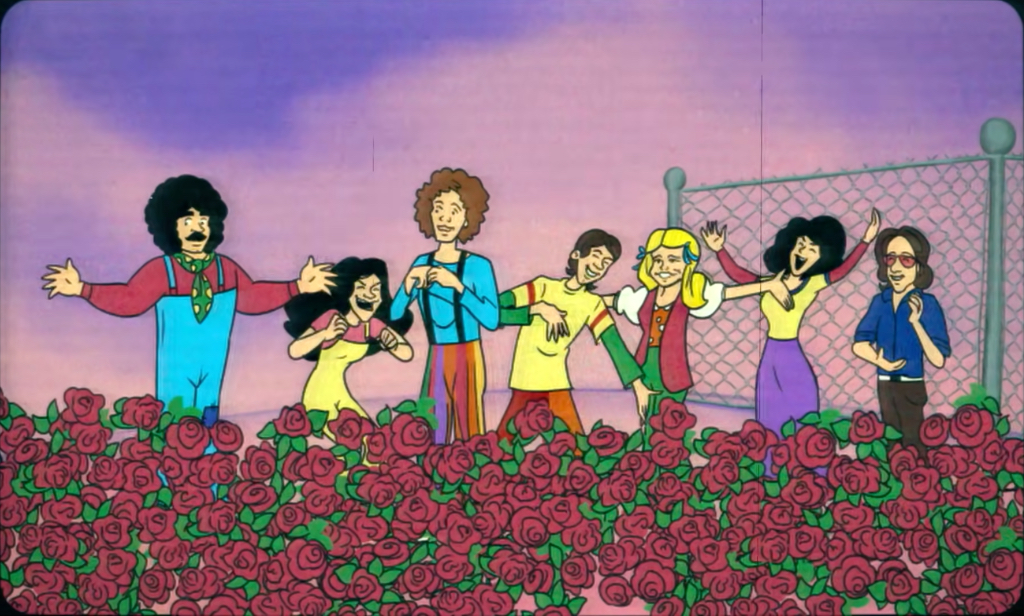
There’s almost no footage of the play available, just one clip from a rehearsal, and a bunch of audio recordings, many of them bootlegs made by Martin Short. So the documentary focuses on the still-living performers giving interviews about their experience before the show, the auditions and casting process, the casting changes during the show’s run, and their friendships and careers afterwards. It’s supplemented by a lot of animation done in early-1970s Hanna-Barbera TV style.
The trailer for the documentary, and the first 15 minutes or so of the movie itself, emphasize what a terrible idea it is to make a film about a stage play for which there is almost no existent recording. Hence the title, which Dave Thomas says in one of his interview clips. I was hard-wired to be into You Had to Be There, but the thing that really surprised and impressed me was how it turns that liability into a strength. By focusing almost entirely on interviews with the cast, it gives more of an insight as to why the production was so important, more than a more straightforward documentary might have.
You get personal descriptions of where these people were in their lives when they were cast, the friendships that already existed and the new ones that would form, and very personal accounts of why it meant so much to them.
Which I think is especially relevant with Godspell. The movie doesn’t actually spend that much time talking about the actual content of the play, with several of the cast simply saying they “didn’t get it” before they started the show. There are also some photographs of people in conservative Toronto protesting that it was blasphemy or a mockery of the Gospel of Matthew, along with a couple of newspaper clippings from people complaining about it.
And Levy acknowledges that it was odd at the time for someone so “visibly Jewish” to be taking over the part of Jesus later in the run, but he just says that he didn’t think that much about it. The more memorable part of that story was the request that he wax off all of his body hair. But that’s the kind of thing that you’d get from any documentary about the play itself.
The thing that makes Godspell so appealing — apart from the catchiness of all the songs, obviously — is that it’s all about accessibility. Getting through millennia of scripture, dogma, and ritual, and right to the ideas presented in the gospels, the betrayal, and the Passion. In a way that doesn’t feel “owned” but universal. It can read to everyone, whether they identify as Christian or not. I think it’s all about giving people the opportunity to form their own personal relationship with the source.
But again, to be clear, this documentary isn’t really about the play Godspell. It focuses a lot more on the group of performers and friends who had this experience change their lives, and then all of the things they’d go on to do in their careers. SNL and SCTV most notably, but really all the various directions — definitely not all of them positive — that a career in the entertainment industry can go. And how one joyful experience can create lifelong friendships.
Near the end of the movie, there’s extended footage of a dinner party where all of the interview subjects (except Thomas, if I remember correctly) have gotten together, and they all gather around Paul Shaffer at the piano to sing songs from the show. I’d never heard Andrea Martin sing not in character, and had no idea that not only did she perform the most well-known song “Day by Day,” but was excellent. (Martin Short describes her as the funniest person you’ll ever meet, which is pretty impressive when you consider all the people that Martin Short has met).
But because Gerry Salsberg, who’d played John the Baptist in that production, has passed away, they asked Eugene Levy to sing “Prepare Ye the Way of the Lord.” I never expect to get teary-eyed hearing Eugene Levy sing, but this is now the second time he’s done it. There are few things that could feel more artificial and insincere than a staged dinner party with a bunch of celebrities, but at the end of this documentary, you really do get the sense that you’ve gotten to spend some time with a bunch of absurdly talented people who’ve been friends for as long as I’ve been alive.


Leave a Reply