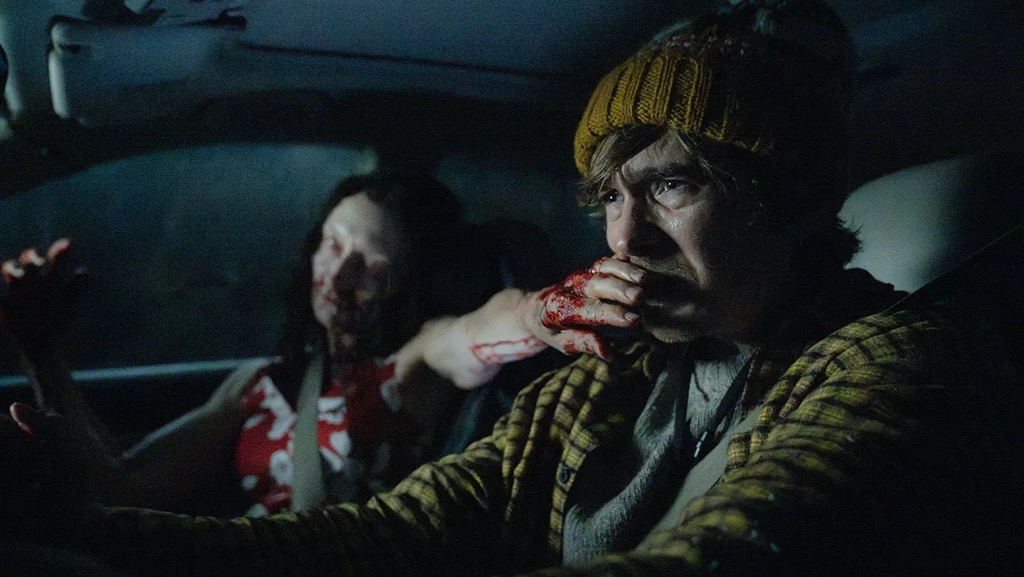
The best part of the new Resident Evil is the extended opening sequence, which could be an outstanding short horror film on its own, before it even shows us a title card.
Austin Abrams is fantastic as Bryan, a medical courier who agrees to take on an urgent request (at double pay) to deliver a mysterious package to the hospital in Raccoon City. We see him driving in the snow at night, knowing far more than he does about what’s going to be waiting for him as soon as he reaches his destination. But things take a turn for the disastrous before he even gets anywhere near the city limits.
This is all Zach Cregger doing what he does best: impeccably timed and paced horror scenes featuring characters who aren’t aware that they’re in a horror movie. And it has what I liked best about Barbarian: so much of the tension comes from following a character who’s absolutely and unwaveringly committed to doing the right thing. Unlike Abrams’s character in Weapons, and Justin Long’s in Barbarian, Bryan is blundering through horrific scenarios not because he’s selfish or foolish, but because he knows what he’s trying to deliver is important. Even if he doesn’t know what it is.
Which means that you get something that’s exceedingly rare in horror movies: a hero. Apparently, there were a lot of negative reactions from certain parts of the internet when the premise was first teased — imagine! people on the internet upset about something they haven’t seen! — because it doesn’t center on the heroic protagonists of the video games, or Milla Jovavich’s super-hero Alice in the Paul WS Anderson movies. I think it’s a lot more interesting, and even a little uplifting, that Cregger’s movies have focused on characters who are normal people breaking every “rule” of horror movies in their attempts to do the right thing.
And of course, it lets Cregger keep riffing on new ways to screw around with the audience, setting up our expectations as we see our protagonist be oblivious to what’s actually going on around them. Even if we haven’t played the games or seen the earlier movies, we probably come into a Resident Evil movie knowing it’s about zombies. So we get to see Bryan do one thing after another that makes sense for a human but is the worst thing you can do with a zombie. The jump cut between finding an injured woman and having guided her back to his car is perfection. And we keep seeing shot after shot of him casually letting her get within biting distance.
Another thing that is becoming one of Cregger’s signature moves: the normal-looking house with the creepy, foreboding front door. I had to keep from applauding in the theater at the sight of another one of his recurring players make a comeback in a new role.
I’ve only played a few of the Resident Evil games — 1, 2, and 4, in case anyone’s keeping track — and have never gotten more than halfway through, because like Bryan, I’m bad at guns. So I could recognize all the references, like Bryan desperately opening every drawer in a house to try and find some ammo. Or the room with an old manual typewriter, which he didn’t explicitly use to save his progress. Or even the overall structure of the movie, with an alternating pattern of finding a new and bigger gun, trying to get past some physical obstacle (in this movie, padlock after padlock), followed by another zombie set piece. As far as I’m concerned, this movie had all the familiar, classic bits except the Green Herbs.1Knowing Cregger’s background in sketch comedy, I can guess it drove him crazy trying to decide whether to make a pot joke there.
The most impressive thing about that is that it could’ve been insufferable if it weren’t so deftly handled. The easter eggs are all there, but they’re not drawn out or allowed to play like simple fan service. It’s more a case of “if you get it, cool, and if not, don’t even worry about it.”
It would be easy to assume that the movie is taking the Rosencrantz and Guildenstern approach, telling a Resident Evil story from the perspective of a non-player character. But I think it’s actually doing something a little more clever: it’s more like someone who plays the games — or more accurately, is bad at the games, like me — getting Jumanjied into the first one. (There’s even a point where Bryan stops in the middle of the action and celebrates video games). It’s clever because it gets all of the benefits of the “normal guy sucked into his favorite game” structure for audiences who aren’t familiar with the property already, but it’s not as cliched or hacky.
My one main complaint about the movie is that there are a couple of sequences that lean hard into the goofy comedy side of it. One features Paul Walter Hauser, and it kind of works since it’s having to deliver a ton of exposition of the Resident Evil variety, with biohazards and Raccoon City and the Umbrella Corporation, and treating it too seriously would be not just dry, but corny. The other is the whole sequence once Bryan reaches his destination.
Neither are bad. Cregger is too good at the mix of comedy and horror that he knows perfectly well how to write and pace a comedy scene and have it work. It’s just that those parts are where the movie feels like it’s trying to be funny. The rest of it just feels effortless. I was laughing out loud throughout, at the jump scares, at the over-the-top horrific moments, at the moments where it was clear that Cregger was screwing with us in the audience. It doesn’t have the tone of a typical horror comedy, but just the work of someone who’s become completely familiar with how an audience’s reaction to horror and to comedy are so similar. It’s so much fun throughout that it doesn’t need moments of intentional, explicit comedy.
Whenever there was another sequence that felt so clearly structured like a video game without drawing attention to the fact, I kept being reminded of Dungeons and Dragons: Honor Among Thieves. It was also an attempt at adapting a beloved, often corny, property, made by someone who seems to have genuine affection for the material, but has no illusions about its being perfect. It can act like a parody or deconstruction, but it’s not just making fun of the source material. It’s saying this is why this stuff is so fun.
I’m skeptical that another D&D movie could work without the filmmakers who were behind the first one, and I’m highly skeptical that Cregger’s take on Resident Evil could start a series. It feels so much like one of his movies, which just happens to be in honor of a video game series, instead of an attempt to relaunch or reboot a franchise. And that’s another part of why I enjoyed it so much. Even with all the easter eggs and attempts to match the structure of one of the games, it feels throughout like a movie that somebody really, really wanted to make.
Leave a Reply