Last year, as part of my hype/optimism for the Steam Hardware announcements, I wrote a post called My Hopes for the Steam Frame. The digest version: I was optimistic that Valve’s VR headset and “Steam Deck For Your Face” combo could help undo the damage of the Metaverse mentality, by encouraging more weird, smaller, and sustainable projects in VR.
A lot of that was based on the same underlying assumption: that the headset would end up costing in the $700-$800 range at most, and you’d be able to get it bundled with the Steam Machine and controller for in the ballpark of 1600 bucks. As we’ve seen, that did not happen. The Steam Frame is priced similarly to the Steam Machine in the US, at $1059 for a 256 GB model.
But it also feels like the Steam Machine sticker shock ripped off the band-aid, and so the higher-than-hoped-for price for the Steam Frame isn’t met with a gasp of surprise, but a sigh of resignation. Turns out that handing the global economy over to a bunch of sociopathic grifters has its downsides.
A Steam Deck For Your Face?
More surprising to me was Scott Stein’s review for CNET, where he approached it as somebody who’s not primarily a PC gamer. He found it less capable as a standalone device than a years-old Steam Deck — fine for running the games that you’d expect to run well anywhere, but more limited than the “let’s just try it and see if it works” method that generally yields surprisingly good results on the Deck.
That probably shouldn’t have been surprising, for a couple of reasons. First is that this hasn’t been the focus1Or foveated focus? of Valve’s marketing: it’s pitched as a streaming device first and foremost. I was actually surprised to hear that they’re releasing a version of Half-Life: Alyx — which again, is in my opinion the best VR experience ever made — that runs natively on the Steam Frame, instead of having to stream from a more capable PC. It sounds like it’s a downgraded experience from the PC, but I’m more surprised that it’s even possible.
Which is the second thing: my experience with the Steam Deck has been mostly one of “I’m surprised this even works at all.” Mine is almost permanently docked to my desktop monitor at this point, since I keep running into examples where it works great not as a handheld, but as the quiet, always-on, jump-in-and-start-playing desktop gaming PC that I never knew I wanted. And that’s a reminder of how much work has gone into it, from both the Valve side and the developer side, to delivering the promise of games that can be mostly hardware- and OS-agnostic and just run wherever you want them. Which means that potentially, the apparent limitations of the Steam Frame’s native game support might be a software issue that can be improved over time.
That’s the opposite of how I’ve always thought of computers and software, for about as long as I’ve been using them. They’re supposed to only get worse over time, as developers keep adding more and more stuff that eventually overpowers the hardware and forces you to buy a new one. It’s a side effect of so much work being put into the translation layer(s), and actually a different mindset from companies that are trying to put all the focus on a specific combination of hardware and OS, to lock people into a platform that they control. And obviously, it’s in Steam’s best interest to pursue this philosophy, since they’re uniquely positioned to be able to profit from cross-platform software.
And all of that indirectly gets to why I’m still optimistic about the potential of the Steam Frame, despite the wet blanket of the price, and the reminder that it’s not actually a 1:1 equivalent to a Steam Deck running on a huge virtual screen. Because I’m still convinced that people have had the wrong expectations of VR, and have been chasing the wrong thing. I still strongly believe that the near-future of consumer entertainment VR is in sustainable weirdness.
I keep throwing myself at and into VR headsets, ever since I was first shown a demo of the HTC Vive and saw Valve’s The Lab. It was essentially an extended tech demo, showing people what you could do with the hardware. But more significantly to me, it showed what you could do with a combination of hardware and Valve’s Portal/Team Fortress 2-era sensibilities. What happens when you emphasize creativity, variety, and most importantly, a sense of humor, with technology that shifts your relationship to the environment and the ways you interact with it?
The Anti-Quest
That first experience in VR felt like such a lightning bolt of an epiphany that it’s still lingering, even after a decade plus of lowered expectations and signs that the entire medium has dead-ended into stagnation. And over the years, I’ve come to the simple conclusion that people first experiencing VR have one of three main takeaways:
- I don’t get it.
- I could make a fortune off of this.
- I could make the coolest stuff with this.
I’ve never been a fan of Facebook/Meta, but I feel pretty free to be even less tactful now than I’ve ever been: that company buying its way into becoming the de facto stewards of VR is the worst thing that could’ve happened to the medium as a whole.
Usually, I try to take a glass-half-full approach. As much as I dislike the company, they have poured a lot of money into funding developers and encouraging people to make new stuff for VR. And they did get the technology into a ton of new people’s hands, giving them their first experiences with VR, by pricing the Quest and Quest 2 at the level of an impulse purchase.2In consumer technology terms, at least. My Quest 2 was from a previous company I worked at, that gave every employee one as a Christmas bonus.
We’ve seen how the company’s big bet on the “Metaverse” fizzled out, and now the company seems to be saying something like “No no when we said ‘metaverse,’ we really meant AI and pervert glasses the whole time.” I haven’t used the Quest 2 in a least a year, and had no interest in the Quest 3, so I can’t say for certain, but I certainly get the impression that the company has decided to let it stagnate if not outright abandon it. It sure sounds like they’re treating it as the consumer tech equivalent of a dead mall.
For consumers, it set unrealistic expectations for how much these things “should” cost, based on a company that was aggressively subsidizing them in order to build a new platform. And for developers, I think it set unrealistic expectations for the business model of VR games, based on a company that was aggressively funding development in order to build a new platform.
And overall, I think maybe the more pernicious side effect is that it set unrealistic expectations for how big a market there should be for VR. I’ve been lumping Facebook/Meta and VR devs into category 2 above, thinking that I can at least sympathize with the sensation of trying a VR headset and genuinely believing that it’s got the potential to change everything. But I think the reality is that category 1 is the largest group, by far. Most people simply aren’t ever going to be that excited about headset-based VR and AR.
I can remember trying out Apple’s Vision Pro for the first time, with a small group of co-workers, because there was the hugest disparity in reactions to technology that I’ve ever seen. I was sitting there thinking that it was one of the most magical things I’d ever experienced. A co-worker absolutely hated it. It was uncomfortable. The video pass-through was disorienting. You had to keep making weird gestures. It felt isolating. She actively avoided putting it on, at the same time I was marveling that I could keep it on while doing other stuff, after years of having VR development meaning taking off and putting the headset back on over and over again every few minutes.
I still think that the biggest limitation of the Vision Pro wasn’t actually the price, but the whole idea of pitching it as a lifestyle device for normal people. You kind of have to be a weirdo like me to put one on and think “this is going to change the world.”
Steam’s marketing of the Steam Frame has emphasized the diversity of its target market. It shows a wide range of ages and genders using the headset in different environments, a reminder that the idea is inclusivity and accessibility. Apple did something a little similar with the Vision Pro, trying to emphasize its appeal beyond the type of people you would expect to get much use out of a big head-mounted display. But all of their imagery had models in their beige, tastefully-decorated homes, lounging on a couch or preparing dinner or on the beach (?!), pointedly not showing any nerds or weirdos.
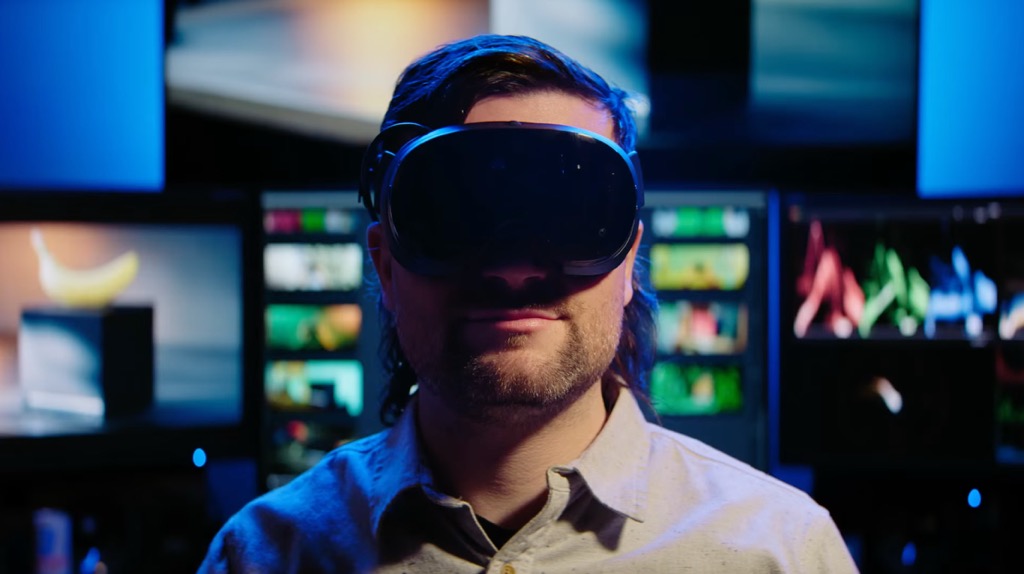
I like Valve’s approach better, though, because they do include the stubbly white guy in a dark room surrounded by computer screens. The vibe isn’t “no weird nerds allowed,” so much as “anyone can be a weird nerd.”
Here’s To The Weirdos
So I actually agree with all of the takes I’ve heard, saying that if anything could’ve taken VR into the mainstream, it would’ve been the Quest 2.
But while that’s mostly used as an example of how VR is dead in the water, I just think that it’s an example of how headset-based VR isn’t mainstream. The trick, as I see it, isn’t in figuring out how to get it more widely adopted, but in figuring out how to make something sustainable without ever expanding beyond a niche market.
Which some people would see as being the equivalent of dead in the water, since it’s targeting a market that has little potential for growth. From the opposite end, some people would see it as a lack of ambition, giving up on the idea that you can create something that will be so appealing that it can’t help but take off to a much wider audience.
Those takes could be right, and I can’t possibly be objective about it. I’m also not invested in it, more than the cost of the previous headsets I’ve gotten which are now sitting in a box somewhere, and the cost of the Steam Frame, which I’m almost certainly going to get.
I don’t think it’s going to have anything approaching the same demand as there is for the Steam Machine, and I don’t even know how much demand there’s been for the Steam Machine. But I do think that it’s going to occupy a similar space. Hardware that isn’t necessarily a huge breakthrough on its own, but just capable enough that it can provide some good experiences. And the bigger appeal is that it’s an open platform, which means we can break from the dominant tech companies like Sony, Microsoft, and Facebook/Meta, in favor of the tech company that we’re still allowed to mostly like.
I still haven’t finished Half-Life: Alyx, even though I love what I have played, mostly because I don’t want to use a Meta product. Is that worth over a thousand bucks? Obviously not, but I’m hoping that it becomes more justified when I see more of the stuff that’s been made over the past few years, but that I’ve skipped because I never want to use the Quest 2.
And the potential for new, weird stuff that developers might try to make, not because they want to make a ton of money by cornering the market with a game that’s a more immersive Halo clone, but because they played Alyx and thought “if Valve can make something like this, what can I make?”
When I was first getting excited about VR, it was mostly glorified tech demos, smaller games riffing on a single idea or a limited set of possible interactions. And like a lot of people at the time, I assumed that these were just a hint of greater things to come. Longer, full-featured games that could “compete” with the AAA productions and have you fully immersed in an experience for hours and hours.
Now, I’m fully convinced that those were the great things to come, and the problem came from assuming that they were too small or lacking in ambition. I mentioned it in my other post, but one of the many things I like about Half-Life: Alyx is that it’s divided into chapters with clear divisions. Even I can play through a chapter in under a half hour, and then take the headset off and take a break. A lot of the focus in VR headsets has been to try and make them smaller, lighter, more comfortable, and less isolating, so that we can wear them for longer and longer. I think the real answer is the simplest one: design experiences so that you can get something interesting, satisfying, and novel in a shorter time.
I think it’s long past time for those of us interested in VR are going to have to shrug and acknowledge that if/when this stuff ever takes over the mainstream, it’s going to be more in the form factor of eyeglasses instead of head-mounted displays. I think it’s also past time for us to acknowledge that really useful versions of that technology are still a long way off, and they’re currently being developed by businesses with the worst agendas and with no consideration for privacy, security, or hell, basic human decency.
Personally, I’m a lot more content to stick with a big screen strapped to my face, with no mistaking the fact that I’m isolated inside my own little world, and which I can use for maybe an hour maximum without wanting to take it off. Which is fine, because I’ve got a variety of interesting stuff to do, which delivers something satisfying in well under an hour.
Can that ever be a viable business model, even taking into account the idea that VR is inevitably going to be a niche market? Don’t ask me; I’m just an ideas guy. But I do know that for the first time in a long time, after repeatedly feeling disappointed and dispirited about the potential of headset VR, I’m feeling inspired to try making something short, weird, and unlike what I can get from a flat screen.
Leave a Reply