The poster for the American release of Black Sabbath shows a headless man barreling through the countryside carrying the decapitated head of one of his victims, while four young women bare their ample cleavage in horror. You can’t quite call it false advertising, but it definitely takes liberties with the kind of thrills that are contained in this movie.
The movie contains three horror comic-style stories: “The Telephone” is about a woman receiving threatening phone calls from a man who wants to kill her and can see everything she does. “The Wurdulak” is about a family dreading the return of their father, who went to the mountains to kill a vampire-like creature that craves the blood of the people it loved most in life. And “A Drop of Water” is about a nurse called in to help prepare the body of an old woman who died while conducting a séance.
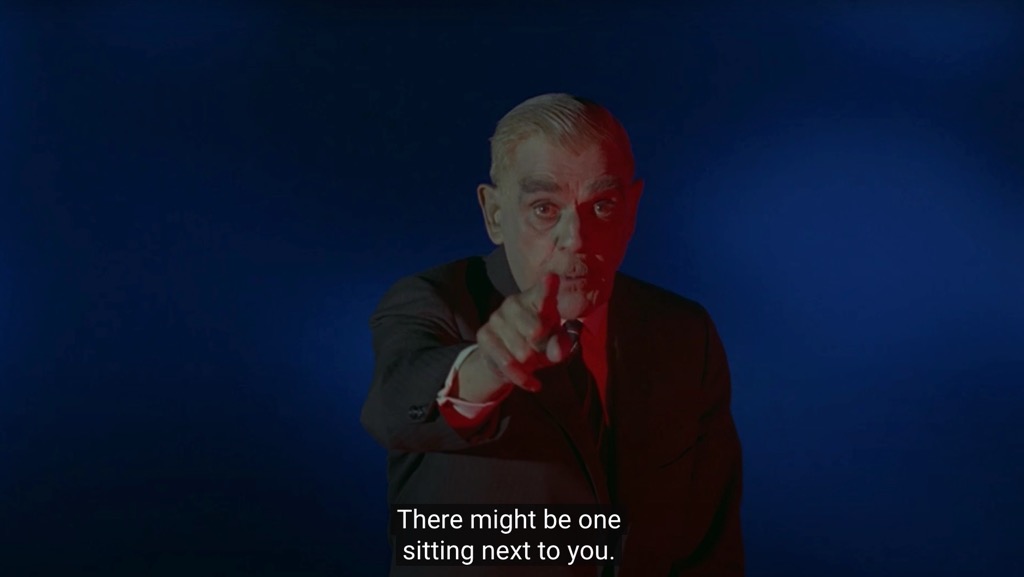
Boris Karloff appears as the father in the second story, and he also delivers a charming segment as himself, as an introduction and an epilogue to the movie. In the first, he appears against a blue backdrop that’s a little reminiscent of Fantasia, and I won’t spoil the second except to say that it’s a repeat of what might be the most memorable image of the movie.
Those charming segments did a lot to nudge me over the precipice into liking this movie, since for the most part, it’s extraordinarily dull. The first segment has just enough tension to be engaging, the second feels like a fifteen minute story padded to twice that length, and the third is mostly memorable for an extremely creepy old woman whose face is locked in a rictus grimace.
It’s fun to see how much Mario Bava and his crew were experimenting with light and color. I’m pretty certain that the ruined cloister set that was used for Black Sunday also appears here, and it was honestly a lot more striking in black and white. Black Sabbath’s scenes work a lot better in tight, confined spaces, with colored light coming from out of a window, or a light unnaturally focused on Karloff’s menacing face as he’s riding on horseback. It’s never as dramatic as anything in Suspiria or even Vertigo, but you can really tell that a lot of attention was paid to getting the light and the color exactly right.
I suspect that Kino Lorber also put a lot of effort into making sure that the Italian version was the one released on physical media and streaming, because both Kanopy and Plex have the original title along with the Italian soundtrack and English subtitles. It’s one of those rare cases where I would’ve preferred a dubbed version, since it was simply distracting seeing Karloff speaking Italian. (The changes for the American release described in the Wikipedia entry sound pretty dreadful all around, so I guess I should be thankful).
It all feels pretty tame and old-school even by the standards of 1963, seemingly going more for suspense than for shocking horror. You can’t deny the artistry behind much of it, but it undeniably feels like a collection of the “filler” episodes of a lost anthology TV series.
Leave a Reply