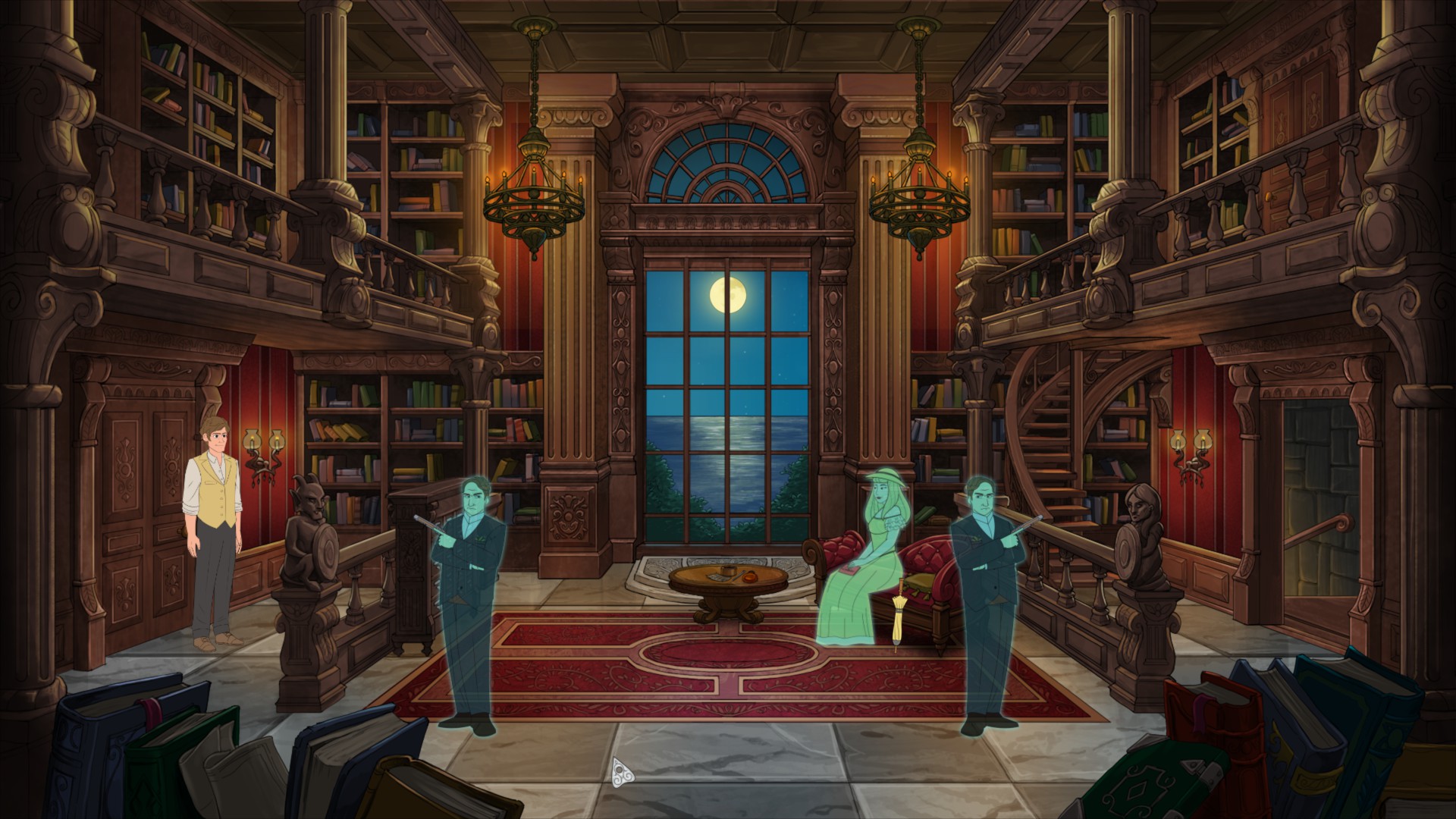
Foolish Mortals is an independent point-and-click adventure game from Inklingwood Studios, which according to its press kit was formed by the husband-and-wife team of David Younger, who’s credited as Designer, Writer, and Producer; and Sophie Younger, who’s credited as programmer.
The game’s described as being inspired by the Monkey Island and Broken Sword games, but you certainly don’t need a press release to see that. The influences are immediately evident, but instead of feeling just like a derivative pastiche, there’s a genuine sense of creators who loved a particular era of video games, and who are doing everything they can to recreate the era (with modern improvements) and recapture the way those games made them feel.
The story structure and puzzle design feel very much inspired by the Monkey Island series, with acts consisting of three or more puzzle chains you can work on simultaneously, culminating in a major plot development that leads into the next act. The art and animation style, and I’d say the overall tone, is more like the Broken Sword series: detailed backgrounds and fluid character-animations that I wouldn’t call “realistic,” but certainly “grounded.” It’s mostly light-hearted, but it’s not a comedy game; it’s more aiming for a general feel of coziness than hitting you with a barrage of jokes and wackiness.
And another clear inspiration is Disneyland; the title and premise obviously suggest the Haunted Mansion, but a love of Disney parks is an undercurrent throughout. The overall vibe I got was “what if there were a Broken Sword game set in and around New Orleans Square and the Rivers of America?”
Maybe the most telling endorsement I can give for the game is that I was compelled to finish it. In case that sounds like damning with faint praise, it’s not: for one thing, I rarely finish any games these days, even ones that I’m enjoying a lot. And more significantly, I genuinely was compelled to finish it. I played it over the course of a few days, and it stuck in my mind as a story left unfinished, and I was eager to see the end.
Which might be the most telling praise of all, since I don’t actually like playing point-and-click adventure games that much. I liked working on them. And some of them are still my most favorite games of all time. But those favorites were more a case of catching lightning in a bottle, the rare times when story, puzzle design, and writing all synced perfectly with my mindset. But over the years, I realized that adventure game puzzles were my least favorite form of interactivity, and more often than not, they felt like an impediment to the story instead of being engaging on their own. The style of game just doesn’t click with me, if you get my point. (Apologies, but I can’t help how my brain works).
So it took something like Foolish Mortals to get me interested in trying out this style of game again, since at least on paper, it seems practically custom-made for me: I loved the Monkey Island games so much that they made me want to work in video games, I worked on one of the installments as a programmer and writer, I love Disneyland, and the Broken Sword games I played are the only non-LucasArts adventure games that I remember actually enjoying.
And one of the things that quickly becomes apparent in Foolish Mortals is that this doesn’t feel like a small team of indie devs making a quaint love letter to a bygone era; the polish and overall production value is remarkable. A ton of care went into the backgrounds, the character animation is detailed and fluid, there’s a ton of music throughout, and all of the character dialogue is fully voiced. The main character is played by AJ LoCascio, who I recognize from his work on several of the Telltale games. And looking over the voice cast, I was surprised to see how many of the other, seemingly disparate characters were voiced by the same actor, many of them I’d been convinced had to be different people.
If you weren’t aware of the game’s release date and the team behind it, you could easily assume that it was a game made by a much larger studio, released around the time of Broken Sword 2. And then you’d wonder why the game was running in such high resolution and had so many quality-of-life improvements that didn’t exist back then.
Steam tells me I spent around 12 hours playing the game from start to finish. I might’ve spent longer if I’d refused to use the hint system, which in Foolish Mortals takes the form of the main character’s journal, recounting his story. There’s a setting for “dynamic hints frequency,” which I kept at its default value, but if it ever kicked in and offered a hint unprompted, I didn’t notice. The journal was sufficient for me, acting both as a reminder of your current story goals, and as a way to get increasingly-explicit clues for how to solve the puzzles that lead up to that goal. I thought it was a pretty elegant, straightforward, and non-punishing way to do in-game hints: prominently placed, so it feels like a natural part of the game instead of a cheat; and with hints that progressed naturally and felt written to give the player as much chance as possible to feel the satisfaction of solving the puzzle. First give a reminder of what the player’s trying to achieve, then a reminder of what they’ve seen and what should be on their mind, and then steps breaking down the logic behind the solution.
The puzzles are my main criticism of Foolish Mortals, with the reminder that I’m critical of adventure game puzzles in general. There were few that fell into the “moon logic” category, but I did need to consult the hints at least once in every chapter. I’m convinced that that’s simply endemic to this style of game; when the whole structure of the game is finding unconventional — and often intentionally non-sensical enough to be interesting — solutions to obstacles that could be much more simply and obviously solved in a straightforward way, you’re inevitably going to run into situations where the player and the designer were just not on the same wavelength.
But those were pretty rare. There were only a couple cases of “ye can’t get ye flask,” where the game flat-out refused to let me do something that I thought made sense, or where the puzzle demanded a bizarre solution that seemed to be there solely for the sake of the puzzle. The more common issues I had were simply ones of communication: an object appeared in a location I’d already visited, without enough signal that the environment had changed. Or an object that I’d already used now had different options available for it, with little clue that the state had changed. Or most commonly, cases of the interface not working like I’d want it to.
For the most part, the puzzles were fairly straightforward to anybody who’s played a point-and-click adventure game before. I was only a few minutes into Foolish Mortals before I felt a gear in my brain turn and flip a familiar switch into place. I was back to solving adventure game puzzles again, often even before I’d even reached the story prompt that told me exactly why I needed to solve them. And even in those cases, where I’d essentially solved a puzzle before the story told me what I needed to do, it recovered seamlessly and took what I’d already accomplished into account.
In fact, most of the puzzles might be straightforward to a fault. The reason I got more of a Broken Sword feel from this than Monkey Island is that many of the puzzles felt like obstacles to advance the story instead of being part of the story on their own. A string needs to be cut, and you have scissors in your inventory. To be clear: that’s not an objective criticism, but more an indicator of the style and tone of this game, and what it emphasizes. The solutions to the puzzles are rarely of the “a-ha!” variety, but more “yes, I see, now how will the story continue?”
My other criticisms are all of the nit-picking variety. There are options for fast-travel throughout, but there are still a lot of cases where you’re stuck watching your character slowly walk towards an object and reaching out to interact with it. As somebody who played every LucasArts game with one hand on the period key to advance through dialogue, it was frustrating that some scenes were simply unskippable, with little indication of when or why. I can absolutely understand the desire to encourage players to slow down and enjoy a more relaxed pace, especially when it’s evident how much time and care went into the animation. But honestly, I wish that more of the effort to create such detailed and fluid animation had been spent on the individual moments that had maximum impact on the story, instead of the more mundane moments of the main character reaching into his pocket to take out an item, or bending down to open a chest.
Overall, it’s impressive how much time and care went into this project. As someone who spent a lot of time working on more frugal productions, I’m especially impressed with how cleverly Foolish Mortals reuses environments without feeling pointlessly repetitive. There’s more a sense of call backs and escalating complexity as more of the island opens up and the story progresses — I know this place from when I did this, but now I can do that — than working on a limited budget. It manages to maintain a feeling of variety that makes the whole place seem bigger than it actually is.
If I’m being honest, I’d expected Foolish Mortals to feel like a quaint but dated throwback, a love letter to a style of game that simply isn’t relevant anymore, now that we’re no longer in an environment where Monkey Island or DOOM were your only two options — a game could have an engaging story and cinematic storytelling, or it could be exciting and fun. And while it does feel quaint and often charming, what surprised me is how it doesn’t feel “dated” so much as “genuinely nostalgic.” A reminder of how it really felt to be engaged in a story-based adventure game and eager to see how it all turned out. Maybe even more impressive than the fact that I finished Foolish Mortals is that it left me wanting to play more of these.
Edit: In the first version of this post, I wrote an overly long, hyper-critical breakdown of specific puzzles in this game, for who knows what reason. I’d just spent three days engrossed in the game, it was bringing back nostalgia for the days when I spent all my time over-thinking adventure games, and it was taking up all of the space in my brain.
Whatever the case, it’s absurd (at best) to be giving “play test notes” to a game that’s already been released, especially when it goes into even more unnecessary detail than I would if I were actually play-testing. (If I’d read similar about something I’d worked on, I’d have just nodded and then gone about my business, thinking “geez, what’s the matter with that guy?!”)
Worse than that, though, it gave a negative impression of the game, which is absurd, since I actually enjoyed quite a bit, and I’m looking forward to seeing what else the studio puts out!
The only things in that other version worth preserving: Dave Grossman and Brendan Ferguson are brilliant game designers that I’m fortunate to have gotten to work with. And also that playing Foolish Mortals reminded me about all of the tenets about adventure games that Jonathan Ackley stressed while making The Curse of Monkey Island, and even so many years later, I continue to be impressed by how much he got it and insisted on details and overall philosophy that made that game work as well it did.