So I ended up doing exactly what I advised people not to do last night: I started thinking too much about The Running Man.
Not consciously, really. It had evidently just stuck in my brain enough that I woke up thinking about a scene with a woman and her scarf, and feeling irrationally irritated by it.
It comes after our hero (Richards) finds himself next to a freeway, and he gets into a random car and holds the driver at gunpoint, ordering her to drive him towards Canada. The driver (Amelia) is presented as an average, upper-middle class woman in this universe, riding in her Ioniq 5-looking self-driving car, having a video chat with a friend while they’re both watching the trashy reality television series we saw earlier. She doesn’t watch The Running Man, she says later, not because of the gross and excessive violence, but because “it’s so clearly fake.”
She refuses to help him, because she believes he’s the person that the TV show is presenting: a ruthless, remorseless murderer trying to get rich with violence instead of doing actual work, carelessly abandoning his slutty wife with no regard for their innocent child. He reminds her (at gunpoint) that everything on the show is fake, and he shows a photograph of his wife and daughter, to explain how he really feels about them, and how everything that he’s done has been for their benefit.
And then he scolds her about her scarf. It’s an ugly but basically unremarkable neckerchief-type thing. Probably chosen carefully by a costume designer not to be so ostentatious that it’s a stereotype of conspicuous consumption, but still distinctive enough to stand out in the audience’s mind. Richards tells Amelia that the money she spent on that scarf would’ve been more than enough for him to buy the medicine that would save his young daughter from needlessly dying of something as innocuous as influenza.
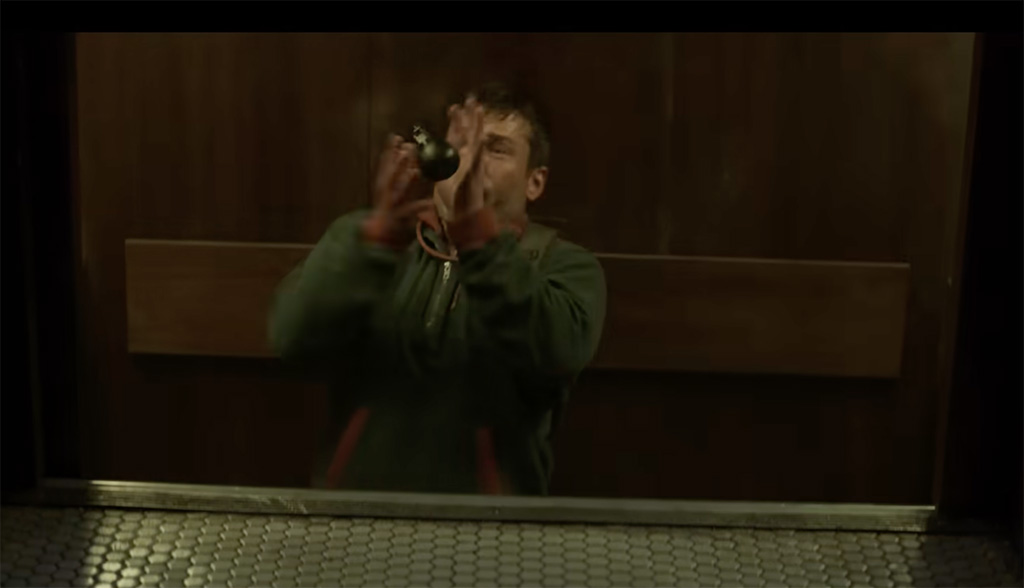
Earlier in the movie, there’s a scene where Richards is trying to escape a hostel, and he tosses a live grenade directly at our still-masked main villain. The villain casually steps on it, then nonchalantly kicks it back towards Richards, who fumbles with it before it explodes.
Can you see the similarity between these two scenes? Take a moment to write the answer in your notebook.
My initial impression of The Running Man still stands: it’s fine as long as you watch it as an often-clever action movie, and completely disregard it as actual satire. It’s ironic that it makes so much effort to stick closer to the original book and correct the mistakes of the 1987 adaptation, since that movie got a reputation for shedding all of the weight and relevance of the book for the sake of mindless action. Now that we’re actually living in 2025, it’s the current adaptation that falls apart the moment you start to dig below the surface level, and the original seems more daring in comparison. Simply by virtue of putting one of the most recognizable and bankable movie stars into a satire that said “don’t trust the media,” long before that sentiment was really in vogue.
It’s a clever bit of self-awareness when the 2025 adaptation implicates itself and its audience in the near-future dystopian media environment it’s depicting. Hey look, this reality TV family is a lot like the Kardashians! And all these people in the movie are fixated on their screens, watching a guy on the run for his life, hoping to see some violence and explosions and some very bad people get a helping of old-school justice: wait, that’s just like us watching the movie! Isn’t that something!
But popular media is terrible at actually satirizing itself. Even the most insightful and hard-hitting satire I’ve ever seen is still invariably turned into a catch phrase, or shorthand for what it actually means. “I’m mad as hell and I’m not going to take it anymore!” Or “That’s so Black Mirror!”
It’s like a magician performing a sleight of hand trick1In retrospect, it’s getting kind of disturbing how well Now You See Me: Now You Don’t and The Running Man work as a double feature., explaining to you how the trick works and not to believe anything that you’re seeing, and then pulling off the trick anyway.
The Running Man has explicit and overt messages about power to the people, pro-union heroes, being the spark that ignites a revolution, taking down the 1%, don’t trust the media, and so on. But that is itself a loaded message. It’s like oil companies or airlines stressing the importance of carbon offsets. Or major polluters telling all of us that it’s up to us to save the environment, by cutting up plastic yokes around six packs, or refusing to use plastic straws.
Or, hypothetically, one of the nation’s major political parties spending decades touting itself as the only line of resistance against an evil totalitarian regime that is always just a hair’s breadth and a small monthly contribution of just $10-$50 away from destroying everything we stand for. All while stressing the need for crossing the aisle, catering to wealthy donors, and actively working against anyone campaigning on a platform of actually trying to make a difference in government.
(One of the things I read about The Running Man was Stephen King praising this adaptation, calling it “bipartisan.” And I mean… wow. I honestly don’t know how I feel about that).
Even the otherwise valid message of “you can’t trust everything you see” is undermined, when you think for even a second of how much and how effectively that’s been corrupted and manipulated by grifters and confidence men. Instead of encouraging a healthy and responsible skepticism, it’s just spent decades chipping away at all of our institutions, undermining all faith in the expertise of people actually trained to understand what’s going on, in favor of the first person who can most loudly and simply tell you whatever it is you want to hear.
Any time I find myself trying to take a piece of popular entertainment as an earnest call to action, I need to imagine this scene in my head: this screenplay comes across some executive’s desk, and they’re immediately on the phone with the director and writer. “Wait wait wait wait… this giant media network conglomerate. That’s not us is it?! Are we the bad guys? Why didn’t anyone tell us? Clearly we need to change our ways, and put the word out to warn others about people like us, in the form of this major motion picture!”
Obviously I don’t want to over-correct and discount the importance of collective action and individual responsibility. There is undeniably a tendency to realize how much you’ve been manipulated by propaganda, and then conclude that it’s all propaganda, I’m done being gullible, none of this is actually our fault, it’s all the corporations and billionaires who are causing all the problems. That’s just tossing the grenade to someone else, which doesn’t accomplish much, even if they are the ones who most deserve to be holding it.
It shouldn’t be about absolving yourself of blame or responsibility, but realizing how much it’s a collective effort. Not so much Us vs Them, but the less-catchy fact that A Lot of Us Are Having Outrageously Disproportionate Impact on the Rest of Us, Without Taking Their Share of Responsibility or Acknowledging How Much We All Need to Give Back to Society.
So my advice: keep using paper or reusable straws, be reasonably skeptical of everything you see in popular media, be doubly skeptical if it’s taking the form of a big-budget action movie, triply skeptical if it’s distributed by a major media conglomerate whose CEO has been very vocal about his questionable views on political and social issues, support unions, go green as much as you can, and believe in the value of collective action and individual responsibility. Just never let anyone tell you that your buying an ugly scarf is the main reason less privileged people can’t afford to buy essential medicine for their kids.