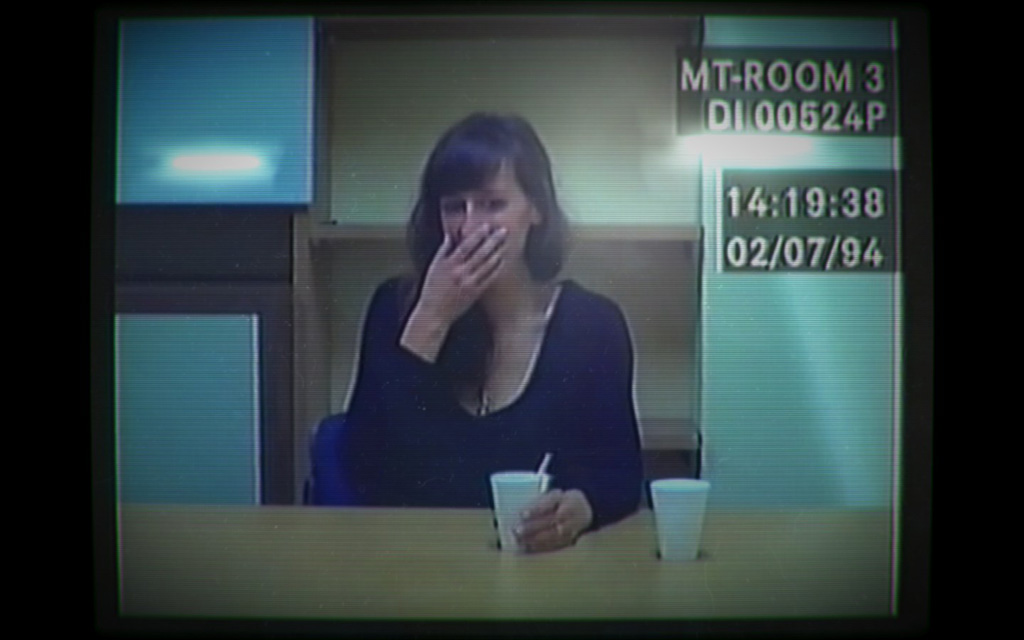
When Her Story came out and was receiving universal acclaim, I bought a copy and was certain that I’d enjoy it, if I just set aside a bit of time to play it. I never got around to it until this week, which is regrettable, because it’s every bit as good as the praise suggested. And more significantly: I wish I’d played it before Immortality.
Immortality is the third in a series of games led by Sam Barlow, along with Her Story and Telling Lies, which all have a similar structure at their core: they present the player with a ton of video clips, all taken out of context. The player has to make meaningful connections to unlock more clips and piece together the underlying narrative that ties them all together.
Right after I played Immortality, I wrote a regrettable blog post that comes across as overwhelmingly negative, because I immediately wanted to vent my frustrations instead of giving myself time to digest it. I wish I’d waited. Even at the time, I could recognize it as a masterpiece, and in the years since, I’ve only gotten deeper respect for what it does, and all but forgotten my criticisms that I had while I was nearing its end.
Her Story is smaller — only by comparison, and deceptively, since it hides what must have been a massive amount of planning and execution — and has a more straightforward and explicit version of that core mechanic. It solidified my opinion that these games really are milestones in the history of interactive fiction, because they’re brilliant deconstructions not just of game narratives, but of how we process all narratives. And it retroactively made me respect Immortality even more than I already did.
In Her Story, you’re seated at a computer screen in a UK police station, with access to a database of video clips, all from a series of interrogations of a woman who’s somehow related to a murder investigation. After viewing the available clips, you can type in a word, phrase, or direct quote to pull up more clips that have the same words in the transcript.
The simplicity of that mechanic makes it immediately feel like an investigation, as opposed to a traditional narrative in a full-motion video game, because you’re not watching it as you would a traditional narrative. You can only proceed through the game by making connections. So you’re not so much listening to what the woman is saying, as trying to pick up on what she’s not saying. The casual or accidental mentions of a name, or a place, or some idea that’ll branch off to other topics.
It’s not even as straightforward as the familiar detective game mechanic of trying to catch a character in a lie, since there’s no implicit acknowledgement that the woman is lying. There’s also no sense that every clip you see is being shown to you for a specific purpose: this clip contains a lie. Did you spot it?
Several of the clips are extremely brief, only a few seconds long. It sells the idea that what you’re seeing are randomly selected parts of hours of often-mundane video footage, instead of carefully-edited performances intended to tell you a story. Often, they’re purely intriguing: what was the question that prompted this response? Why did this woman’s personality seem to change so significantly? Why is she holding a guitar in an interrogation room? Very, very rarely, you can barely see the (figurative) hand of the artist peek in, where a clip seems clearly intended to emphasize a word or phrase that you should search for next.
You’re also given no context for why you have access to this database, or what specifically you’re trying to find. Instead of exposition, you can find a note on the computer’s desktop that establishes a couple of basics: the game is set in the present day (of the game’s release, at least), all of the clips you’re seeing are from years ago and haven’t been seen since then. Apart from that, your only apparent goal is to satisfy your curiosity. You’re at a computer screen queued up with several video clips on the topic of MURDER. You can’t not want to know what happened.
The overall effect is astounding. At first glance, it might seem like it’s just a stripped-down version of the kind of environmental storytelling that’s fairly common in games, where you’re given a bunch of disconnected bits of narrative and have to figure out how they all fit together as a coherent story. But by putting all of its focus on that process of fitting everything together — your only agency in the story is telling the story — it deconstructs everything down to the most fundamental similarities between interactive storytelling and traditional, “passive” storytelling.
For years I’ve been fascinated by the idea that what we think of as “passive” storytelling is anything but passive. You’re not the main character, you’re not doing anything to change the outcome, and you’re seeing everything in the same order the artist intended you to see it, but still, if the story’s being told well, you’re actively engaged in the storytelling. Making connections, making assumptions, reformulating those assumptions as your expectations are confirmed or subverted. It’s easiest to recognize in horror or thrillers, or mystery stories, but you’re always doing it, even if you don’t notice that you’re doing it.
Her Story makes you notice that you’re doing it. So (almost) every clip has that electric feeling of discovering something new, unlocking a new potential story path, subverting what you thought you knew, suggesting a surprising twist or complication. Over and over again, in short bursts that only last a few seconds or a couple of minutes. It’s like mainlining undiluted story.
Who is that person she just mentioned? What city is she talking about? What night did that happen? Is she talking about her mom? Why is she upset right now? Is that a bruise? Why did her demeanor change? What children is she referring to, the detective’s?
But these aren’t ideas that you have running in a separate thread while the narrative relentlessly continues without your input, before inevitably revealing the answers (or, especially if you’re watching a David Lynch movie, the lack of answers). Your entire agency in Her Story depends on making those connections, finding some key idea that will keep the investigation going.
I was trying to think of other examples in mainstream media that do the same type of thing with non-linear storytelling, if only to figure out if I was being hyperbolic for saying that these games work unlike anything I’ve ever seen before.
I can think of Pulp Fiction, which uses it more as a stylistic flourish than anything else; or Lost and similarly-structured stories, where having to make connections between scenes from alternate timelines sparks the intrigue that draws you deeper into the story. Maybe the closest thing I’m aware of in mainstream movies is Memento, where “the presentation is the point,” and you can only make sense of it by re-ordering scenes in your head and re-establishing cause-and-effect chains as you go.
No doubt there are less mainstream, more experimental movies or books that go farther with this, and I’m simply not aware of them. Also, this seems like the kind of experience that was promised back in the 1980s when “hypertext” was still novel, but I’m not familiar with any that made this their primary method of interaction. 50 Years of Text Games has an account of a project called Uncle Roger, which sounds fascinating and in many ways similar to Her Story, in that it presents a database of narrative content that the player can query for different passages.
I suppose that it’s also similar to alternate reality games, which seed bits of intrigue that encourage you to make connections that reveal an ever-expanding story. Her Story and Immortality are kind of like smaller-scale, self-contained ARGs, but with a more straightforward and consistent interface.
What makes Her Story and Immortality different from any of these examples, as I see it, is that they combine a player-controlled timeline with pieces of artfully-withheld information.
Player-controlled timeline is significant, because it means you have more agency than in traditional media. The story can’t continue unless you get it. And withheld information is significant, because it means that your agency is different from what it typically is in interactive fiction. You’re not an active participant in the story, you’re an active participant in the storytelling. Essentially, your only verb is “understand.”
It’s a pretty esoteric distinction, but the decision to make the video clips — the “passive” parts of the storytelling — be fragmented, intriguing in their lack of context, is the key difference. There’s no mode switch between active and passive, performing an action and then watching a piece of content, because you have to be actively engaged with the content. A clip rarely gives you a complete idea, the crucial clue that makes everything make sense. You have to put the pieces together yourself to make sense of them.
My main criticism of Her Story and Immortality — while stressing yet again that they are both masterpieces, key-milestones-in-the-history-of-interactive-fiction caliber — is that putting the player in control of context and unlocking the narrative means putting the player in control over the pacing as well. Which means that both experiences feel front-loaded. All of the potential energy is at the start of the experience, when it’s all about the intrigue and discovery, and every new clip and new revelation feels like it might go off in a dozen different directions.
To take my clumsy analogy a step too far: if the start of Her Story is like molecular gastronomy for interactive fiction, the last third of the game is more like eating fried chicken. No matter how wonderful it is at the beginning, there comes a point where you’re just picking bits of gristle off the bone, simply because it doesn’t feel right to just leave it there.
I spent about three hours with Her Story, and I’ve seen over 75% of the available clips. It’s an excellent length for this game, enough time to feel like you’re following threads down various surprising rabbit holes, but not so long that it feels overwhelming or tedious. There’s a visual representation of the database, showing you exactly how many clips there are, and how many you’ve seen. I did get to the end credits earlier, and after they’re finished, it gives you a couple of commands that you can use to help see everything in the database — it doesn’t just open everything up all at once, and there’s still some digging required, but at least it gives you an opportunity to satisfy that completionist impulse.
I’ve spent so much time thinking about just the core mechanic, but I can’t stress enough how good the production is. No matter how brilliant the central concept is, it wouldn’t work as well if the execution hadn’t been flawless. Obviously, a ton of Her Story hinges on the strength of the central performance by Viva Seifert. Any false note would’ve undermined the whole thing. And it’s not just that there’s not a single false note anywhere (even for people who are, by nature of the game, scrutinizing every single detail), but that her performance gets more nuanced and multilayered as the game progresses.
Less immediately apparent is how painstakingly the game itself must have been structured, giving near complete control of the narrative over to players, while still making sure that a near-infinite number of seemingly random paths will manage to make sense.
As I mentioned, every once in a while, you can detect when a clip has been written or performed specifically to nudge the player towards a specific query. But it’s extremely subtle. And instead of breaking the immersion, it’s just a reminder of how much work went into making this extremely not-real experience feel so real. It gives you greater respect for just how much command Barlow had over the chaos.
I will say that Her Story had a much more satisfying implementation of the core interaction than Immortality did. They’re the same basic idea, but Her Story gets exactly what is so interesting to me about it, since it’s so straightforward, consistent, and predictable. You type in a word or phrase, you’re only going to get clips that have that word or phrase in the transcript. The only game-imposed constraint is that you’re limited at the start to five clips at once, so if your query has dozens of matches, the rest will be sitting there just out of reach — you’ll know you’ve hit on something, and you’ll just have to figure out exactly how to reveal more of it.
Intellectually, I understand all the reasons Immortality handles it differently. If you’re unfamiliar with it, it’s presented like an editing bay, with a play on the “match cut” idea, where you can scrub backwards and forwards through the clips, and then select a specific image from the clip, which will jump to a corresponding image in a different clip. On a purely pragmatic level: this game was intended to reach a wider console audience, so it needed a more controller-friendly interface than typing words into a text prompt, and it objectively plays better with a controller than with a mouse and keyboard.
More thematically, Immortality came from a love of cinema and filmmaking. The match cut is a classic idea from film editing, and it seems to correspond perfectly to what games like Her Story were already doing: forming meaningful connections between seemingly disparate images. Plus, cinema is a visual medium, and this approach emphasizes how film uniquely functions with visual symbols; it’s reductive to think of it as nothing more than a bunch of actors reciting words from a screenplay.
But it throws off the balance between audience and artist, active and passive, which I think is the most novel and interesting aspect of these games. Because you can’t reliably predict what might result from choosing a specific image, Immortality imposes a level of interpretation on top of your agency. If you click on an apple, you might be taken to another scene with an apple, or you might be taken to a scene with something that is symbolically similar to an apple. Obviously, that adds a sense of surprise and discovery to the mix, but it also means that the electric moment of interpretation and realization comes after the fact: it’s “ah yes, I see now how this image is symbolically related to an apple,” instead of “I’ve figured out other ideas that the apple might represent, so show me more of those.”
A more specific example from Her Story: some of the interactions were as simple as my hearing a word or phrase in a clip, and then typing that exact word or phrase to reveal more related clips that would expand on it. But the more interesting ones were when a clip seemed to be suggesting a certain topic, so I mentally built a “word cloud” of ideas that might be related, and I pursued those. (Of course there are too many mentions of “blood” in a murder investigation, but what if I ask about “periods?”) It was more rewarding when these paid off, since it felt like I was the one to make the connection, instead of the game explicitly telling me that there was a connection.
While I’m describing the interface as simple, straightforward, and predictable, I should stress that it’s more sophisticated than I’m making it sound. Barlow didn’t just film a long video, cut it into pieces, put a text field in front of me, and say “here, you figure it out.” It’s all deliberately selected and edited, with careful choices made throughout the script, to suggest ideas and connections that make the narrative navigable at all, much less play out with the kind of progression, twists, and reveals you’d get from a linear story. I’m aware that I was being manipulated, but the illusion that I was making a story emerge from total randomness was completely effective.
Which goes back to my issues with pacing, and how both of these games felt as if all their potential energy was in the beginning, and actually playing them wasn’t so much building to a climax as having story moments give ever-diminishing returns. The somewhat simpler and shorter presentation of Her Story actually gave me an even greater appreciation for Immortality, because of all the ideas that they inspire about the most fundamental nature of storytelling.
I don’t think it’s just another case of my going off on a wild, overly-eager interpretative tangent, since Her Story so often references story-telling and fairy tales. (And bizarrely incriminating murder ballads). And Immortality even more directly addresses it, not just with its frequent references to shifting identity, stories within stories, behind-the-scenes footage that is itself manipulated, and so on.
Both of these games made me think about how storytelling — or more accurately, I guess, story-listening — is as destructive as it is creative. I tend to think of the act of actively engaging with a story as a kind of creative process in itself, or at least the completion of the creative process: by making connections, predictions, interpretations, and constantly re-evaluating them, you’re almost playing back the process of making the art in the first place. Joining the artist in the writer’s room or the word processor, thinking about the same things that they were in each moment, making the choices that build up to the conclusion.
The format of these games brings to the forefront the fact that you’re also collapsing possibility spaces. Each decision you make, or reveal that you watch, does open the story to a bunch of new possibilities, but it also prunes away many of the ideas that had been percolating and cross-pollinating to lead up to that point. Essentially, and over-dramatically, you’re destroying entire universes of potential stories at each step.
Neither of these games has an unambiguous, “correct” answer; they’re deliberately left open to interpretation. (Immortality much more than Her Story, almost to a fault). But I have a hard time thinking of either of them as ambiguous, because in both cases, I don’t find one of the explanations satisfying.
I know I’m not the only one who felt disappointed by Immortality just because, after you’ve peeled back a certain number of layers, it suggests a version of what’s really going on, that I frankly thought was pretty silly. To me, it didn’t introduce a new idea that made me re-contextualize and re-evaluate everything that I’d seen; it just felt like a rug pull, introducing a supernatural aspect to a game that didn’t need one. I know that at least one other person felt the same way, because they complained about it at the time in a spoiler-filled review. (Which I don’t agree with, for the record. They are much, much more dismissive of the game, while even at my most negative, I was thinking of it as a frustrating masterpiece).
But with Her Story it’s even simpler. Basically, you’re prevented with two versions of the “truth:” the version of events that the main character describes, and then the version where we realize that she’s not capable of fully understanding what actually happened. And the former version doesn’t appeal to me at all. It seems to reduce the entire game to a simple case of “just find enough clips, and you’ll find out what really happened.”
I think the implicit idea underneath all of that is that, of course, none of this really happened. It’s all fiction. It’s even got “her story” in the title. It’s reductive to think of the value of a story as being entirely in reaching the end; that’s dismissive of everything that happens during the telling. You’re explicitly not given a goal at the start of Her Story, the goal is simply “experience this thing.”
And similar to Immortality, after you reach a certain point in Her Story, there’s an event that implicitly signals that you’ve seen the core of what the artist intended to present. You can keep exploring if you like, but you have now seen enough to “get it.” Roll credits.
Her Story even makes this all but explicit by asking you two questions: “do you understand what happened?” and “have you seen enough?” Pragmatically, it’s a signal that you don’t have to 100% everything unless you really want to. But I think it also might possibly suggest part of the real intent of the game, to make it apparent that the “magic” of the story isn’t in the conclusion, but in the process.
It made me consider how Immortality couldn’t have been more apparent that it was about artifice, identity, interpretation, varying versions of events, stories within stories — and yet I still insisted that as soon as the game told me what was “real,” I believed that that was the entire intent. Why did I insist that everything I’d assumed was a metaphor stopped being a metaphor, just because this obviously fictional work presented one set of the things that it was showing me as if they were the “real truth?”
The presentation of Her Story suggests that this is a murder mystery game. You’re on a police computer, you’re watching the interrogation of a person of interest, and you’ve got a “just the facts, ma’am” interface, where you’re entering specific words into a computer and getting just the matches on those words, no more, no less. That all sets you up for an investigation into the facts of the case, at the end of which you’ll be rewarded with complete knowledge of the whole truth.
And then it subverts that idea over and over for the next three hours, repeatedly asking you to formulate your own ideas instead of just passively accepting everything that you’re shown. All while giving increasingly explicit revelation of who you, the player, are, and why this investigation is relevant to you.
The reveal is understated but profound in its implications: it makes you realize that the game isn’t relevant to me simply because I reached the part where the game’s author told me what was “the truth” and what it all meant. It was relevant to me because I’d been actively participating in every step of the storytelling.
Comments
2 responses to “Her Story”
By coincidence, I finished this just last night, and had more of a mixed reaction.
Because I was very (overly) assiduous at finding every clip to see if there was one more thing I could find to clarify the mystery. I got about 98% there (without the admin cheat) and exhausted my enjoyment as I slowly developed the gnawing sense that there is no ‘canonical’ solution. I had spent an extra hour or two chasing a needle in a haystack that was in fact never in the haystack. Or more accurately, I found several needles of slightly different shapes, never sure which was the one I was the one I was supposed to look for.
I guess when it comes down to it, this was an ‘investigation-turns-into-a-cold-case’ simulator, as diminishing returns eat away at your resolve, and you end up with a nagging sense of a job left undone. Well done, Mr. Barlow!
I’ve always wanted a codicil to Hal Barwood’s old “Don’t exhaust the player rule” (the #1 rule of the 400 rules!), which is “Don’t let the player exhaust themselves.” Players can be compulsive idiots, doing things in games that other games have rewarded them for. It’s like the old experiment where if a rat in a maze learns to bang on a lever that rewards them with food entirely at random, their lack of ability to distinguish a pattern makes them bang on that lever all day. It’s an unintentional formula for bad gameplay.
So I respect Her Story greatly, but after a while the little lever gave fewer and fewer rewards, and ultimately I felt dumber than a rat.
Well put! And similar to my initial reaction to Immortality.
It’s undeniable that both of these games get worse the longer you play them. I wouldn’t just blame your own compulsive nature, though; Her Story has a visible indicator of how much you’ve seen vs how much remains to be unlocked, even if it is initially hidden behind the main window. Seems like there were plenty of opportunities to emphasize “no, you’ve really seen all you need to” as the default, and leave the opportunity to 100% it as something you have to dig for. As it is, both options are given equal weight.