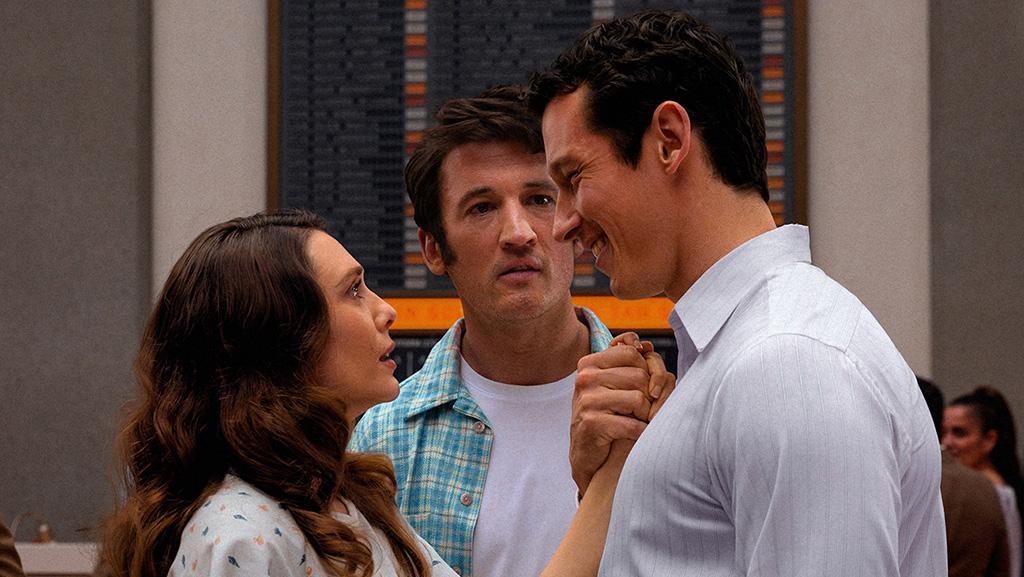
I went to see Eternity not expecting to have more of a reaction than “well, that was pleasant enough,” but I was surprised by how much I loved it. It’s genuinely funny, sweet, and charming as all hell. I cried, multiple times.
But possibly more than any other movie I’ve seen this year, I can see this one being divisive. This is very much a movie where you get out of it what you bring to it. I can completely understand someone watching it and finding it just okay, or even downright disliking it.
Its entire premise is absurdly contrived, even beyond the point where it acknowledges how contrived it is. (At one point, Elizabeth Olsen’s Joan tells her husbands to stop arguing because “it’s not a competition,” and everyone in the room says, “Yes, it is. That’s 100% what this is.”) It’s content to be shallow about the implications of this version of the afterlife, preferring to let it remain little more than the premise of a romantic comedy. Not all of the jokes land, and the endlessly recurring gag of seeing ads for potential eternities often feels like they could’ve spent more time brainstorming funnier ideas.1The idea that not only is there an afterlife with No Men, but that it’s constantly filling up and forcing them to make new ones, is the highlight.
It’s distracting how so much of the movie relies on the idea that Callum Turner’s Luke is drop-dead gorgeous, so immediately and universally hot that it’s all anyone can comment on, when I just didn’t see it. That’s not an insult to Mr Turner, either; I’ve seen publicity photos where you can imagine a casting agent choosing him as Impossibly Hot Guy on sight. But somehow this movie has five unusually attractive people as its leads and yet still manages to make everyone look like they’re in a PBS documentary.
And of course, for as much as it presents itself as a story centered on Olsen’s character, she is almost entirely reduced to the prize to be won by one of two men. For the bulk of the movie, her only agency — deciding for herself how she wants to spend eternity — is limited to choosing a husband.
Even acknowledging all of that, I loved it. I should admit that I’m a sucker for stories, especially romantic comedies, dealing with the afterlife: A Matter of Life and Death is an all-time favorite, Defending Your Life is one of the only Albert Brooks movies I actually enjoy, and of course I loved The Good Place.2If they treat the afterlife as a dysfunctional bureaucracy: oh man, I’m watching the hell out of that. And Elizabeth Olsen is on the short list of actors it’s impossible for me not to like.
The main reason that Eternity worked so well for me is the rapport between the characters. The movie might not do a good job of making its characters look glamorous, but it more than makes up for it by having them play off of each other perfectly.
Miles Teller’s Larry is the underdog of the story, Joan’s husband for 65 years who’s always resented living in the shadow of her first husband Luke, who died in the war.3The Korean war, so don’t get carried away. He and Joan have such a casual familiarity with each other that I thought was instantly believable; you just immediately accept that these actors in their 30s have known each other for almost 70 years.
Meanwhile, the relationship between Joan and Luke plays out like more old-fashioned romantic stories: passionate young lovers separated by tragedy, eternally longing to be reunited. They’re more stiff and formal, reading not so much as a married couple as two people still in the awkward stages of being completely smitten with each other. I don’t think that’s a mistake or a lack of chemistry, though. It’s essential to making this work within the confines of a romantic comedy love triangle: the lovers fated to be together, vs the safe and familiar Guy She’s With Right Now.
In fact, there’s a lot more chemistry between Luke and Larry, and some of the most appealing scenes of the movie are ones where they’re fighting or bonding. This was crucial for making all the characters likeable, instead of the usual rom-com cliche of having one of the sides of the love triangle making a last-minute heel turn, paving the way for true love to win with no complications. It drives home that Joan really is faced with an impossible choice. There are no bad guys here, beyond whoever came up with this ridiculously awful scenario for the afterlife.4Was it Frank? Or Kevin?
Da’Vine Joy Randolph and John Early play Larry and Joan’s “afterlife counselors,” slotting into the familiar romantic comedy roles of Sassy Best Friends To The Romantic Leads. But the situation is so contrived that it allows them to be completely aware of how contrived the situation is. The movie doesn’t work without them, and it also doesn’t make them the sole comic relief. Everybody in the cast gets the chance to be funny.
I’m not particularly bothered by the fact that Joan’s character isn’t really developed much beyond A Perfect Woman for two men to fight over, because the men’s characters aren’t that developed, either. Unless you consider “eats pretzels” or “dyes his hair” to be character development, they’re not much more than The Perfect Idealized Love vs The Stable Familiar Love.
For that matter, I’m not that bothered about its refusal to wrestle with any of the higher questions of a movie about the afterlife, what it means to be human, what is our purpose on earth, and so on. Eternity is actually pretty unconcerned about the afterlife. It’s little more than a setting and a premise that allows it to play with all of the standard elements of romantic comedies, flip them over, or turn them inside out. It starts with the “and they lived happily ever after” ending, then asks you to reconsider all of the familiar key story beats of a rom-com with that in mind.
(Vague spoilers for Eternity follow. I’m not interested in outright saying what happens, but if you don’t want to have even a hint that might make you guess how the movie ends, then stop reading here).
One of my favorite sequences in Eternity happens when Luke and Larry are bonding over drinks. Luke tells Larry that he looks like a guy who’s always got a lot on his mind, and Larry insists that he really isn’t. Earlier, he’d admitted that he had no idea why Joan fell in love with him. Now, he admits that he’s been dead for over a week, and he never once thought about the meaning of life.
Later in the conversation, as the two men are reminiscing about their happiest moments with Joan, Larry comes to a sudden realization that makes him understand what Joan really wants, instead of just thinking about what he wants. That prompts him to enact Eternity‘s version of one of the oldest and most familiar scenes in a romantic comedy.
I like it because it’s a familiar scene used in a different way. For one, it’s not the climax of the story; it goes off in a few more directions after that. But more significantly, it’s a case of Larry answering both of his own questions.