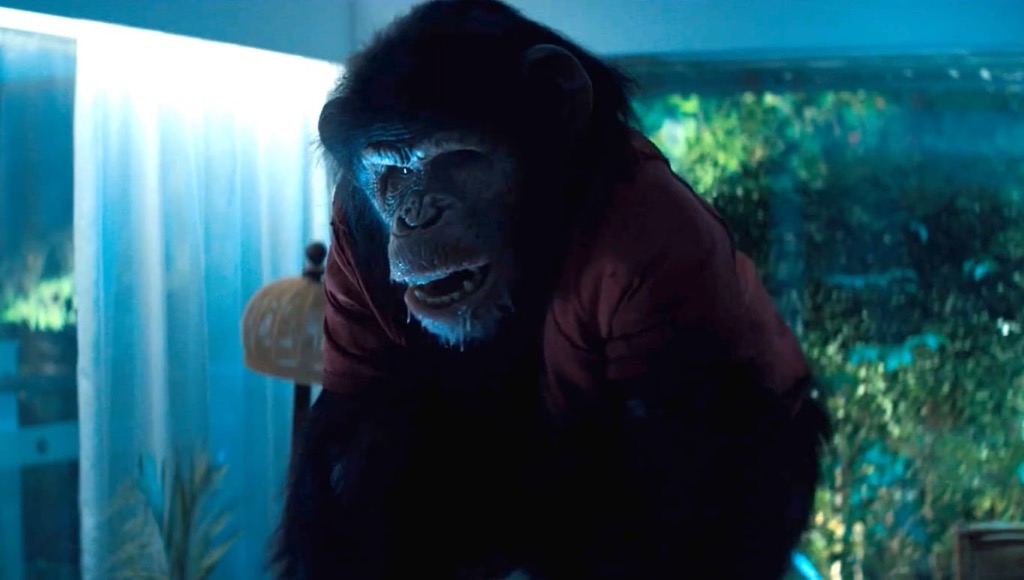
It is a truth universally acknowledged, that chimpanzees are scary as hell. Fortunately, we’re decades past the days when we’d dress them up in clothes and have them entertaining children1Although honestly that’s exactly the kind of thing I could see RFK, Jr trying to bring back, but it seems like there are still too many people who say “they’re so like us!” and want to bring them home and teach them sign language. Even though there’s no chimpanzee who’s so adorable that they don’t seem to be more than a few seconds away from going nuts and ripping you apart with their bare hands.
That’s exactly the fear that Primate taps into, it’s exactly what it promises in the trailers, and it’s almost exactly what it delivers. The movie asks two questions: “Are you deeply, innately terrified of chimpanzees?” and “Why the hell not?”
If you don’t have that deep-seated fear of Our Closest Relatives, then maybe Primate won’t work for you. I don’t know; I’m not even a little bit Catholic, and I still think The Exorcist is one of the scariest movies I’ve ever seen. All I can say for sure is that seeing a reasonably convincing-looking chimp among a bunch of hapless young people had my heart pounding even before the movie got cooking. And I spent the bulk of the movie reacting exactly like you’d expect someone bad at horror movies to be reacting: jumping, holding my hands over my eyes or various threatened body parts, crossing my legs, trying to curl up into the fetal position in my reclining theater seat.
Primate is very violent and often gory, and it doesn’t shy away from showing the gore the best it can. But the thing I like best about it: it’s not torturous.
The very first scene of the movie has a cameo from a recognizable actor that I didn’t expect to be in it. I won’t spoil who it is, but I will say that just seeing them in the movie helped set the tone for everything that was to follow. The scene has one of Primate‘s most gruesome effects, so it’s preparing you to be anticipating even more explicit things to follow at any moment. But at the same time, even though it’s not a comical scene, it’s an implicit reminder that it’s just a movie, and you shouldn’t be taking any of it too seriously.2In retrospect, it’s also a signal that the movie was filmed in England. Which still is hard to believe, even though I knew that detail going in and watching for indicators, since I never would’ve suspected otherwise that it wasn’t filmed completely in Hawaii.
I appreciated that, since I’d sat down thinking, “hell yeah! Terrifying killer chimpanzee! Let’s do this!” but during the trailers, the opening credits, and all through the movie’s post-cold-open setup, I was getting more and more anxious about what exactly I’d gotten myself into. Was this going to be too intense for me? Was it going to be like Good Boy, where I was all-in on the premise without understanding how easily-manipulated I am, especially when animals are involved?
One of the dominant images in the marketing — including the wall-sized standee display at the theater I went to — has Ben the chimp dressed in his clothes, sitting sullenly yet menacingly in a corner, his beloved teddy bear nearby. Had I not sufficiently anticipated how this wasn’t going to be a monster movie so much as Old Yeller?
So I was pleasantly surprised, repeatedly, when I saw how deftly Primate walks the line between giving moments maximum impact, and pumping the brakes so that it doesn’t feel like too much. We see a few still photos of Ben as an adorable baby chimp, we get a couple of scenes showing him being a playful, rambunctious member of the family, but it mercifully never dwells on that aspect of the story for too long.
There are a few moments that emphasize this is an innocent animal who’s sick, and invite you to feel sympathy for him, but the movie quickly moves on from that. Letting the idea land, before turning it into something else. It’s tricky to keep a movie with this premise moving along and functioning as a horror movie, without concentrating too much on the tragedy of it.
I think it helps that I never bought it 100%. I was never tricked into thinking that Ben was an actual chimpanzee, instead of practical effects or a performer in a suit. I’ve only seen a few clips from the press junket interviews, but I still don’t know whether they used an actual chimp anywhere during the production or not. I’m honestly happier not knowing. Every time I felt that twinge of anxiety, thinking, I’m fully aware that this is a horror movie, and that no animals or humans were actually harmed, but should I feel genuinely miserable right now?, there’d be a shot of the chimpanzee that felt just over-the-top enough to reassure me that it was all just a movie.
And as for the human animals, Primate does a similarly good job at keeping the violence and suspense-anticipating-future-violence at its peak, without taking it so far that it just becomes miserable and torturous.
It’s never a horror comedy, but it does completely understand how horror movies like this — the “bunch of characters picked off one by one by a ruthless killer” variety — are always just a hair’s breadth away from black comedy. One of the kills involves a character falling off an impossibly steep cliff, and it’s supposed to be sudden and shocking and tragic, but the movie also shows you, in close-up, exactly what happens when the character hits the ground. It got a laugh from me, just for being so ignoble, and for the surprise of I can’t believe they went there.
But the bulk of Primate isn’t really shocking or surprising; it mostly plays out with the beats that you’d expect, to the degree that I wouldn’t have been all that surprised if they’d jump-cut to the Cabin in the Woods control room, and “RABID CHIMPANZEE” was written on the whiteboard.
What makes the movie work isn’t necessarily its shocking deviation from what you’d expect, but how well it executes on its beats. The main exception is that there are a few scenes that take great advantage of the fact that the character of the father is deaf; I’d expected the need for silence and sign language to play an even bigger part in the story, but still, the way that it was used for suspense here was excellent.
And Primate handles its human characters the same way it handles the chimpanzee: staying aware of how the audience probably feels in the moment, keeping a steady hand on the controls, turning up the shock and horror when it has the most impact, then turning it back down or defusing it before it gets too intense. Certain characters have plot armor, a couple of really gruesome injuries seem to be magically healed a few minutes later, a suggestion that a character is going into shock raises the tension in the moment but is forgotten a few scenes later. And it guesses how much the audience likes or dislikes certain characters, and mostly assigns them accordingly gruesome kill scenes.
For a long time — watching Cloverfield was the first time I really noticed it — I took it for granted that horror movies like this had to maintain a certain distance between the audience and the characters, or else the whole thing seemed ghoulish. It was asking you to get invested in characters that were doomed to die horribly.
After I saw Final Destination: Bloodlines last year, I started to re-think that assumption. That movie worked so well mostly because it perfectly understood how comedy and horror are similar but not identical, but I think it really landed because it also understood how to get audiences invested in the characters without being too somber, over-thinking their inevitable fate.
Primate kind of splits the difference, constantly turning the Sympathy Dial for each of its characters up and down for maximum effect from moment to moment. I don’t think it’s as good as Bloodlines, either in character development, or in the “fun” aspect of seeing characters get killed in horrible ways. But also, that’s an unfairly high bar. Primate delivers on exactly the kind of horror and suspense you’d expect from its premise, while being deft enough to keep it all from feeling too by-the-numbers.