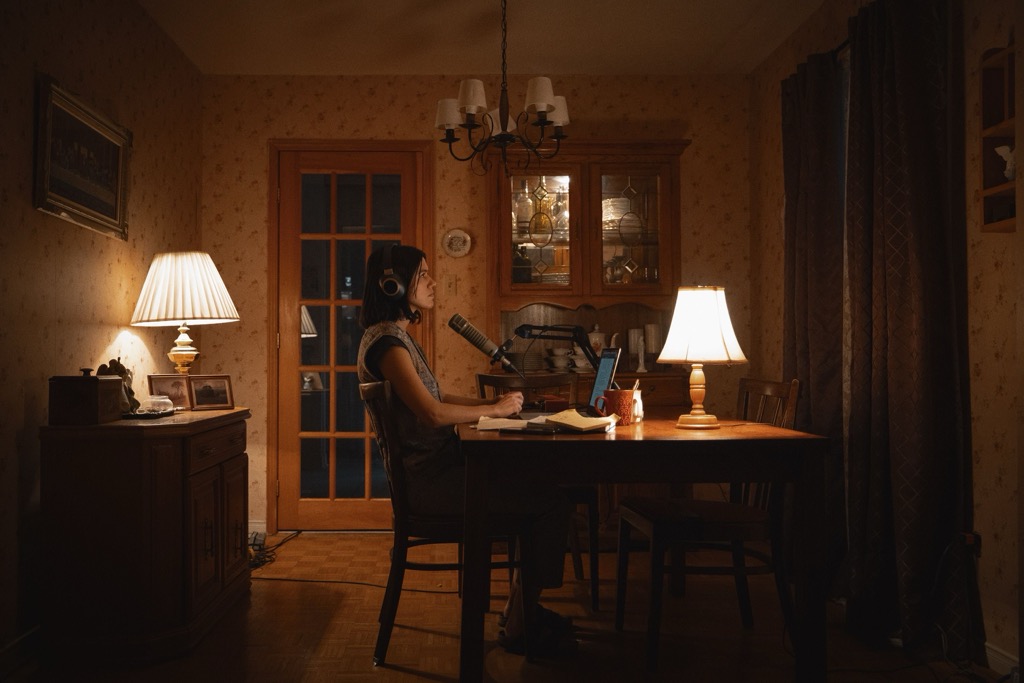
undertone1Sticking with the lower-case from the movie’s marketing, which is a sign of how much I liked it is about Evy, co-host of a podcast about spooky phenomena. She’s the hard-line skeptic, and her co-host Justin (who we never see) is the true believer. He’s based in London, so to account for the time zone difference, Evy has to record the podcast alone in the house, in the dark, very late at night.
Also she’s the sole caregiver for her dying mother, who was a devout Catholic, and the house is full of Catholic imagery along with Evy’s ever-increasing stress and guilt. The topic for this episode is an email that Justin received, with a cryptic message from an anonymous address, and 10 audio files attached. They decide to listen to them for the podcast, Justin listening and looking for hidden messages in the audio, Evy ready to debunk every one of his theories.
It’s really not hyperbole to recommend seeing this in a theater with a good sound system, since as you’d expect from the premise, the movie achieves a lot of its creeps via sound design. Just the transition when Evy puts on or takes off her noise-cancelling headphones is effective. There are lots of “did you just hear that?!” moments, and undertone is surprisingly sparing in its use of sounds that seem to move out of the screen and into the theater with you, so they never feel rote or overdone.2I’m not sure whether it was intentional, or just something to do with my theater, but the frame always had big black borders inset from the screen, and I kept expecting a moment when the image would fill up the entire screen. If you want to see it but don’t want to go to a theater, I highly recommend watching it with headphones.
(And I’d still recommend a theater if you’re at all interested, because a lot of the fun of this one was feeling the need to periodically look around the theater to see where that noise was coming from, or whether that weird shape in my peripheral vision was a ghost or just someone getting up to go to the bathroom).
But even with that caveat, the thing that surprised me the most about undertone was that it didn’t rely solely on the sound design. It feels like a deliberately old-school horror movie in all the best ways. Trading all of the gore and violence for good old-fashioned creepy stuff like dark hallways just off to the side of the frame; eerie things half-seen in the background of a shot; lights turning on and off inexplicably; and a woman alone in a house at night, walking with trepidation up a staircase with a crucifix prominently placed on the wall.
Yes, the majority of it does feel like Manipulative Horror Movie Tricks 101, but in combination with the premise and the sound design, it all worked for me. I kind of miss movies that just put everything into being scary, instead of deeply upsetting or shocking.
Note that if you’ve ever had a terminally ill parent, it might cross the line into deeply upsetting. I imagine especially so if you were your parent’s caregiver. I was initially concerned that it was just going to be crassly manipulative with it, another horrible thing to pile onto the protagonist. So I was surprised by how much a genuine sense of empathy came through. In the end credits, there’s a message that the movie supports the Kidney Foundation and an organization for Alzheimer’s research, and there’s a personal text message from the writer and director (which scrolled by too quickly for me to read in full) that dedicates the movie to his parents and to people who’ve been in the position for caring for their parents.
undertone seems very much like a movie where you get out of it what you’re willing to put into it. There are lots of suggestions of ideas about religion, what you owe your parents, guilt, motherhood, guilt, and having to suffer through trauma alone, but it doesn’t actually say that much about them so much as offer empathy for people who are going through it. I think that’s plenty, personally.
I already said it on Letterboxd, but my only real criticism is how it was such a weird choice to pause the movie halfway through so that the characters could talk about Hello Fresh.
And I couldn’t come up with a circumspect way to describe what I liked about my two favorite scenes, so I’ll save that for after a spoiler break.
The most effective scene for me is after Evy comes back to the house after what seems like a night out. She (eventually) comes upstairs, and we just get a shot of the door to her mother’s bedroom, where we see her mother’s legs lying on the floor.
That one shot is so quiet and matter-of-fact, and it suggests much more than it actually shows, but it hit me as hard as anything I’ve seen in a horror movie in months.3And this is a year when I’ve seen a chimpanzee rip a man’s face off, and a zombie pull a guy’s entire head and spine out of his body. You already know that something bad is going to happen, just by virtue of the fact that Evy’s allowing herself one night out after weeks. But it was so much more effective than any shots of creepy figures or shadow creatures, or even her mother sitting upright in the background later on, just because it’s laden with so much guilt.
I think the best scene in the movie happens later on, as Evy puts in her Air Pods and lies down with a gentle relaxation recording. The narrator begins with a peaceful description of a tranquil lake, then calmly and seamlessly segues into describing something floating to the top of the lake. Something pale and bloated.
It’s such a perfect line delivery, and such a seamless transition into Evy’s nightmare. And you get that minute or so of dread, as you realize that you’ve transitioned into a nightmare, but the really horrific stuff is still yet to come.
When I was going into this movie, I was expecting to see a ton of close-up shots of the Logic interface, zooming into sound waves, scrubbing back and forth over audio clips, playing them in reverse, and so on. And there is plenty of that. But what I hadn’t anticipated was how many different ways they’d use audio to be completely disorienting. I still don’t know how many of the whispers or crackling noises that I heard were actually from the other people in the theater, or from the movie’s soundtrack.
And I especially hadn’t anticipated how much of the movie would work by combining all of its sound design tricks with good old-fashioned horror movie tricks. After-images in the darkness, bizarre dutch angles, lighting changes, shots composed to have you scanning not just the empty space around Evy, but the empty space in the theater around your seat.
Honestly, there’s not much in undertone that feels all that original. But it’s the combination of sound design and old-school visuals, all executed well, and with a pretty great performance from its lead actor, that makes it all work a lot better than it has any right to.
Comments
2 responses to “Heebie dBs, or, The SFXorcist (One Thing I Like About undertone)”
Heebie DBs…? WOOF.
I also really liked this movie. I have a good 5.1 setup at home but I’d still prefer it in the theater. The audio work was just truly superb and really delivered. Excellent command of tone.
In the moment, I wasn’t entirely sold on the ending, but it has stuck with me more than a face being ripped off by a chimpanzee or a zombie removing a head and spine (and I really liked that movie, and it took me a moment to place the image).
Yeah, it’s not just the audio setup, but the fact of being inside a dark theater with a bunch of strangers who may or may not be ghosts or demons.