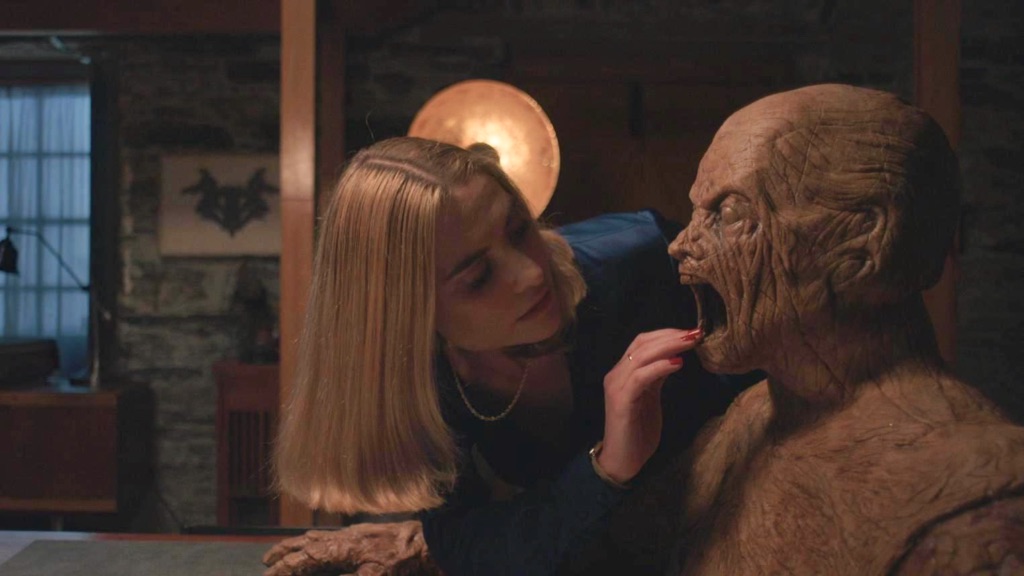
I watched Oddity in preparation for Damian Mc Carthy’s new movie out this weekend, Hokum.1I haven’t yet seen Caveat. I didn’t know anything about it apart from its extremely effective marketing, which suggests intense “elevated horror” in an old manor house, featuring a severe white-haired woman and an unnerving and grotesque, life-sized wooden figure.
And it delivers on that! If that sounds like your thing and you haven’t seen it yet, I highly recommend seeing it without reading on.
What surprised me the most about Oddity was that it delivers on being genuinely chilling, but also manages to be drily funny throughout. Fully aware of the absurdity of the things it keeps tossing into the story, but never mocking or undermining them. As a result, over the course of just a little over an hour and a half, it transforms from supernatural horror that’s scary as hell, into a fun and twisty episode of Tales from the Crypt. All the while keeping its edge and without descending into camp.
It starts with a woman in an old, secluded manor house that she’s in the process of renovating for herself and her husband. While she’s alone in the house one night, she’s visited by an agitated man, warning her that there’s someone in the house with her, and she needs to open the door. She learns that he was a patient at the asylum where her husband works nights. She’s left to contend with both the deranged man outside, demanding to be let inside, and the idea that she might not be alone in the house.
Then it’s a year later, and we’re introduced to her identical twin sister. She runs a shop selling “oddities” in town, cursed objects that have dark histories. Also, she’s blind, and she’s psychic; by touching an object of personal value to someone, she can gain insight about that person and see their memories. When her brother-in-law visits, she suggests a visit with him and his new girlfriend back at the house, on the one-year anniversary of her sister’s death. She’s intent on finding out what exactly happened that night.
Oh, and before she arrives, she has a box delivered, containing a life-sized human figure carved out of wood, its mouth open in a perpetual scream.
The wonderful thing about Oddity is that it layers on all of its creepy details with just enough restraint that it acts as misdirection. It’s ratcheting up the tension and the overall sense of unsettling weirdness all while quietly transforming into a different type of horror movie, as you’re watching it. You know that this has to be an extremely haunted house, and you know that terrible things are going to happen. But instead of giving you the usual structure of increasingly unsettling occurrences, it plays out more like an awkward social comedy.
A huge part of why it works is because of Carolyn Bracken’s brilliant performance as the sisters, Dani and Darcy. (Darcy is the psychic one we spend the most time with). Dani is likeable and unfailingly normal. Darcy is a full-on creepshow. Played with restraint and, occasionally, a dry and direct sense of humor, but unmistakably off.
It makes for an interesting dynamic with her brother-in-law Ted (played by Gwilym Lee) and in particular, his girlfriend Yana (played by Caroline Menton). It’s set up for us to see Darcy as our protagonist, to take an instant dislike to Yana, and to be disappointed in Ted for moving on so quickly. But the tension comes from the fact that Darcy is acting so weird and creepy.
She’s staying the night and not taking the hint to leave. She’s obviously set up the wooden man to sit at the end of the table, while simply denying that she did it and offering no other explanation. There’s a funny dissonance throughout, where Yana and Ted are behaving exactly as normal people would in a similar situation, but because we’re fully aware that this is a horror movie, all our sympathy is with Darcy. And the intrigue over what she’s going to do next, once the house’s ghosts start to reveal themselves.
Oddity goes on delivering more twists and revelations in the form of visions, flashbacks, and jump scares (which all work, a rarity), completing its transformation into a story from an EC horror comic. But it always feels like a smart and modern take on a good, old-fashioned ghost story, understanding that you can be fun without being silly. As various ideas seeded throughout the movie all come together at the end, it has the satisfying feeling of everything clicking perfectly into place.
I’ve tried avoiding any outright spoilers in this description, but there’s one moment that I really liked that would be a spoiler. So I’d suggest avoiding the rest until after you’ve seen Oddity. It’s a lot of fun and I definitely recommend it to fans of horror movies.
Oh, before I get to the spoiler: my first thought for a title for this post was “Tree’s Company.” Because it’s an Irish movie and they pronounce it like “tree” and also because it’s made of wood and for much of the movie there are three of them in the house. I just wanted to get full credit for that dumb thing.
The moment I really liked is when Darcy is telling Ted about her plan and revealing everything she knows. She tells him that Dani would’ve gotten over him; it would have been difficult, but she’d have support from her sister. I thought his reaction was well-played as reading both as the kind of matter-of-fact denial of someone who’s used to talking to delusional people, and anxiety over being found out. There’s really not much room for doubt left at this point; we in the audience are already pretty sure he’s guilty, and any new twists at this point would’ve come out of left field. So I appreciated that the scene was still played to leave some sense of ambiguity, instead of going instantly to “oh shit I’m busted!!!”
But the capper is immediately after, when we see him talking to Ivan, who asks him outright why he doesn’t just divorce Dani. His first answer is “She loves me. She’d be devastated,” followed by the real answer, which is that he’d lose his assets in a divorce. It’s such a perfectly efficient way to establish that he is the most loathsome character in a cast full of murderers.
It reminded me of my favorite scene in Companion, where we see a man so dismissive of the agency and independence of a woman that he’s incapable of accepting that she might be able to live just fine without him. And he rationalizes his greed by convincing himself that he’s showing mercy.
And it makes the ending more satisfying than the simple ironic capper it might seem to be at first. I’d been disappointed that we didn’t get to see either him or his henchman completely torn apart by a vengeance golem; it seemed like there was no justice in this movie. But instead, we get an even more satisfying two-fer: he executes one more betrayal, and his sadistic accomplice gets taken out by one of the patients he’d always taken pleasure in abusing. And Ted is ultimately taken out by his own arrogance. His confidence that he’s untouchable, that anything he doesn’t believe in doesn’t exist, and his refusal to acknowledge that there might be things beyond his understanding.