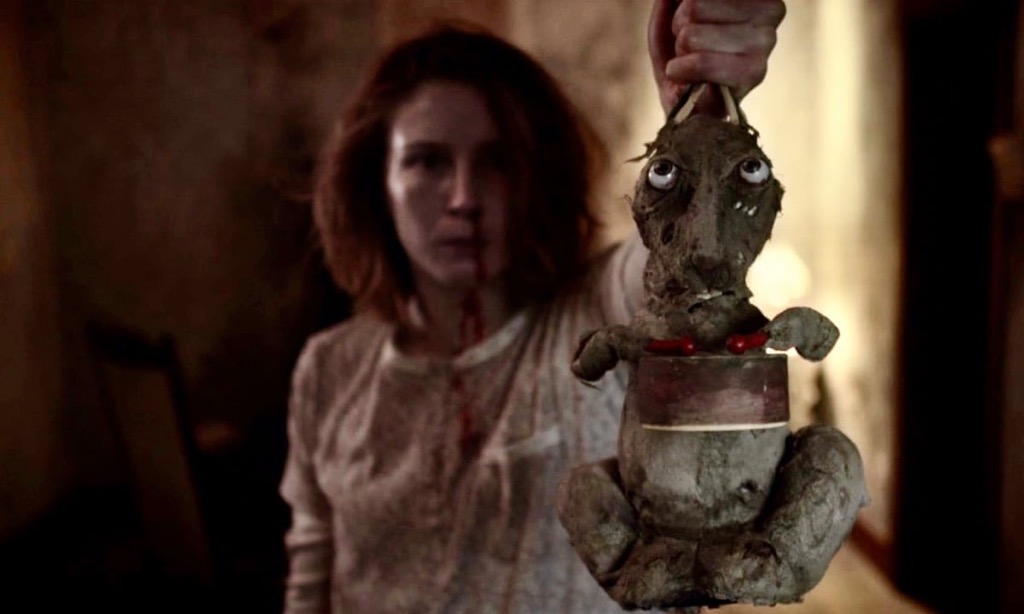
Caveat opens with a young woman walking barefoot through an extremely run-down, dark house. It’s unclear whether we’re seeing the aftermath of something horrible, or if it’s the beginning of something horrible, but we’re so immediately plunged into sinister and suspenseful atmosphere that there’s no question that horror is involved.
She’s holding a grotesque, grizzled old bunny doll/toy by the ears, and she carries it out in front of her like a totem or a shield. Periodically and spontaneously, the bunny beats a short rhythm on its toy drum as if to guide her. It takes her past a series of foreboding doors and creepy paintings, eventually leading into the basement, and to the ominous crawlspace on a far wall, which has been sealed up. The bunny gives another tap on its drum. She finds a drywall saw and gets to work.
I mention the cold open because I’m convinced that it’s somehow key to what makes this movie work at all, because I’m still struggling to figure out why it works at all. Often, you can read a short text synopsis of a movie and see how ideas that seem ludicrous on paper can be transformed into compelling stories when they’re on film. Performances, art direction, cinematography, music, editing, and dialogue all add substance and weight to the premise and the story, making it all flow and make sense. The premise of Caveat never makes sense, and it doesn’t seem to be all that concerned about that, because it’s so confident it can creep the hell out of you anyway.
After the cold open, we’re introduced to our protagonist, Isaac, who’s being presented with a job opportunity by a man named Moe Barrett. Barrett’s niece is a mentally ill young woman living in an isolated house on her own, after her father committed suicide and her mother went missing. He wants Isaac to stay in the house for a few days to keep an eye on her, and he’ll get paid 200 euros a day for a simple babysitting job.
It’s only after they get near the site that the reason this movie is titled Caveat starts to reveal itself. The house isn’t just isolated; it’s on an otherwise unoccupied island accessible only by a small rowboat, and Isaac can’t swim.
Once they’re inside the house, Barrett explains that his niece Olga is prone to episodes that leave her completely catatonic and unresponsive. She also can’t stand to be too close to other people, so Isaac is forbidden from entering her room. To guarantee that he can’t go in — and to maintain some sense of propriety instead of leaving a strange man he’s just hired alone in a house with a young woman — he’ll lock Isaac into a harness connected to a long chain, which extends throughout the house but not outside, and most significantly stops just short of the door to Olga’s room.
Obviously, no rational human would agree to all of this. Even if they hadn’t just seen the cold open, and they weren’t aware that they were in a horror movie. Isaac protests at every step, and yet after a quick edit, we see that he’s taken the job and he’s letting Barrett lock him in and put the key in the still-catatonic Olga’s room.
One of the things that’s so interesting about Caveat is that it doesn’t seem to be making any attempt to hide what it’s doing. We’re first introduced to Barrett in a pretty extreme close-up that makes him look pretty extremely sketchy.1That’s not an insult to the actor, by the way. In his regular headshots, he’s not all skeevy sideburns and teeth. Isaac is wide-eyed and guileless; we get hints of his desperation and confusion (it’s mentioned that he has memory loss), but he’s still capable of basic self-preservation, and he has some awareness that he’s being manipulated. There’s a significant amount of money involved, but not so much that it patches over any reservations; it’s not a case of “stay in this haunted house and you’ll receive one million dollars!” And all the caveats are given some justification, but not so much that they stop seeming suspicious or unreasonable.
Even if I hadn’t seen the opening scene, I’d have refused just on the basis of how uncomfortable the whole situation sounds. Having to spend a week locked inside a ruined house that is almost certainly haunted, with a young mentally ill woman who’s all but completely unreadable? How would I even smoke?2Although based on the visible rot of the house, I don’t think I’d have much hesitation about smoking inside. If anything, the yellow-brown tobacco stains might help give the place some warmth.
It’s the most fundamental idea that drives almost every horror movie: don’t do that. It’s so well-known that it was masterfully manipulated by Hitchcock in The Birds, parodied by Edgar Wright with Don’t, and was the basis of the title of Jordan Peele’s Nope. But in Caveat, it’s pretty much baked into the premise (and again, the title). It doesn’t work too hard to give a reasonable justification, but it also piles on its unreasonable caveats to such a degree that it’s not simply saying, “roll with it, this is horror movies work,” either. It seems to be not just acknowledging, but embracing that compulsion that drives people to do things they clearly shouldn’t.
As a result, it reminded me of being outside the entrance of a haunted house at Universal’s Hollywood Horror Nights or Knott’s Scary Farm. The facade is explicitly telling you, “come inside and have the shit scared out of you,” and there’s a long queue of people waiting for their turn.
And that’s the best analogy I can think of, because Caveat seems to exist primarily to creep the hell out of you. I’m sure that people can and have come up with interpretations that label it “psychological horror,” but I didn’t get much sense that the movie was that interested in your intellectual response. It’s all dread and atmosphere and constant creepiness — with plenty of shots of creepy paintings that seem to change from scene to scene — but with enough of a sense of a good old-fashioned haunted house story that it never becomes more overwhelming than fun.
I’ve watched Damian Mc Carthy’s first two movies back to back, in preparation for seeing his third, Hokum, this evening. And there’s already a neat pattern evident in them, where they feel like modern versions of old-fashioned folklore. They’re beautifully shot, performed, and edited, full of details that don’t “just feel right,” but which feel wrong in exactly the right way. Moments flow from one to the next without much question, because of course this is what happens next. The leaps in logic or absurd twists don’t feel like mistakes, but like the kinds of jagged edges that make ghost stories linger in your memory.
And the revelations rarely feel like complete surprises, but I never get the sense that they’re supposed to. I realized late into the movie that I’d been at least partially spoiled for it, because people making YouTube videos and writing reviews have no problem putting the most surprising images from the movie in their video thumbnails.3In other words, don’t do a search on this movie if you haven’t seen it yet! But still, the moments felt like they worked as intended. Jump scares still made me jump. And much like in Oddity, the various twists and reveals didn’t work so well because they were so completely surprising, but because they seemed inevitable. Deep down, I knew that something like this was going to happen, and that’s part of what compelled me to walk into this haunted house in the first place.
And speaking of the drum-playing rabbit toy: it was the underused star of the movie, so I was retroactively happy to see it make an appearance on a shelf in the cursed oddities shop in Oddity. A different and lesser movie would’ve made it the entire focus of the story, but here, it’s just one of those unforgettable creepy details that gets added to a classic ghost story as it’s told and re-told over the years. Why exactly is there a cursed drum-playing rabbit toy? I dunno, why does the Baba Yaga’s house have chicken legs?
