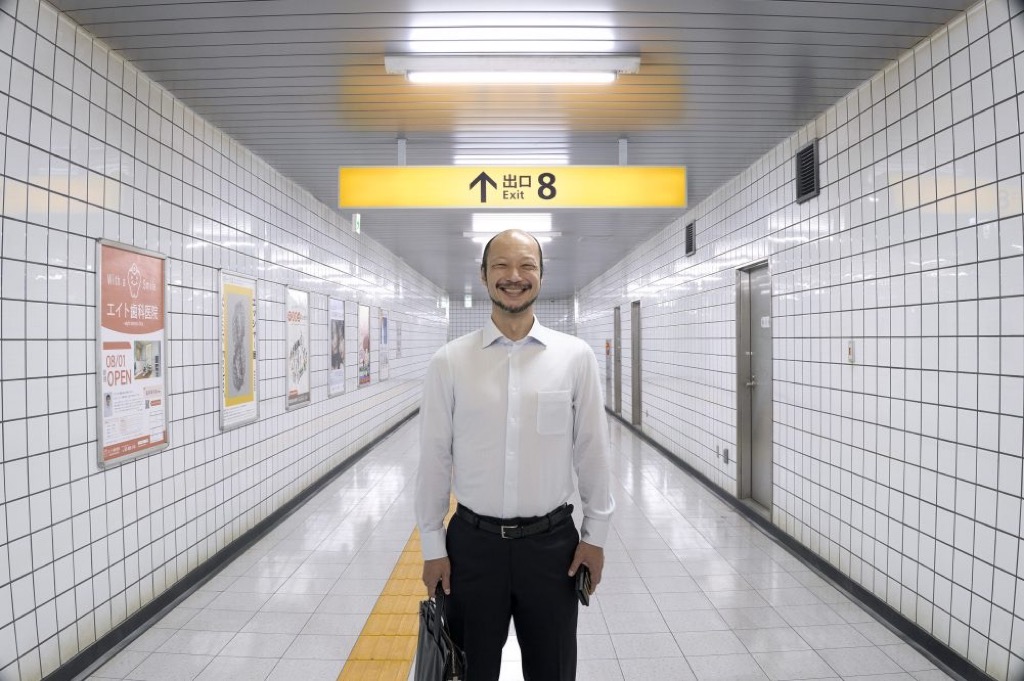
The video game Exit 8 is essentially a straightforward spot-the-difference puzzle game, with a clever concept and an ingenious presentation. You’re trapped inside an endlessly-repeating hallway in one of Tokyo’s labyrinthine train stations, and you’re just trying to walk forward to find Exit 8.
At the start, you see a sign pointing to Exit 0, and a simple set of rules: look for anomalies. If you don’t see any, keep walking forward. If you do see any, turn back the way you came. Every time you do it correctly, the number will advance by one. Every time you get it wrong, you’ll be reset back to the start.
When I heard that it had been adapted into a movie, I thought it was a brilliant idea. I continued to think that as I made a reservation, drove to the theater, parked, and went inside to my seat. It was only at about 30 seconds into the movie that I spotted the anomaly: wait a second, this is a terrible idea for a movie, actually!
How could a movie adaptation possibly add anything? Best case, it’d be just like a play-through of the game. Worst case, it’d have all the repetitiveness of the already played-out time loop genre of movie, but with no stakes because nothing that happens is permanent. “Losing” in Exit 8 just means frustration and wasted time, which isn’t an issue in a movie because you’re not the protagonist. And everything that time loop movies mercifully cut out to show how the protagonist is learning but without feeling tiresome — that’s the entire substance of Exit 8 the game.
At the start of the movie, it strongly suggests that it’s just going to be a straight adaptation of the game. Everything is filmed (and heard) from first-person perspective. It even does the frequently-used video game trick of having the main character see their reflection, to establish the person you’re playing as. It continues like this for several minutes, introducing you to a rough idea of who the protagonist is, and setting up the scenario that’ll be waiting for him once he exits the station.
I was prepared for an entire movie delivered in first-person, and I was already speculating on how they could possibly pull it off and make it interesting.
But part way down the initial corridor, as we’re starting to suspect something is weird and getting our first hints of the premise, the camera leaves first-person mode and rotates around to show our protagonist. This was my favorite bit in the movie, because not only did it establish how this movie was going to deviate from just a play-through of the game, but it also signaled the start of the weirdness. Above the protagonist, we see the back of the already-familiar Exit 8 sign, and unknown to him, it reads, “Turn back Turn back Turn back”.
I’d been wondering whether the movie would play better or worse for people who’ve never been inside a Tokyo train station. Would it be like, “what a strange and unusual concept to base a movie and/or game around!” Instead of, “Oh yeah, this is exactly what it’s like. Realizing you’re in purgatory, and you will be trapped in here for eternity.”
But the bigger question is probably how well it’ll play for people who’ve never played the game. The game is far, far creepier, with a variety of anomalies that range from hard-to-spot discrepancies, to eerie did that just move? moments, to more dramatic that-shouldn’t-be-there changes that affect the entire space. I was hoping that the movie would take them further, but I didn’t catch any anomalies in the movie that weren’t already in the game. (To its credit, it did include what I think are some of the best ones).
But then again: I’m not sure how a movie could have taken them further? The rules of the game are that the moment you see something weird, you nope out. It’s basically a series of jump scares, or more accurately, jump creeps. Again, there don’t seem to be any real stakes, since there’s never real danger beyond wasting your time and having to start over.
The movie does suggest some real repercussions, though, in a way that I won’t spoil. And it’s in the deviations from the game that the movie is strongest. Most interesting is the suggestion of what happens when you fail. But the bigger deviation is giving enough of an introduction to the main character that it’s more explicit what the experience represents.
Which I say is a good thing, since the game doesn’t mean much of anything. At least, it doesn’t invite interpretation. It’s an interactive nightmare, made to appeal to The Youth by giving them the Liminal Spaces they crave. It doesn’t ask any questions larger than “you know what would be really creepy?”
The movie gives its main character a specific nightmare and leaves it ambiguous as to whether the events of the game are the result of a mental breakdown or extended panic attack. For this specific character, it represents his going from being lost and directionless to choosing a purpose and being determined to fulfill it.
But I think it also pretty cleverly adds a more universal theme, that ties even more directly into the game. The idea of passing through life in a dull routine treating everything and everyone as incidental and unremarkable, as typified by a dehumanizing commute on a Tokyo train during rush hour, instead of being present and making an effort to be aware of everything and everyone around you.
Ultimately, I think the game and movie are similar in that they’re really effective in the moment, but feel emptier and simpler the longer you spend away from them. It’s a pretty fascinating example of how to make a movie adaptation of a video game, being faithful to what people love about the game while still recognizing the aspects that inherently don’t work well when they’re not interactive.
It’s admirable that it aspired to do more with its narrative than make a framework for a bunch of creepy stuff. But I also wish they’d spent less time with its anime-style surreal introspection, and more time just showing us a parade of creepy stuff. Really leaning into the things that can work even better in a movie where you have complete control over the timing and the framing.