Last week I saw a link to a review of Mortal Kombat II where the subhead claimed “fans deserve better than the sloppy CGI blood and empty characters.” It just made me sad. Why are they sending reviewers out to movies without telling them what they’ll be seeing?
For me, my take was: I bought the ticket, I knew what I was getting into. And I can’t really claim to be a fan of Mortal Kombat; I’ve played one of the games exactly one time, and it was around 45 minutes of “matches” against my former roommate, which were each about 30 seconds of him using “get over here!” repeatedly until I was dead. But I know enough about it to be completely baffled by the claim that Mortal Kombat fans would be turned off by CGI blood and empty characters. “Fans of Tomb Raider deserve more than all of this raiding of tombs.”
I also didn’t see the first movie in the reboot, although I did see a recap, which pretty much reinforced the consensus that it was very dull. I couldn’t get a sense of whether they believed it was crucial to build up the characters and their relationships, the universe of the Mortal Kombat and the tournaments, and please the type of person who’d go into one of these movies expecting more story and deeper character development.
Maybe it’s just that they came up with the idea of Sub-Zero stabbing a guy with a frozen spike of his own blood, and they were so proud of themselves that they didn’t bother with anything else. (And honestly, can you blame them? That is, objectively, the most bad-ass thing ever committed to film).
In any case, I never once felt like my lack of preparation was robbing me of any of the enjoyment of this movie. And I never once got the impression that you had to have been a fan of the franchise to get what’s appealing about this one. The exact same forces that drive the popularity of the games are what drive this movie. It’s not complicated.
Because Mortal Kombat II focuses on two characters: Kitana for the lore, and Johnny Cage for the self-awareness and humor, there is even an exchange that says exactly that, as plain as it could possibly be. Cage is balking at having been recruited for the tournament, saying nobody told him that they’d have to fight to the death. Sonya says, “It’s called Mortal Kombat.”
On Rotten Tomatoes, a particularly asinine blurb stood out, where the reviewer said, “I’m terrified that maybe it’s the future of movies.” Stop clutching those pearls, Cassandra. My only fear about media literacy comes from reviews like that one, which act like this isn’t the past and present of movies. It’s not even new to this franchise. The 1995 movie was gloriously stupid fun. The 1997 sequel was a complete mess, largely for acting as if the game’s nonsensical lore and characters combined with late 90s CGI would be rich and fantastic enough to drive an entire movie on its own.
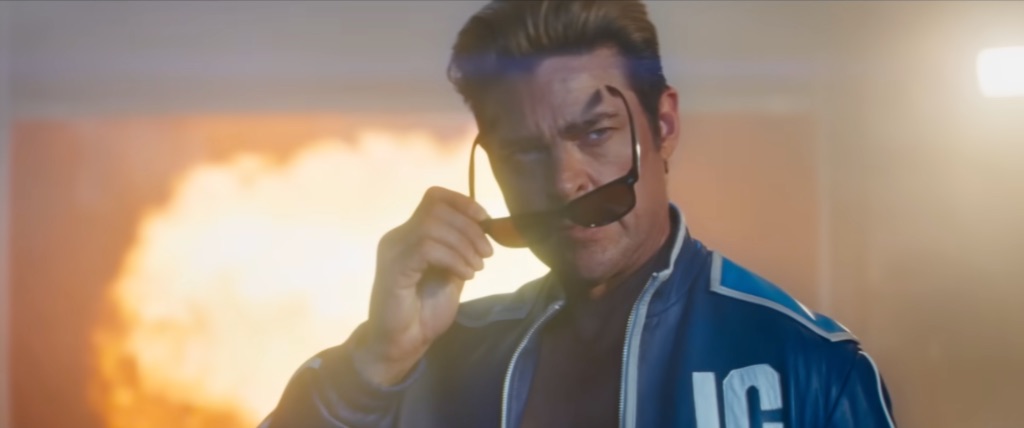
And again, that’s something that Mortal Kombat II makes a self-aware comment on. My favorite part of the movie is when Johnny Cage is introduced, via a scene from his hit movie Uncaged Fury. It’s a 1993 production from New Line Cinema, and we get to see the action-packed finale, with Cage fighting off a bunch of bad guys and one villainous woman with a missile launcher.
I thought it was pitch perfect. Clumsy martial arts choreography that wasn’t so clunky and amateurish to be completely unbelievable, but still just ludicrous enough to be funny. Karl Urban as Johnny Cage pushing right up against the border of too over-the-top, but never quite going so far that it collapses into outright parody. And the climax, which makes no sense but would’ve seemed rad as hell at the time.
You really can’t overstate how much this is Karl Urban’s movie. He is an actor with an unstoppable streak of just plain getting it, the highlights for me being Dredd, Star Trek, and even playing it straight in The Lord of the Rings. But I’ve never seen him in anything where it wasn’t immediately obvious that he knew exactly what he was doing, exactly what the movie required, and making every correct choice to pull it off.
But really, everybody involved seemed to understand exactly what movie they were making. Highlights were Adeline Rudolph as Kitana, given the thankless job of being a completely serious lead character in an otherwise silly, funny, and hyperviolent movie; Josh Lawson as Kano, foul-mouthed comic relief practically begging for a Cage/Kano buddy movie; and CJ Bloomfield as Baraka. But pretty much everybody delivered on exactly what they were there to do.
The fact that Kano was brought back to life, after being killed in the last one, is evidence that this movie is concerned first and foremost with giving people what they want.1It’s possible that my pro-beardy Australian bias is showing, I’ll admit. Fun, cool, or hot people (or a combination of the three) in fantasy settings fighting each other with cool magic powers or scary weapons, with the chance of seeing an over-the-top gory or gruesome finishing move.
I thought Mortal Kombat II delivered on those as well, by the way: there were at least four surprisingly gory kills, and while I had been expecting the gory finishers, I hadn’t expected any of them to play out exactly like they did.
Movie adaptations of video games too often fall on the side of being too faithful or too dismissive. Either they try to treat the characters as having the kind of depth that works in movie narratives, or they act like video games are inherently silly, so anything goes. I can respect the reboot wanting to establish stories for characters that have resonated with players, but even that is a little condescending. It assumes that the parts that resonate are the parts that approximate film, instead of understanding that a lot of the time, the parts that resonate are the parts that work as games.
Liu Kang is interesting because he’s a champion fighter who can shoot fire out of his hands. That’s really all you need. You don’t need to give a guy with huge robot arms a tragic backstory to make him cool. Same for a guy named Scorpion who can shoot out a grappling hook, or a guy named Sub-Zero with ice powers. Also, Sonya is here.2No offense at all to the actor. No movie ever knows what to do with Sonya, and she does the best she can with a character who mainly exists to be hot, provide exposition, and be a straight man for Johnny Cage.
So Kano’s back because he’s a fun character that people liked. He asks for an eye that shoots laser beams, and they give it to him. Again: none of this is that complicated.
And when the attention of the plot splits between the tournament and some bullshit about having to find and destroy a magic amulet3And yes, Johnny Cage makes a reference to The Lord of the Rings, which is not surprising, but what is surprising is that it works., it’s fine. There’s little sense that the movie is asking us to get any more invested in it than we would in any MacGuffin, because we’re all aware that it’s a setup for more fights between cool characters.
I will always be annoyed when I see someone describing — or worse, defending — a movie by saying “you have to turn your brain off.” I have seen plenty of movies like that, and they’re just plain bad. You have to be genuinely smart to make something that understands exactly how smart it needs to be, and where. Otherwise, it’s obvious that you think you’re smarter than the material, and worse, smarter than the audience, without having made any effort to demonstrate it.
And that goes double for light-hearted self-awareness. In clumsy hands, self-awareness reads as, “we’re perfectly aware of how silly all of this is.” Prompting an immediate response of, “are you, though?” In the right hands, as in Mortal Kombat II, the self-awareness reads as, “we’re perfectly aware of what makes all of this fun and cool.”