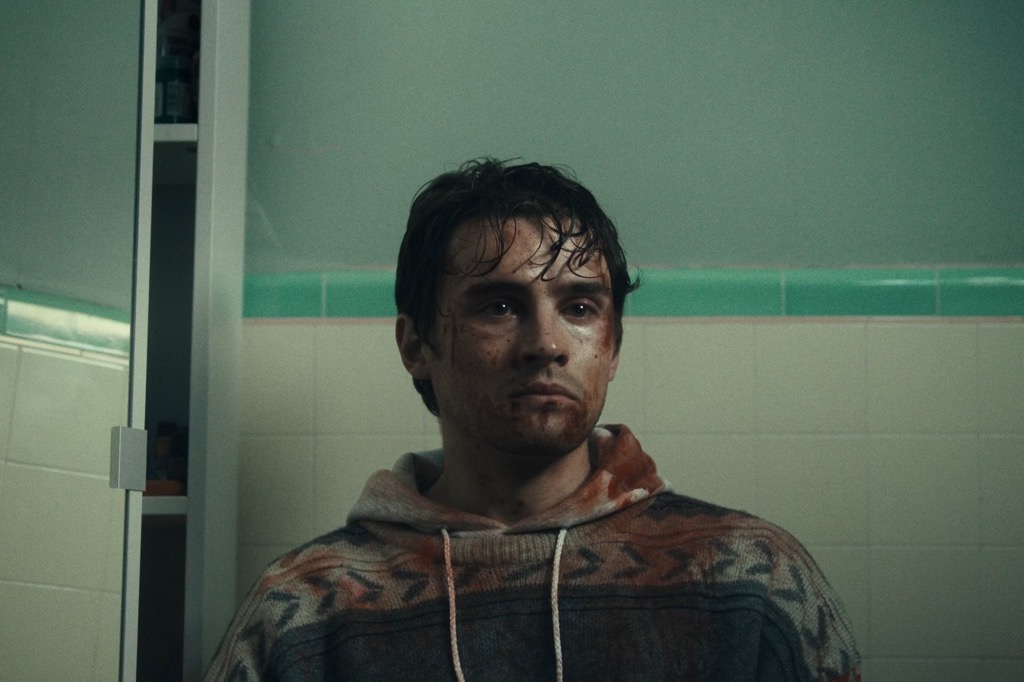
I was eager to see Obsession as soon as possible, almost entirely because it’s been super-hyped by the Dead Meat YouTube channel. My tastes seem to align with theirs more often than not, and they loved it.
I wasn’t quite able to fall under its spell, but I appreciate what the movie is trying to do, and it has several moments that were well-executed and worked on me exactly as intended. And the universal praise for star Inde Navarrette is entirely justified. She’s excellent, and it’s not an exaggeration to say the movie just plain wouldn’t work without her going all-in.
The premise is that a guy named Bear has a crush on his longtime friend and current co-worker Nikki, and he’s trying to tell her how he feels but can never quite work up the nerve. One night, after a series of missed chances, he makes a wish on a toy that she’d love him more than anyone else. The wish comes true.
I think going in with realistic expectations and with as little information as possible is probably key to getting the most out of the movie. It gets a recommendation from me, not that it needs it with all of the buzz it’s been getting.
Describing the one thing I liked most about it requires spoiling it, and requires describing how I was slightly spoiled going in.
A few days ago, I saw a friend vague-Letterbox about the movie with a comment that was critical, which had me intrigued. It was literally the first time I’d seen anyone say anything approaching a criticism of the movie, since I’d only seen praise for it from people who’d seen it at festivals and screenings.
That had me looking up reviews on Rotten Tomatoes specifically to get the gist of the negative reviews. I didn’t want to go in over-hyped and with unrealistically high expectations.
The two that stood out were one that just called out its misogyny, and another from someone who disliked the director’s short horror film Milk and Serial1For whatever it’s worth, I disliked it as well., and said that it was a Monkey’s Paw story that didn’t understand how Monkey’s Paw stories work. Specifically: Bear is the one who makes the wish, but it’s Nikki who suffers all of the repercussions from it.
I think both observations are (partly) true, but are missing the point. Another comment dismissively called the movie derivative of Fatal Attraction, and it struck me as bizarre that anyone would think that wasn’t intentional. Substitute an accidentally dead cat for a deliberately murdered rabbit, and then take everything several steps farther, and it feels like a direct reference.
Even if it somehow weren’t a direct reference, the overall intention seemed pretty unambiguous. Obsession plays like someone watched Fatal Attraction and thought, “Well that was inexcusably gross.” That movie presented itself as a harrowing ordeal for Michael Douglas’s character, insisting that he was a flawed protagonist sufficiently punished for his indiscretion, instead of the villain of the movie. The whole thing seemed to be designed as a warning for men to remember that bitches be crazy sometimes.
Throughout, Obsession deliberately calls back to “romantic” movies, and the occasional suspense thriller, from the 1980s and 1990s. There are several moments between lovelorn “hero” Bear and the object2Red flag of his affection Nikki that are set to music that’s always just synth-heavy enough, or just acoustic enough, to call back to a time before people called out these movies’ worst aspects for being deeply problematic at best. And Obsession is pretty clearly accusatory about all of them.
I think the two most effective scenes in the movie happen near each other: just after the wish, and then a night they spend together, not long afterwards.
Nikki’s reaction as the wish starts to take effect is so unsettling that I wished the movie had stayed in that mode for even longer, before ramping up the more blatant scares. She is visibly, undeniably, losing herself. I kept thinking that the moment — which you know is going to happen, just based on the premise — would have been so much more merciful if it had happened instantaneously. Instead, you see the woman (and ostensibly, good friend) who’d been sitting there just a moment ago, now having these disorienting flashes of losing her mind, and not understanding what’s happening to her.
After a weird and uncomfortable night, Bear and his friend come up with the theory that she’d taken Molly. You can already tell that Bear knows that this probably isn’t true, but he’s still eager to believe that he’s finally gotten his wish. Both of the men acknowledge that it would’ve been reprehensible to take advantage of her in that state, and Bear insists that of course he didn’t.
A short time later we see them at a restaurant for a date, having a conversation that starts out normal enough before getting weird and awkward. Bear gets a call with info that Nikki had told him a false story, and a reminder that she’s been acting uncharacteristically weird. After the date ends, we cut back to the house, in the middle of Bear and Nikki having sex.
The reason I think it’s so effective is because it clearly establishes that Bear is the real villain of this movie, and I had fully expected Obsession to leave that up to interpretation. As a middle-aged man who grew up watching movies that treated sexual assault as a “gray area,” or even with just a dismissive shrug, I liked seeing a movie that matter-of-factly declares that it’s unacceptable. And with the implicit accusation, “were all you people sociopaths in the 80s and 90s?”
Even if he somehow still doesn’t believe in the wish, despite tons of evidence to the contrary, Bear is still undeniably aware that Nikki isn’t fully in control of her faculties. But he’s so adamant about finally having what he always wanted, that he chooses to ignore that. His objection to taking advantage of her while she was on Molly comes across as understanding the “letter of the law” but not the intent of it.
And we get frequent reminders of how the experience is horrific for Nikki. Suggestions that she hasn’t been transformed, but that the real her is still somehow conscious and aware of everything. The “customer support” voice on the phone asks Bear if he wants to talk to Nikki, and we just hear her constant screaming. She talks to him in her sleep, begging him to kill her.
He has the same vacant, bewildered stare throughout the movie, refusing to do anything about a situation that he’s fully aware that he caused. Even though the person he claimed that he loved is being tortured.
So I appreciated seeing a movie finally calling out the idea of the “hopeless romantic” as absolute bullshit. The apparent misogyny of the movie is similar to that of any horror movie that mostly consists of a woman being put through hell, with the difference that in Obsession, the final girl and the monster are (ostensibly) the same character.
And the modern stereotype of the pathetic incel is really just a more blatant extension of the same type of character that we’ve had presented to us for decades as some kind of sympathetic, romantic hero. “Unrequited love” treats the other person’s agency as irrelevant. It’s a self-obsession that dresses itself up as “love” for the idea of a person instead of the actual person.
So I liked the core ideas of Obsession, and I appreciated how it made those ideas unambiguous without too explicitly telling the audience what to think. And I even appreciated how often it went immediately to sudden extremes, even though it did often feel like it was going for shock value instead of crafting genuine suspense. Too often, it felt more like instead of suspense, it just repeated the same note over and over of “what extreme thing is she going to do next?” which got kind of tiresome.
I found myself looking at my watch a lot, with increasing regularity once it became clear that it was out of surprises, and everything was going to happen pretty much like I’d expected.3And the idea that “it’s a Monkey’s Paw story but only Nikki suffers any repercussions” doesn’t quite add up since she’s the only one who survives, more or less. I knew exactly what the final wish was going to be, but I did still think it was a good moment, seeing the change play out on Bear’s face.
Part of why I stressed at the beginning that it’s good to know as little as possible going in: I was aware that the director and writer Curry Barker had established himself with YouTube comedy videos and horror shorts, collaborating with Cooper Tomlinson, who in Obsession played Bear’s friend Ian. So it’s impossible for me to know whether that affected my impression of much of the movie: so much of it plays out like a bigger-budget, feature-length YouTube short.
It was most evident after the other wishes came into play, especially when Ian wishes for a billion dollars. But a lot of the movie had that same feeling of setting up a premise, and then iterating on that premise over and over again, seeming more like the result of a brainstorming session than a feature with complete story and character arcs. None of the characters really change throughout the movie, once the wish takes effect, and the story doesn’t really develop so much as it just escalates.
But that feels somewhat hypercritical, especially since I’ve been more receptive to movies that were a lot weaker. Maybe it’s a testament to the movie that it didn’t occur to me not to be hypercritical, since it feels so confident, assertive, and opinionated that it’s easy to forget it’s a debut feature. I don’t feel like I need to see it ever again, but I am interested in seeing what all of these people do next.