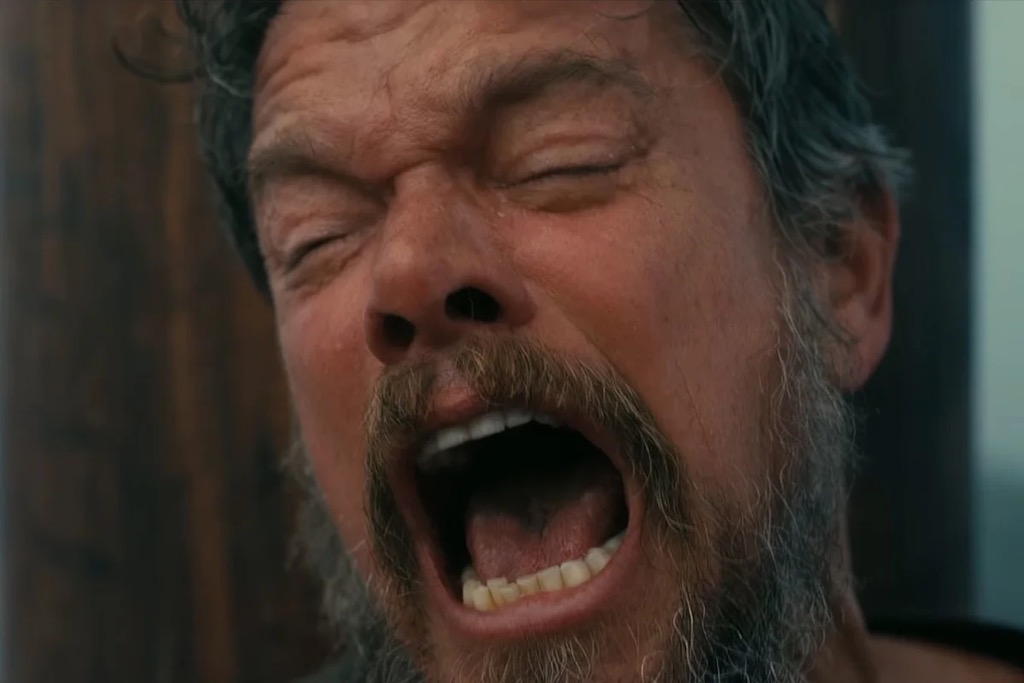
I didn’t like The Odyssey (2026) very much, and any objections to that take are going to fall on deaf ears.
Literally, since I saw it yesterday and my ears are still ringing. I honestly don’t understand why people are so eager to give bad audio a pass — I’ve even seen reviews praising it! — as if it were just like any other stylistic quirk of a well-known director. You know, Wes Anderson insists on fixed cameras and rigidly symmetrical shots, and Christopher Nolan makes movies that are so unbearably loud it’s physically painful to experience, and I always leave the theater feeling like I’ve been beaten up.
The whole point of my take is going to be that there’s no such thing as a single definitive, correct version of any piece of art. Still, I do think it’s a misstep for any version of The Odyssey to leave the audience thinking, “Man, I wish I were one of Odysseus’s crew! They had it so good!” And yet I’ve rarely been so envious of any movie characters as when they all got to use beeswax to plug up their ears.
To clarify that this isn’t just a grumpy old man talking: sitting next to me in the theater were two young women who were chatting with each other at full volume throughout the trailers and the opening of the movie. I thought, “Well, at least this is a Christopher Nolan movie, so it won’t be long until I’m unable to hear them.” That turned out to be true, but I glanced over during the Cyclops scene, and they both were wincing and had their hands over their ears. They walked out partway through that scene. I remained faithfully at my loom and awaited their return, but they never came back.
And a lot of the rest felt like it was exactly what I’d expect from a Christopher Nolan movie. I jumped ship after The Dark Knight Rises, and my reaction to The Odyssey is a lot like my reaction to that Batman trilogy. It seems almost obsessively committed to taking a fantastic, even absurd, story and presenting it in as grounded and serious way as possible.
There are tons of people who want exactly that. They want an adaptation or interpretation that shows proper respect to source material they love, and which does it justice. That’s not what I’m into, though. For me, it just drains the color and wonder and joy out of the story, undermining the sense of magic. And occasionally, since several of the Nolan movies I’ve seen have story elements that are patently absurd, it backfires.
The scene with the Trojan Horse seems less silly in context than it did in that extended teaser trailer from a few months ago. But I still had to chuckle when Menelaus calls Odysseus “the wisest of us all,” and then recounts the story of building the most impractical version of the Trojan Horse imaginable, clown-car stuffing a dozen men into it, getting them drowned when the tide comes in, stabbed when the Trojans test if it’s hollow, and flipped turned upside down when it’s hauled into the city. Because I guess putting wheels on it would’ve made it seem “silly” or “implausible.”
I would’ve been all set to complain that the Greek heroes at the center of the story are all played by the most Caucasian members of Nolan’s repertory company, but considering how the movie makes all of the Mediterranean look gray and overcast like the British Isles, it seemed somehow appropriate.
And I always imagined that the part of the story where Odysseus is held captive by Calypso takes place in some lush paradise; here, it just looks like he and Furiosa spent seven years living on a flotsam-covered beach, with even fewer luxuries than the crew of the SS Minnow.
But the other thing it has in common with every Nolan movie I’ve seen is that there’s at least one scene that is genuinely excellent. In The Odyssey, the first runner-up is the scene where Odysseus meets Sinon, Agamemnon, and the other shades on the outskirts of Hades. It’s where the more grounded approach really pays off. There are enough sinister and fantastic aspects, especially the character (Tiresias played by James Remar, I think?) half-emerged from the ground and covered with a black shroud. Contrasted with a kind of similar scene in The Return of the King, which was going for rousing high fantasy, it felt more in line with a mythology where the divine realms are physical places, and the gods regularly take human form.
The casting in that scene is excellent, too. Most notably Elliot Page as Sinon, who’s able to convey both youthful idealism and the rage of betrayal, at the same time as the cynical detachment of knowing that his story is already over. Even more surprising to me was a barely-visible-under-the-helmet Benny Safdie as Agamemnon. While the scene was playing out, I thought he was comically miscast: the voice of Just Some Random Guy coming out of this over-the-top bad-ass suit of armor. But after the movie was over, I started to suspect that may have been the point. This legendary hero was ultimately human.
But the best scene in the movie is the one where Circe changes Odysseus’s crew into pigs. It’s tense and genuinely horrific, and best of all novel and inventive. Even if you somehow don’t already know what’s going to happen, there’s a prolonged sense of something terrible approaching, just by how greedily and compulsively all the men are eating. As she goes around, matter-of-factly working her magic, it’s the one part of the entire movie where I felt like everything was working in concert: the devotion to “realism,” the cinematography that hints at spectacle more than delivers on it, even the sound design. Unlike the more magical transformations in some other movies, it’s prolonged and gruesome. And unlike the horrific transformations in something like An American Werewolf in London, it’s a much more hands-on process.
I was disappointed that the scene just kind of fizzles out after that. The conversation between Samantha Morton and Matt Damon is well-performed, and it’s shot as if it’s full of significance, but I didn’t get anything out of the dialogue, and Odysseus didn’t say or do anything particularly clever to resolve it. He basically just asked nicely, and she agreed. Which is perfectly fitting with the movie’s ideas of hospitality and civilization, of course, but doesn’t come across as dramatic or cinematic.
That part of the story is the only one I know well from The Odyssey, because I really enjoyed the book Circe by Madeline Miller. But I didn’t mind at all that it’s so abbreviated in the movie, seeming to take place over the course of a single day instead of having Odysseus spend a year on the island, because that didn’t fit into what this movie was trying to say. And that gets at what I liked most about Christopher Nolan’s version of The Odyssey: it’s very opinionated, it does try to say something, and it says it explicitly and repeatedly.
And the thing it’s absolutely not trying to say is “Here is the definitive version of The Odyssey.” That’s why I can be sitting here in view of my own copy of Robert Fagles’s translation, which I bought years ago with the best of intentions but have never read beyond the first page, and still declare that the strengths of this adaptation have little to do with how well they present the source material. You could say it’s because I’m a semi-literate rube with an American public school education — and again, I won’t be able to hear you — but I appreciated seeing a long, big-budget movie adaptation of one of the most classic pieces of Western literature that seemed so unconcerned with “getting it right.”
Basically, I like that one of the biggest movies of the summer is generating so many different, even contradictory, interpretations.
Not the bad faith ones, obviously. Those are just creeps with a fetish for getting yelled at, trying to ride the coattails of a marketing campaign to normalize backwards ideas and make people act like the most basic aspects of human decency are somehow “controversial.” I wish everybody had just ignored them, but I guess people can’t resist the siren song of Someone Saying Something Stupid On The Internet.
What I’m talking about are the people actually engaging with the movie and the mythology it’s based on. I’d been expecting to skip the movie in theaters (since IMAX screenings are all sold out for weeks) and wait until I could watch it at home, but I was swayed by various interpretations I saw online. It’s about American imperialism? Maybe I wasn’t giving the movie enough credit!
After seeing it, I’m not quite as impressed with some of the interpretations, because the movie isn’t very subtle about the ideas it’s trying to get across. But it definitely has ideas, and unlike other adaptations and “inspired by” versions of The Odyssey I’ve seen, it brings those ideas to the forefront, more than the obligation to be a comprehensive or even faithful adaptation.
In other words: as much as I enjoyed Circe, and how it brought an equally opinionated mindset and clear point of view to the material, it was also careful to structure its story to include as much of the original mythology as possible. It felt obligated — or at least, it felt as if Miller were enjoying the challenge — to fit everything into an existing classical continuity.
My other favorite adaptation, unsurprisingly, is O Brother, Where Art Thou? But the Coens use The Odyssey to make fun of themselves and their own pretentiousness, casting themselves as self-important Barton Finks trying to present the classics in a way that the Common Man can understand.
Nolan’s version cuts the parts that don’t fit with his overall message, or reinterprets others. The various vignettes feel included less out of an obligation to present The Odyssey to people, than to use the different elements of the story to pound home his ideas: about hospitality, honor, trust, responsibility, and respect being the foundations of civilization; and hubris, guilt, and regret being associated with its downfall.
So the seemingly unrelated adventures of Odysseus and his crew are actually one example after another of invading the homes of people, demanding resources and subservience. When people refuse to comply, they’re either violating “Zeus’s Law” of hospitality at best, or called monsters and witches at worst. The year that Circe spent treating Odysseus as a charming fixer-upper doesn’t fit into that story, so it was cut. Polyphemus being sentient and capable of being tricked by Odysseus doesn’t fit with that, so there’s no hint of it until the end of that story.
I don’t think it was done flawlessly by any means. The one that seems like an outright mis-step, as opposed to not just being to my preference, is the scene where the ship passes the sirens. I always thought that the only thing Christopher Nolan loved more than loudness was non-linear storytelling, and The Odyssey is largely told through flashbacks, stories, fragmented memories, and a meaningful reveal at the climax meant to tie everything together. But when the sirens appear, Odysseus gives no justification for being tied to the mast other than wanting to be the first man to hear their song and live.
In the moment, it only feels a little bit off, mostly because Matt Damon has the cockiness to sell it. But in both the movie’s timeline and Odysseus’s timeline, he’s already been shown over and over again that his self-aggrandizing arrogance gets him into trouble. He’s supposed to be a thoroughly haunted and shamed man by that point in the story, but it’s played as a cocky “Let’s give ’em a listen!” But the whole reason for the scene to exist in this movie is for his account at the end, where he describes longing and regret and the idea of wanting something so badly but knowing that you don’t deserve it.1At least, I think that’s what he was saying? For being so loud, I still couldn’t understand a significant chunk of the dialogue.
I think the even more interesting aspect of The Odyssey is the one that seems to directly contradict the core of the original: removing all of the gods. I wasn’t blown away by most of the dialogue in the movie, but I really liked Athena’s response to Odysseus’s claim that the gods don’t speak in ways that humans can understand: “Who doesn’t understand thunder? Fire? A child’s smile? A good harvest?” The basic idea is echoed throughout, especially in the scenes with Calypso, that all of these characters have more control over their actions and their fates than they like to admit.
They’re not separate ideas, since the frequent mention of “Zeus’s Law” is at the heart of it. Characters insist that the law is universal, and that everyone understands it: show hospitality to that poor beggar, since he might be a god in disguise. When someone reminds Antinous of this, he stops chewing the scenery just long enough to point out that this particular old man clearly isn’t a god.
I don’t know if everyone else picked up on the subtlety, but Antinous is supposed to read as a bad guy. His reaction shows how ritual and tradition (and by extension, modern organized religion) have taken the place of a genuine moral code: the reason to be hospitable to strangers is to avoid punishment from the gods, not simply because it’s the right thing to do. If there’s a codified set of rules, then there are loopholes and exploits, and ways to take advantage of people.
From my vague, half-remembered Cliffs Notes/Wikipedia understanding of Homer’s The Odyssey, that goes almost completely against the entirety of it. It’s all about the gods directly interfering and intervening in the lives of the characters, manipulating them, taking revenge on them, rescuing them at the last minute, or sending them to hell as punishment for a previous transgression. The idea of self-determination doesn’t even enter into it.
Which means that the audience’s appreciation of this movie has little to do with their familiarity with the source material. So even my read of the movie — as somebody who either forgot or never knew that Clytemnestra and Helen were two different people2And who still doesn’t quite get it, since again, I couldn’t make out a lot of the dialogue — is as valid as someone who is a foremost authority on it, and has likely forgotten more about the original stories than I ever knew.
I’m referring to the most notable part of the “hot takes” on the movie, where Emily Wilson, whose translations of The Odyssey and The Iliad have become some of the preeminent contemporary versions, wrote a pretty condescending review of the movie for The London Review of Books. She got a lot of praise and then a ton of flak for it, of the “who does she think she is?” variety. To her credit, she seems pretty good-natured about all of it. And that’s as it should be, since her take on the movie, which I largely disagree with, doesn’t have a ton to do with her take on the source material, which I have absolutely no place agreeing or disagreeing with.
She herself distances her own work from the movie, even though it had been cited as a major inspiration for the movie. And that’s also as it should be, even though the idea gets kind of lost as she’s dismissing it as shallow blockbuster entertainment. I’ve seen a few responses to all of this that say everybody needs to back off and be more respectful to her, because the act of translating a work requires not just transliterating it, but understanding it line by line. Knowing how to make the jump not just between languages, but between its original context and its current one.
I say everybody should back off and be more respectful, but not because she’s the translator, but just because it’s the right thing to do. (Which is kind of like using “Zeus’s Law” as justification for hospitality instead of just “being a decent person.”) And especially because a translation and an adaptation are very different things. A translation is obliged to convey as much as possible of the original, the spirit and intent of the story as much as the story itself. There is a standard of “accuracy” there.
But adaptations aren’t obliged to be “accurate.” So in a weird way, The Odyssey is kind of a companion piece to “Wuthering Heights”. A depressing number of reactions to that movie were of the gatekeeping variety, insisting that Emerald Fennell didn’t understand the original, refusing to acknowledge that the movie was trying to do something different than present a cinematic translation of the original.
I’ve seen a lot of takes on Christopher Nolan’s The Odyssey that start by establishing their bona fides.3Pronounced, of course, like Penny does in O Brother, Where Art Thou? As if an academic familiarity with the classics makes someone more qualified to have an opinion about a work that’s not presented in an academic context. I’m happy whenever a piece of popular entertainment makes people talk about what it said to them, or how it made them feel, instead of whether they got the correct answer.
The Odyssey didn’t make me feel much of anything, but I did like its ideas. And as critical as I am of the self-seriousness of Christopher Nolan and the often over-the-top praise of his fans, I like that he’s built a team of people who like collaborating with him, and I like that he’s interested in popular entertainment that makes audiences think. I’ve tried hard to detect any sign of condescension in his movies, the sense that he feels like he’s got deep ideas that he’s trying to communicate in a way that the uncultured masses might understand, and I just can’t see it. I get the sense he understands that you can still say something without having to give the last word on it.

Comments
One response to “One Thing I Like About The Odyssey”
Somewhere between Interstellar and Tenet I decided that I was never going to try to watch a Nolan movie without subtitles and preferably a volume knob. I think he must be deaf/hard-of-hearing the way he wants the sound mixed.
It’s incredible to me how terribly loud The Odyssey is. At the cinema I have been frequenting I have found the sound from it travels two houses over. Both houses have decent (but sure, not great) soundproofing. I was trying to watch the rather quiet The Invite and getting distracted by the wall of noise from The Oddysey.
I was also complaining about how loud it had gotten while I was in the bathroom and thinking it was one of the houses to either side of the bathroom, but the hallway was even worse and it was the house on the other side of the hallway from the bathroom. Both doors were closed on that house, too. That has to be ear damage levels of sound inside the house.
So maybe someday I’ll catch it on streaming or find a open captions showing on a day I remember ear plugs.