A side effect of watching Damian Mc Carthy’s first three feature films back to back — Caveat, Oddity, and now Hokum — is that it makes it all but impossible to avoid seeing recurring ideas and patterns.
That’s not entirely a good thing. Not every artist’s work is intended to be taken as a companion set, and it’s reductive to keep expecting them to iterate on the same thing over and over again. But in this case, it’s turned me into a big fan of Mc Carthy. He’s already one of my favorite filmmakers working in horror, and I’m already looking forward to seeing whatever he comes up with next.
Hokum is my least favorite of the three, but it’s still solid and a lot of fun. It’s got a visibly bigger budget, for one thing. It also attracted Adam Scott to be the lead; apparently, he was already a fan of Oddity. I like seeing a filmmaker having more power to make what he wants, but it also feels as if some of the charm of the earlier movies has been sucked out of this one. It feels overall bigger and louder, without as much sense of filmmakers making creative use out of limited resources.
The movie is about a successful author named Ohm Bauman (played by Scott) who travels to a hotel in the west of Ireland for the purpose of scattering the ashes of his parents. They’d spent a memorable vacation there, and a photograph of his mother from the woods nearby is the only relic he has of her being happy.
It takes some time for us to learn one other detail that’s not immediately evident from the premise: Bauman is an asshole. He’s rude, arrogant, bitter, condescending, pushy, and just really awful to be around. Knowing nothing apart from “an American in Ireland,” we’re already expecting a story about a skeptical outsider being dismissive of the superstitious locals and their corny old folklore. I hadn’t been expecting our protagonist to be so unsympathetic from the start.
Saying literally anything more about the story would spoil it, though. But instead, I can call out all the recurring ideas and images from Mc Carthy’s movies that make them feel like such an interesting and original take on modern horror.
The most evident is the cinematography. These movies use pitch blackness for maximum effect, usually shot with a single light source, just enough to suggest all of the dreadful things that are lurking just outside the boundary of what we can see. And just enough to give multiple opportunities for jump scares, and these movies never shy away from a jump scare. Dark figures just barely visible in the distance, or faces just barely appearing from the darkness.
Also there’s the impeccable art direction. We rarely see any architecture or technology newer than from the 1980s, and even 20th century buildings seem old just by virtue of the land itself being so old. All of them are packed full of artifacts, each and every one of them almost certainly cursed. These movies lean hard into the idea of Ireland as a place with not centuries but millennia of history and folklore.
The movies look so great, and they’re so masterfully edited, that it creates this dissonance with the plot and story that I actually enjoy a lot. I compared Oddity to Tales from the Crypt, and Caveat to Halloween haunted house mazes, as a welcome change from the recent trend of “elevated horror” that forgets to be fun. The ghosts and other supernatural elements in these movies aren’t metaphors for grief, or family dysfunction, or loss of innocence. They’re ghosts. As a result, they don’t feel like being put through an emotional or psychological ringer; they’re like hearing a good, old-fashioned, twisty ghost story.
Hokum works best when it feels like a Halloween haunted house, and there’s a lot of that. But it does also try to take us through an emotional ringer along with our protagonist, as Bauman works through his childhood trauma. I hate making a condescending “stay in your lane” criticism, faulting a storyteller for being interested in character development, but I felt like this aspect of the story was a little too heavy-handed. Mc Carthy’s scripts already explicitly repeat ideas that have already become evident to the audience, but it hasn’t bugged me because it feels like punctuation instead of revelation. In Hokum, Bauman’s character arc veered into the realm of feeling like it was banging me over the head with an idea that would’ve been more powerful if it had been more subtle.
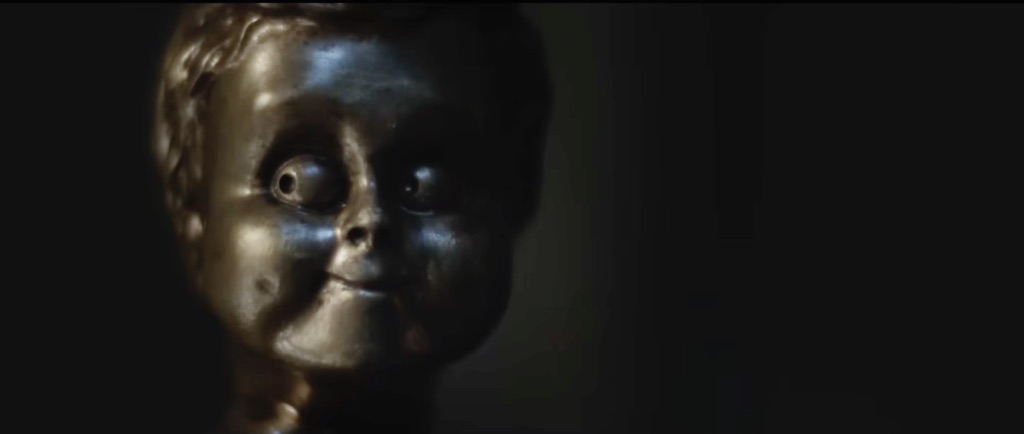
Back to the recurring idea of cursed artifacts: my favorite thing in Hokum is a clock. There’s an antique clock that becomes significant to the story later on, with a metal figurine on top that periodically rings a bell. The figure is a small, cherubic boy with a mischievous expression, and the movie makes as much use of this thing as possible, like using every single part of the buffalo.
In the middle of tense and horrific scenes, the movie will cut to a close-up of this figure, with its “wait for it…” expression, and it leaves absolutely no question that this clock is screwing with all of us. There’s a pretty great interview with Mc Carthy from Collider [with spoilers!], where he explains that they made special larger versions of the existing figure, both so that they could change the face’s expression, and so that they could do extreme close-ups. And to me, it’s absolutely money well spent, the perfect example of how going to the extra effort of getting the details exactly right ends up having a huge payoff.
A different scene I loved, but with a related idea: Bauman meets Jerry, a big-bearded drifter living in a caravan in the woods outside the hotel. At one point, Jerry is describing a time he encountered a ghost in the hotel. As always happens in Hokum when a character is telling a story, the movie cuts to a flashback to show the scene play out, with no voice-over. His story ends with a sighting of a ghost in a creepy pose, and right as it cuts back to Jerry, he’s making the same pose with the same expression on his face.
Hokum isn’t comedy horror, but it is funny in a way that horror movies usually aren’t. It’s definitely not Sam Raimi-style over the top, it’s not black humor, and it’s not even like Final Destination Bloodlines, where the most gruesome moments and the funniest moments align perfectly. With Hokum, and Oddity, and to a lesser extent Caveat, they seem funny simply because the movies are most interested in being fun.
It feels like it comes from confidence. They know that they can execute on the scary moments, so they’re not at all scared of leaning into the perfectly goofy moment or bizarre non-sequitur. Horror is inherently full of absurd details, and it’s fun to see movies that acknowledge that they’re absurd, all without undermining their scariness. I’d been worried that Hokum would be the one where they started winking at the camera, but thankfully, there’s none of that.
And ultimately, it feels like it’s building on a long tradition of classic ghost stories and supernatural folklore, without feeling like an uninspired pastiche, without feeling like a dated B-movie, and without being too precious about it. Realizing that you can apply accomplished, artful storytelling to good old-fashioned stories, and have a lot of fun just scaring the crap out of audiences.