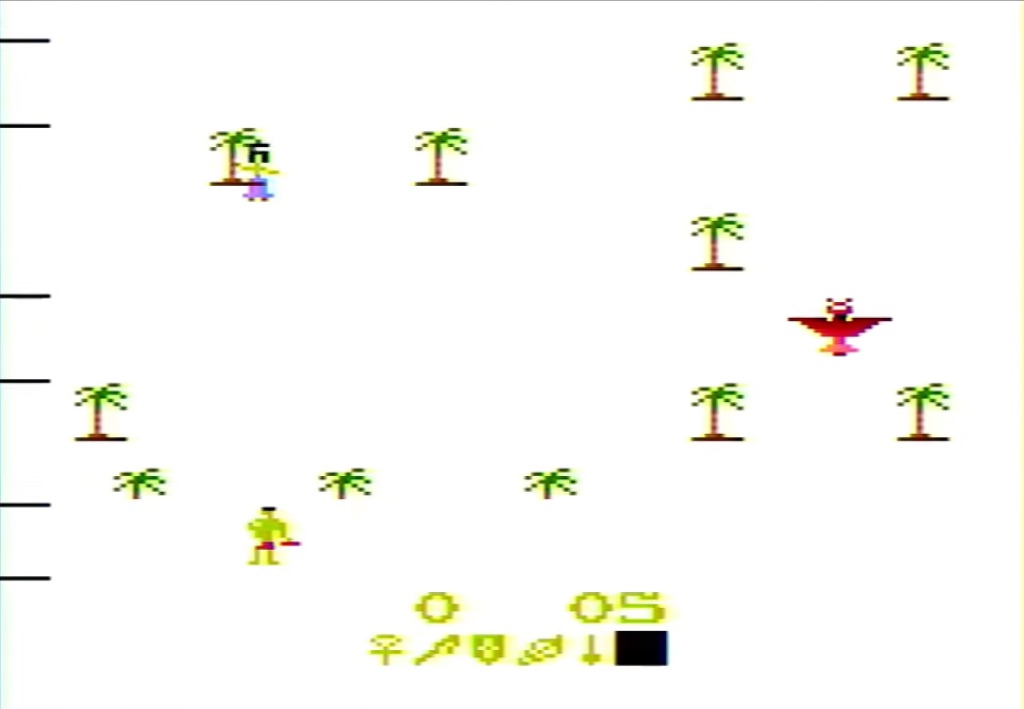
The featured image for this post (as well as the reminder to write it) is from the Riddle of the Sphinx retrospective video on the Atari Archive YouTube channel.
For years, I’ve been remembering Uninvited as the first adventure game I ever really got into. The Infocom text adventures have always been games that I want to like, but I’ve always bounced off them due to my lack of patience. It wasn’t until they started adding pictures that the genre really took off for me.
But a video about Riddle of the Sphinx, by Bob Smith for Imagic and released in 1982 for the Atari 2600, reminded me that I was completely obsessed with that game for a pretty long stretch. I’m still not certain whether I ever completed it in its most difficult puzzle mode, but my memory is that it had such a hold over me that I wouldn’t have been able to rest until I’d won.
The game is presented like a vertical shooter, where you’re traveling through the desert throwing rocks at scorpions and bandits. (I doubt I would ever have made the connection to River Raid if that video hadn’t pointed it out). Along the way, you’re searching for treasures to give as offerings to Isis, Anubis, or the temple of Ra.
One of the elements of the game design that seemed ground-breaking at the time was that some of the treasures had dual uses. One of the treasures let you run quickly through the desert, for instance, so you had to think about whether to use it as an offering or save it to help you find the other treasures. It’s a simple concept in retrospect, but at the time, my brain was locked into the idea of either “power-ups” or “key items” and had never thought of them acting as both.
The reality of being a kid in the Atari 2600 age meant that you were always having to manage disappointment. The covers always suggested these grand adventures and experiences that would transport you to other worlds; the reality was often you moving a single dot around a black screen while pursued by a sea horse.1People like to make fun of the “dragon” in Adventure a lot, but I’m here to say that they don’t make fun of it enough. Pitfall was a very simple and honestly tedious game in retrospect, but part of the reason it became such a huge hit was just because it actually looked like what it claimed to be.
I remember Imagic also being my first exposure to the kind of community-building (and brand loyalty-building) stuff that would later be such a huge part of the appeal of LucasArts. I was a proud member of Imagic’s “Numb Thumb club” and am pretty sure I wrote at least one fan letter, even if I didn’t submit an entry to solve the actual Riddle of the Sphinx. One of the many things I liked about the early days of Telltale was that devotion to building up a community of fans.
Even though Riddle of the Sphinx mostly faded from my memory, it was likely planting ideas for what games could do, years before I’d consciously get it. It was more ambitious than most 2600 games at the time, and it rewarded some level of decision-making and puzzle-solving while still being pretty fun as a more straightforward shooter.
It wasn’t until I played Half-Life 2 that I finally appreciated that games could be fun and be engaging as stories and puzzles. You didn’t have to choose one or the other. Maybe if I’d been paying more attention in 1982, I would’ve caught on a lot sooner.