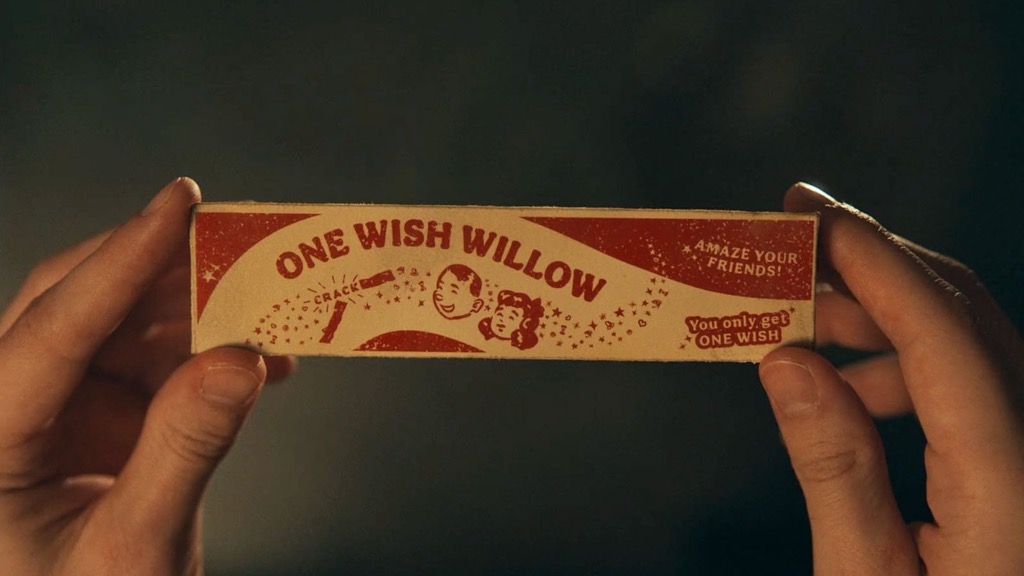
I didn’t get enough out of Obsession to want to do a deep dive on it1But obviously, that’s never stopped me before, but there was something interesting in the other reactions I saw to the movie:
I’d thought that the movie was pretty unambiguous in what it had to say. But I read several reviews that I completely disagree with — even ones that I think are directly contradicted by what’s in the movie — and still, I thought, “Sure, that’s fair.”
Because the movie’s all about a woman losing her autonomy, agency, and even personality, and a “nice guy” who not only caused that, but took advantage of it. Whether you think the movie is commenting on that and condemning it, or just perpetuating it, the takeaway at the end is the same: that’s hell of gross and horrific.
If there’s going to be discourse around this movie, I’m glad that it’s “this is gross” vs “this is gross, and they were completely aware of how gross it is.” Instead of the alternative, which is “male fantasies about ‘romance’ are often actually about robbing women of their autonomy and replacing their identity with a fantasy version that exists simply to serve their own desires,” vs “bitches be crazy sometimes am I right?”
“I’m Not Going to Be Ignored”
Part of why I assumed that of course I knew exactly what Obsession was intending to say was because we’ve already had a very famous “bitches be crazy sometimes” movie from the late 1980s, called Fatal Attraction.
It’d be absurd and infantilizing to say that nobody recognized the problems with Fatal Attraction when it came out, or to hand-wave that away with “it was a different time” or some such. I was still a teenager at the time, but even I could recognize that it was meant to be little more than a steamy, lurid, thriller. Something meant to further Michael Douglas as a leading man, and to give Glenn Close a villainous role to sink her teeth into. Pointing out how it’s so steeped in misogyny, enforcing gender roles, and punishing women for men’s failures that it reads like conservative propaganda wouldn’t have been wrong, just over-thinking it.
But I assumed that in the years since then, if it gets mentioned at all, it’s always with the understanding that that shit is messed up. Douglas is presented not just as the protagonist but the victim, Close as the undisputed villain, and Anne Archer as The Good Wife and mom threatened by this insane home-wrecker.
Until I read a plot recap just now, I’d completely forgotten that she’s the one who delivers the final blow, not Douglas’s character. That adds a whole additional layer of gross moralizing that I’d forgotten: even though his adultery put her and her child in danger, it’s her duty as a good wife to stand by her man. I’m likely giving teenage me too much credit, but I remember that while watching it, I wanted the wife to wait and let him get stabbed a whole lot more before she came in to wrap things up.
The key idea of Fatal Attraction is that it’s a warning to men: stay straight and keep it in your pants, because you never know when some batshit crazy woman is going to misinterpret your perfectly natural urges as something meaningful. It’s a story from the man’s point of view, and it presents its women as having little to no agency beyond how they interact with the man. Even Close’s character’s suicide attempt is framed as a plea for attention and attempt to manipulate him. It’s meant to be read as a harrowing account of a flawed but sympathetic, normal guy who’s punished way out of proportion for a single indiscretion.
Even though it’s been almost forty years (!) since I saw Fatal Attraction, I’ve got no hesitation declaring that that’s all it was, without doing due diligence with a re-watch. Its value now is pretty much entirely as a cultural artifact of the Reagan era, and even at the time, it was more parody-able than shocking. To this day, if I’m walking around the kitchen with a knife, I’ll sometimes grip it menacingly and say “I’m not going to be ignored,” you know, for yuks. It’s difficult to describe just how ubiquitous the movie and its trailer were for a while. I always thought of it as something that everyone was familiar with and didn’t take all that seriously beyond a shrug and “The 80s, huh?!”
I was either unaware or had forgotten that it had been remade a few years ago, not just as a movie but as a limited-run series? Even with the always-great Lizzy Caplan involved, I still have no interest in seeing it, because it sure looks like it’s just an attempt to slather 21st century values on a core of pure 80s cheese. Not just cheese in the sense of being a disposable thriller, but cheese in the sense that it’s aged so poorly that you can’t cover up the stink. Maybe if we show the male lead suffering some consequences, it won’t feel so rotten?
Back to the main topic of this post: I’m also completely unconcerned about and uninterested in figuring out the authorial intent of Fatal Attraction. I’m skeptical that the filmmakers deliberately intended to make a proto-Men’s Rights Activist movie, and think it’s more plausible that all the gross ideas driving the movie were just part of the background radiation of the 80s. There was so much overt conservative misogyny during the Reagan era that searching for the latent kind seems beside the point. For all I know, there were critics at the time praising the movie for having the audacity to present Close’s character as a single woman who was unashamedly sexually active.
But the movie itself has no hint of self-awareness, or any inkling that it’s making any kind of subversive commentary on what it depicts. Just the act of turning a sexy thriller into a warning for men was probably considered subversive enough.
The New Power Generation
All of that is the context for my assumptions going into Obsession. This is a movie by former film students, of course they’re plenty familiar with Fatal Attraction. And by extension, they’ve got to be familiar with the modern consensus on that movie and movies like it.
And it establishes from the start that this is not Fatal Attraction. The main character isn’t depicted as a suave man-about-town but an awkward guy so timid about saying how he feels that he has to practice on a stranger. His “friend” is a guy in his mid-20s with a backwards ball cap and what is now known as “an extremely punchable face.” Later, we see that his relationship with Nikki is one of long-time friends, and it’s about as far from a seduction as you could imagine. She even asks him point blank “do you like me,” and he still can’t rise to the opportunity and say how he feels. The movie seems to be going out of its way to establish that our protagonist has got no game.
If anything, it felt more like a horror version of Swingers, although Obsession has no scenes that are as horrifying as the answering machine scene in that movie.
Primed for the idea that it’s subverting movie cliches — especially after a short montage showing the happy moments from early in Bear and Nikki’s post-wish relationship — I started looking for signals that it was referencing male-centric romantic comedies of the 80s and 90s. Movies that, like Fatal Attraction, were based on gross ideas about young men pining for the woman of their dreams instead of the real woman who’s actually right there, but always presented its protagonists as if they were romantic. Often starring John Cusack or the equivalent.
So having all of that in mind, I thought it was obvious what the movie was intending to say. Especially after the scene where Bear’s “friend” Ian suspects he took advantage of Nikki while under the influence, calls him out on it, and they both agree that would’ve been unforgivable. “The kids are all right,” I thought, “and they just innately understand the importance of consent and bodily autonomy in a way that many people of my generation had to be taught.”
But that’s the other thing that was on the forefront of my mind: this movie made me feel old. More and more often, I’m seeing movies that feel very much like they were not at all made for me. With Obsession, it wasn’t as intense as, say, Bodies Bodies Bodies, but I still somehow felt even less targeted than when I’ve watched an episode of Showtime at the Apollo. It’s not openly hostile to Gen Xers — it even lets us point and say “hey look, it’s Andy Richter!” — but it did feel as if the thought of someone my age possibly being in the audience never once crossed anyone’s mind as anything they should be concerned about. Meaning that I didn’t actually relate to any of the characters in the movie beyond a vague awareness of “Like me, these people are also white or mostly-white Americans.”
Which means that they’re not drawing from the same well of references as I was, which in retrospect, should’ve been obvious. Few 26-year-olds are rubbing their hands together at the prospect of subverting a thriller that’s now almost forty (!) years old, or a bunch of mostly-forgettable romantic comedies that were made before they were born.
And that means that the authorial intent, which I’d assumed was obvious and unambiguous, was unavoidably pulling in assumptions that I’d already made, before I even sat down in the theater. Stuff that I’d thought was clearly intentional was, in fact, my own interpretation.
Wish You Were Different
None of that really changes my impression of the movie. If I were to rewrite my “One Thing I Like” post again for some reason, it’d be mostly identical. I’d just change parts that sounded like “the movie clearly says this” to more explicitly say “I think the movie says this.”2Which should always be the default assumption, anyway, for any take on a movie that’s not just recounting things that happen in the plot.
It has changed my impression of a lot of other people’s takes on the movie, though. I was reading some of them thinking, “How could you possibly think that?” (accusatory), whereas now it’s “How could you possibly think that?” (curious). I can and do still think that there’s plenty of evidence to support my take. But it would be interesting to look at the reviews calling out all of the objectionable stuff depicted in Obsession, and figuring out how the movie might have felt ambiguous, if you didn’t go in with the same set of assumptions that I did. Otherwise, the reviews just feel like someone watching a slasher movie, describing all of the murder scenes, and giving the movie one-half star because of its pro-murder stance.
That might be an interesting exercise for somebody else to do, though, since again, I didn’t get all that much out of Obsession.
There are a couple of ideas that I do want to reconsider, though, which were brought up in critical reviews, or brief snippets of interviews with the cast and filmmakers. And they’re all about sympathy and culpability.
In a clip of an interview with Inde Navarrette, the actor who played Nikki, she mentioned that the direction for the early stages of the post-wish relationship was to play her as fiercely codependent. I’m inferring that was mostly to be distinct from going right to “demonic,” but it still raised a red flag for me, suggesting that my interpretation and the intent may not have been exactly the same.
I’d been assuming that from the start, the movie was making it clear that Bear’s selfish wish had robbed her of both her agency and her personality. “Codependent” implies someone giving up their personality to a relationship, not having it robbed from them. The end result is the same — and to be clear, I think it was 100% the right way to go, to stress that Bear really is getting exactly what he wished for — but it slightly lets Bear off the hook by making him seem more sympathetic. It makes it feel more like a relationship that got too intense, instead of a violation from the start.
I think core to the whole idea of the “corrupted wish” story, whether it’s from a Monkey’s Paw or a freed Genie or whatever, is that it’s taking advantage of a sympathetic protagonist who had good intentions, but didn’t fully understand all of the implications. So I thought one of the clever things about Obsession was how it subverted that. I thought it illustrated that Bear’s wish was never actually well-intentioned; it was entirely selfish.
Even if he didn’t believe it at all, and even if he just said it in the spur of the moment, the wish was his saying how he really felt: he wanted her to love him more than anyone else in the world. Not even “love me the same way I love her.” And sure as hell not “I wish I weren’t such a dipshit and could tell this woman how I feel about her.” Because the movie front-loads a lot of stuff designed to make you feel sympathetic for Bear, but it also drives home the idea that he’s annoyingly timid and insecure.
It never even seems to occur to him that he should improve himself. He wishes for her to change, which is strike one, and he wishes for her to love him more than anyone else, which is like wanting ownership.
And the reason I liked the smash cut to the two of them having sex3So, I guess, literally a smash cut was because I thought it was the movie unequivocally declaring that Bear was the villain. Even if you’d stayed sympathetic up to this point, and you thought he was just childishly or impulsively blurting out something he never really believed in, by that point in the story, there was no denying that he realized that something was wrong. But he still chose to take advantage of it.
Die Harder
And that question of sympathy and blame is the other thing I kept seeing pop up over and over in reviews. Even positive ones still said that Bear was presented as mostly sympathetic, that he was a stereotypical “nice guy,” and that his worst flaw was not having courage. And the extremely negative reviews declared that the movie was on Bear’s side all along, that it treated him as a good guy who was punished for inadvertently making a wish he didn’t believe would come true, and that the horror of the movie was all just an extreme version of how women get crazy and clingy in relationships.
One idea I saw come up repeatedly was that the wrong characters got punished. The most extreme violence in the movie happens to women, by far: the extremely gory murder of Bear’s friend Sarah, and Nikki’s disturbing self-neglect and then later sudden and violent self-harm. By comparison, Bear’s “friend” Ian gets unceremoniously shot and dies instantly, and Bear himself dies from poison. Nikki survives, but only technically.
It’s interesting because I thought it was the only case of Obsession leaving something up to interpretation. And my interpretation was that it was driving its main point home even harder: women always have to suffer the repercussions of men’s failures.
However much you think the men in Obsession are or aren’t sympathetic, the one thing that’s undeniable is that the women are blameless. I read a review claiming that the movie didn’t do enough to establish Nikki as an interesting character before her transformation, to show the difference, which is something I completely disagree with. But it’s clear that she did nothing wrong, not even any of the completely blameless things that real-world men try to spin into making it the woman’s fault.
To me, it’s what made the movie feel at all relevant as a horror story: there are all kinds of cases of injustice in the real world where male sexual offenders are given a pass or let off easy “because one ‘mistake’ shouldn’t ruin someone’s entire life,” with zero thought given to how their victims’ lives have been ruined.
Obsession gives Sarah the most gruesome and violent treatment, which I read as more or less inevitable, since male-oriented stories always pit women against each other, often in competition for a man. I’ve read several complaints about the later scene, which does Sarah an even greater indignity by having Nikki put her nude body on display in a chair, and I totally agree that it was excessive and unnecessary, and it felt clumsy for being driven by shock value alone.
But it did still feel like there was a bit of thematic intent there. The conversation between Bear and Sarah in the car felt reminiscent of act 3 moments in “romantic” movies, where the “hero” who’s been pining for his dream girl finally realizes that the perfect girl for him has been right there in front of him, the whole time. While I was watching it, even knowing that it’s a horror movie going for shock value, so of course something terrible is about to happen, the part of my lizard-brain that lights up when subjected to movie tropes started thinking, “maybe these two will find a happy ending after all!”
So in Obsession, even though I thought Nikki’s display of Sarah’s body was excessive, I did read it as ripping away the last part of the illusion that there was ever anything actually romantic about stories about men pining over their unrequited love, and the true connection that had been hiding in plain sight. It lays bare the base truth hiding underneath all the self-serving romantic language: he’d been horny, he wanted exclusive ownership over one of his friends, and when she got to be too much to handle, the other one is The Backup.
Meanwhile, Ian has been intentionally deceiving his “friend” Bear the whole time. Not only did he never reveal that he and Nikki had been hooking up for a while, but while knowing this, he actually discouraged Bear from saying anything, told him to wait, and encouraged him to doubt himself and second-guess himself. He deserves the least sympathy of any of the main characters. So when Nikki casually shoots him dead, I thought he was getting exactly the amount of sympathy he deserved.
And finally, Bear’s timidity is what started the whole thing. So I thought it made perfect sense that we see him trying to kill himself with the gun, and even at his lowest point, he’s unable to follow through. He goes for the option that he thinks will be the least violent and painful for himself.
And you could see Nikki’s final wish coming from a mile away, since it’s the most obvious punchline for the whole story. You could read it as nothing more than the final irony a story like this needs, you could read it as Bear getting a happy ending he didn’t deserve, or you could read it as underlining the idea that turning a person into your fantasy of them destroys that person.
While doing image searches for these posts, one of the “key” images that shows up is that shot of Bear in the bathroom looking completely traumatized, with the word “Obsession” overlaid. I like that it makes the title a little ambiguous. Obviously, the premise is about a wish for love that turns into obsession. But I prefer the implication that what he’d been thinking of as love, or even an intense crush, was actually the obsession.
Okay, Gang, Let’s See Who The Real Villain Is!
At least, that’s how I interpreted the ending. So much for not wanting to do a deep dive into a movie that I didn’t think was that deep.
In any case, I still think the most interesting part is stepping back and reconsidering how many of my assumptions about intent were actually just my own confident interpretation. And whether or not knowing intent is key to “understanding” a movie in the first place.
Last year, Together was another movie that queasily combined romantic comedy and horror, and while I thought its metaphors were pretty clear, its authorial intent wasn’t. I read opinions that saw it as being about a condemnation of losing your identity to codependency, while I thought the resolution was almost sweet. Together didn’t seem to have a particularly strong opinion about how you were supposed to interpret it, though.
But again, Obsession doesn’t invite the same type of open interpretation. Based on the reactions I’ve seen, you either think that it’s a brilliant commentary on toxic ideas, it’s an okay movie with some interesting things to say about toxic ideas, it fails to communicate what it’s saying about toxic ideas, or it’s just toxic. And again, I think the part that matters is that everybody agrees that the ideas are toxic.
It’s actually surprising to see myself not getting that worked up about the “reality” of intent, since I’m usually all about that. I definitely don’t think the artist’s intent is the only meaning in a piece of art, or even the main source of truth. But I do believe pretty strongly that usually, it should be an essential part of your interpretation, and you should gauge the success of the work based on how well it delivers on its intent. Otherwise, it stops being a conversation.
And go too far in that direction, and every movie becomes an opportunity to catch a filmmaker unwittingly telling on themselves. This is what the movie is actually saying! My visceral reaction to some of the negative reviews about Obsession wasn’t about defending the movie or its writer/director4I want to see creative people succeed, but also I can’t get that invested in defending a 26-year-old who’s already got multiple movie and TV deals and wears sunglasses to every interview and photo shoot, apologies if it turns out to be because of an eye injury or something that’s none of my business, so much as having such an antagonistic relationship with a movie that they’d never even considered that they might have misinterpreted or misread something.
But maybe the most interesting thing to me about Obsession is how it’s made me reconsider how necessary it is to have a “source of truth” in a piece of fiction in the first place. Especially in horror, where it’s baked into the entire premise that it’s not intended to be an endorsement for what it’s showing. And when you’re at the point where you’re considering whether a character’s violent death was gruesome or violent enough to feel “satisfying,” are you still even talking about morality?
I had no problem accepting from the start that the character of Bear was the villain, and Ian was an asshole, and that the actors were deliberately playing them as such. For that matter, I imagine that Glenn Close was delighted to get to play a villain in Fatal Attraction, even though she’s presumably not that murderous in real life.
If we can distinguish between a fictional character and the person playing them, why should we insist that the director or screenwriter of a piece of fiction is endorsing everything depicted in it, unless we’re clearly shown otherwise? After all, we rarely know the true authorial intent anyway, especially now that director’s commentaries are uncommon. So the idea of a distinction between intent and interpretation is kind of a false one, anyway. It’s still “here’s what I think was the intent,” and “here’s what I think that means.”
One of my main reactions to Obsession was that I was more critical than I’d otherwise be of a debut feature, because it felt so confident. Part of the confidence is that it doesn’t seem all that concerned with what you think of it. It doesn’t seem like it needs you to know that they get it, as long as you get it.