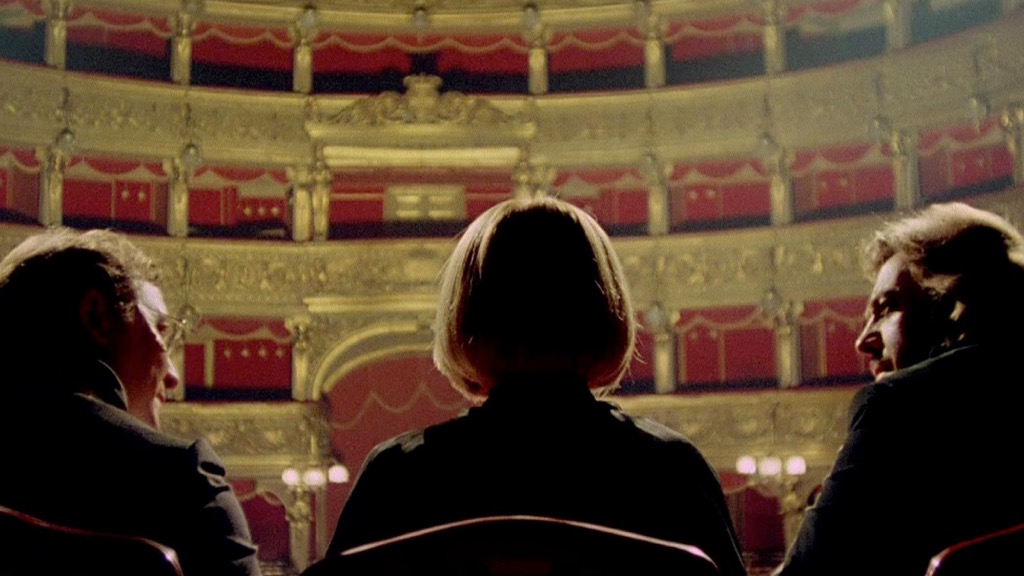
I’m fully prepared to acknowledge that you have to be in the right frame of mind to watch Dario Argento’s Profondo Rosso, or Deep Red. I can absolutely recognize what other people see in it. I can imagine that it might’ve lived up to my high expectations if I’d watched it at a different time. I went in fully prepared to enjoy a lurid suspense thriller with all of the elements I love in Suspiria: bold colors, striking visuals, surreal and dream-like story, and absolutely phenomenal music.
And at the start, Deep Red seems like it’s going to deliver. It opens in a grand theater, and the camera moves through the lobby, past a few bored Italian men who’ve stepped out for a minute, and through huge deep red curtains to reveal a packed house watching three people alone at a table on a stage. A man with the most perfect mid-70s prog rock hair is explaining how it’s established science that many species use telepathy to communicate: butterflies, termites, and zebras. But it rarely exists in humans beyond childhood, with few rare exceptions. Like our guest, Mrs. Helga Ullman of Lithuania.
After a short demonstration of her telepathic talents, Mrs. Ullman is overcome by the thoughts of someone in the audience. The horrific, perverted thoughts of a murderer! After the panel concludes, she confides in her host that she saw enough to know the name of the murderer, just loudly enough for anyone still lurking in the theater to hear.
It’s all pretty great stuff. Melodramatic and weird, with an earnest suggestion of the paranormal, immediately dropping you into a world where everything is surreal and all the colors are turned up to maximum saturation.
I especially appreciated the details that went into a brief interlude, where we have the POV of the murderer inside the theater’s washroom. It’s all white tiled but dirty — not suggesting squalor so much as the idea that everything in Rome is impossibly ancient.1In retrospect, it had to be at least subconscious inspiration for the bathroom in Saw. The killer looks into a rusted mirror which completely obscures their face; there’s only enough to suggest that you’re seeing things through their eyes. And a man asking them whether they need help is standing just outside the toilets, with nothing on the white walls besides the men’s/women’s icons on a sign, reminding you that we don’t yet even know the killer’s gender. They could be anyone!
It felt like everything working together in concert. But the rest of the movie never really lives up to that. It’s a lot of moments of brilliant imagery, or striking set design, or surreal intrigue, or a gruesome murder, or an imaginative composition or camera movement, that made me wish it were working in conjunction with everything else instead of just standing out as style for its own sake.
The bulk of the story centers on David Hemmings as Marcus, an English engineer living in Rome, who witnesses the (ending of the) murder of his neighbor while coming home one night. When a tenacious young female reporter photographs him with the police at the crime scene, she publishes his photo in the paper as the only eyewitness. This marks him as a target for the killer, so he sets off on his own to piece together the clues and solve the murder.
I said “on his own” even though the reporter (played by Daria Nicolodi, who became Argento’s partner and screenwriting collaborator after this movie) is also on the case, because I watched an edited version of Deep Red on Kanopy. As I understand it, the full version has at least 20 minutes more footage, largely building up the relationship between Hemmings’s and Nicolodi’s characters. I consider it a merciful cut, since I don’t miss the romance subplot a single bit.
The actors have zero chemistry, and the remaining suggestions of their budding romance feel awkward and out of place. I normally wouldn’t have said “young female reporter,” if not for the fact that there’s an overlong scene with clumsily-written “banter” between her and Marcus establishing her as a modern, independent woman, and him as an ostensibly charming male chauvinist. It ends with them arm wrestling.
Over the past couple of weeks, I’ve watched a string of movies that more or less demand that I watch them in the proper context and appreciate them for their strengths, and turn off the part of my brain that dismisses anything that doesn’t conform to my own tastes in scriptwriting or storytelling. So it’s possible that my brain had finally had enough, and it simply stopped tolerating anything that wasn’t a conventional movie.
As the best example: in what might be Deep Red‘s most well-known scene2It’s the only scene in the movie that I’d seen stills of, and I’d heard it obliquely mentioned when people talk about the Saw franchise, someone is alone at home when they suspect that actually, they’re not alone at home, and after a lengthy build-up of suspense, they’re surprised by the sudden appearance of an extremely creepy mechanical puppet.
All of the components are there, and they’re pretty fantastic. Everything is shot and composed perfectly for maximum effect. The idea itself is great, as it works as a jump scare, but also lingers as unsettling since it’s so weird and creepy. It should have worked perfectly on me, and been the scene that won me over. But instead, I just kept thinking, “that makes absolutely no sense.” There’s just no plausible in-story explanation of how it was set up to happen, and thematically, it doesn’t even tie in with the killer’s usual schtick. It could’ve been a great scene in a different movie, but here, it just felt so out of place that I was taken out of it before the scene had even ended.
And Deep Red is full of moments like that. Scenes where it seems like everything is coming together and becoming something truly great, but it never quite coalesces.
There’s a sequence where Marcus is at home alone playing his piano when he suspects that someone is in the house with him. We get lots of close-up shots of the inner workings of the piano, his fingers on the keys, and suddenly, bits of plaster dust falling onto the piano from the ceiling. As the tension builds, and the telltale recording of creepy children’s music starts playing, we get an extreme close-up of his temple in profile, as we see a bead of sweat form. Again, they’re all terrific components of a well-crafted scene of suspense, but the mood always breaks before I can be fully pulled in.
And there’s a lot of Marcus exploring an abandoned and almost certainly haunted palazzo in the dark, as some fantastic prog rock plays on the soundtrack but never quite syncs with what’s actually happening on screen. This was Argento’s first collaboration with the band Goblin, and the music does a lot of heavy lifting throughout. None of it reaches the heights of Suspiria, probably because it feels as if they were still in the process of figuring out exactly how to combine the seemingly out-of-place music with the surreal visuals.
Even the more mundane scenes have these flashes of brilliance. There’s a small3By Roman standards plaza outside of the apartment building, which we only ever see at night. On one side is a jazz club where Marcus’s friend Carlo seems to work, and it immediately evokes the painting Nighthawks — huge windows, with a few contemporary Romans standing inside, all but static. Against another wall, there’s an impossibly huge classical marble statue of a man lying on his side. During a conversation between Marcus and Carlo, the camera gradually pulls out to a wide shot, where the two are standing on either side of the frame, dominated by the statue positioned in the center.
In an even more straightforward walk-and-talk scene, Marcus and Carlo are going through a colonnade leading to that plaza, and they pass by several modern Romans standing silently and motionless looking through shop windows and the like. So much of the movie reminds you that Rome and its surroundings are ancient and huge, the scale of its architecture and its history dwarfing any contemporary people living there. It is constantly giving the impression that everyone there is surrounded by countless ghosts.
And a couple of the kills at the end of the movie have those flashes of surreal imagination and excess, and they’re really well done and perfectly in the spirit of what I’d expected from Deep Red. Especially one involving a garbage truck.
For me, the end result was that Deep Red feels like a collection of components for a genre-defining classic, but they weren’t assembled well enough to keep me from being thrown out of the movie, right as I was getting into it. Like with many Italian movies, none of the audio was recorded on set, and all of it was added afterwards. That always results in an uncanny disconnect, where even if an actor is speaking English — like most of the actors in Deep Red — the voice never quite matches perfectly with the image. I felt that disconnect throughout the movie, not just with the dialogue, but with everything.