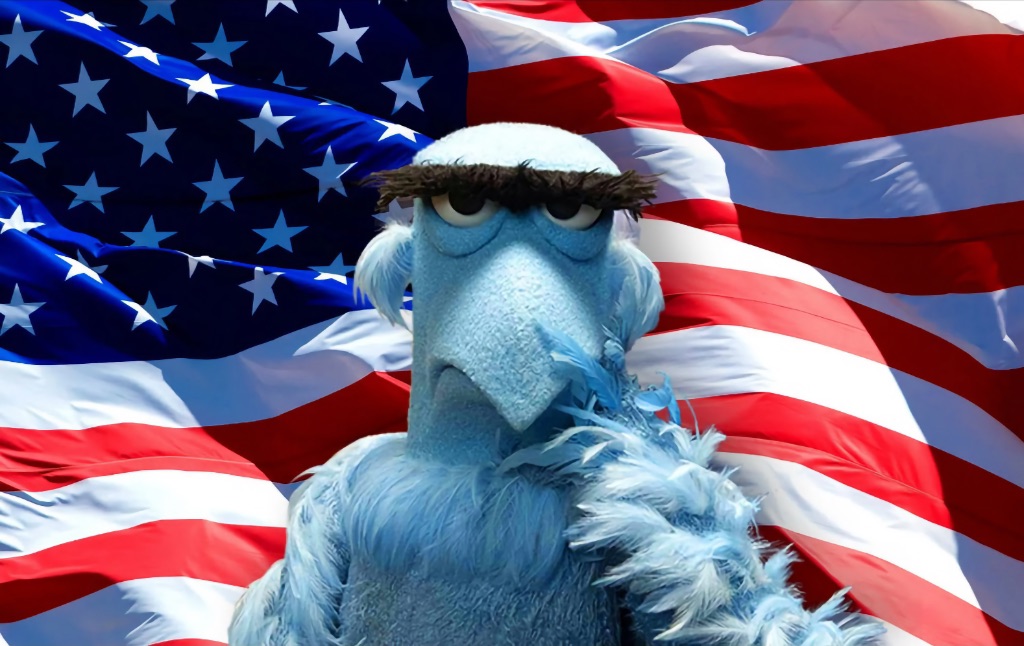
The latest installment of Todd Martens’s newsletter for The Los Angeles Times is about Disney promoting some of the stuff it’s planning for the upcoming July 4th holiday, to celebrate the 250th anniversary of the United States of America. It raises an interesting question: “Are you somehow not aware of what the USA is like in 2026, Disney?”
It’s the kind of idea that you don’t normally hear discussed by theme park enthusiasts, who are going to focus on the thing itself, without touching on what the thing means in a larger context. As someone who considers himself a theme park enthusiast, I totally get the appeal. It’s the same appeal as the parks themselves: it’s a bubble. It’s so much easier and definitely cheaper to watch videos of people going to parks than actually going yourself. And it’s just as reassuring to feel that you’re watching something that almost certainly won’t have the real world creeping in.
People try to defend theme park fandom by claiming it’s not mere escapism. I think people just underestimate the real value of escapism.
I even think there’s value in all the petty but heated arguments that arise from people having strong and even arrogant opinions about the parks. It feels more mentally healthy to get upset about things that either have simple, achievable solutions, or ultimately don’t matter, or both. Healthier at least than the overwhelming sense of dread that we’re surrounded by an infinite number of problems that are insurmountable.
A big part of Disney’s celebration is a new video for the Soarin’ attraction, flying across the United States instead of just California or a few sites around the world. Since I’m unlikely to see it in person, I watched a video of it via one of the aforementioned YouTube theme park enthusiasts. I think it’s so generic as to be completely apolitical, and the most offensive thing to me is its over-reliance on CG imagery. In everything after the original Soarin’ over California, Disney has more and more lost the plot and spirit of it, adding elements or entire scenes that were completely computer-generated, and even losing that sense of constant forward motion and imaginative transitions.
Anyway, even the footage of Washington DC is aimed away from anything even slightly politically charged, flying over the Mall towards the Washington Monument.1I guess you could glance at the Smithsonian and be freshly annoyed about how that’s been pillaged by racists. There’s a shot of Mount Rushmore, which is either a beloved national landmark or an enormous piece of propaganda carved by a racist into stolen and sacred land, based on how you want to look at it. The film starts with a rocket launch from Cape Kennedy, which doesn’t have quite the same patriotic impact it did back when Epcot opened, now that we can’t see it without thinking of slashed budgets and increasing corporate influence over the space program.
Ultimately, it doesn’t actually say anything. Of course, they’re not going to be soarin’ over ICE concentration camps, or the huge No Kings protests across the country, because that’s not the point of a theme park and it’s never been Disney’s thing anyway. Walt Disney was famously patriotic and conservative. It was only in my early teens, years after his death, that you’d see anything in the park try to update the Disney Version of American History. Even then, the closest you’d get to a more inclusive and critical take was in the American Adventure at Epcot, which still lightly skips over the problematic parts — the Civil War was sad because it divided (white) families, and the only thing we need to be concerned about with the whole Civil Rights movement is the stirring, inspirational “I Have a Dream” speech.
But again, that’s just not Disney’s thing. At least in the theme parks; in the movies and especially the documentaries, I’d want to see a more realistic take that at least addresses the issues. But expecting a theme park attraction to give an unflinching, or even well-rounded, version of American history would be as misguided as expecting an accurate history of piracy in the Caribbean. It would’ve been nice to see more images of culturally significant landmarks, like the Crazy Horse monument. But the existing video flies over the Statue of Liberty, and it’s still unlikely to make any of the most anti-immigration people in the audience suddenly see the light.
And a detail that I think is easy to miss: a theme park is such a bad venue for anything other than the most shallow take on edutainment, that even with the best intentions, it can backfire. Those of us who saw the early days of Disney’s Animal Kingdom will probably remember just how hard it went on its messages against poaching and for conservation. But even as someone who is 1000% on board with those messages, the handling of them in the park felt didactic and preachy. It was the opposite version of “read the room, Disney.”
The most effective message was the most subtle one that most directly impacted your experience as a guest: it was the first theme park to eliminate straws and cup lids. A direct way to remind everyone, via slight inconvenience, about how small things compounded across millions of people can have a huge environmental impact.
So I appreciate that one of the mascots of Disney’s celebration of the 250th is Sam the Eagle. He’s also been the icon of the American Adventure pavilion at Epcot ever since they redid the restaurant. I have no idea how much, if any, thought Disney put into the choice of the character beyond “we bought The Muppets,” but it’s a perfect choice. There’s always been a counter-culture streak to The Muppets, and Sam was devised as a parody of jingoism and chauvinistic patriotism. It’s one of the core threads of Disney parks nostalgia by this point: “A salute to all nations, but mostly America” from Muppet-Vision 3D.
Especially as somebody who saw the country go nuts over the Bicentennial in 1976, and then grew up during the Reagan era, I love having Sam as a symbol. It says “I can get swept up in the patriotic ideal of the United States, but I’m nothing like those guys.”
For most of my life, we had the worst people in the country wrapping themselves in the American flag and claiming exclusive ownership of it. Corrupting it to mean that being patriotic meant believing in the same stuff that they did. And conversely, being pro-labor, pro-immigration, pro-globalization, and socialist democracy in the broad sense, were deeply un-American. That racism wasn’t a shameful, indelible stain on the founding of our country, but was just an unpleasant topic to be ignored because that’s all in the past now and when you think about it, was it ever really that bad? A lot of people of my generation were happy to let them keep their flags and anthems and July 4th celebrations, because if being a patriotic American meant being like that, then we didn’t want any part of it.
So a huge part of why the Harris/Walz campaign was so invigorating at the start was because it felt like they were taking back so much of the imagery that we’d ceded to the right, decades ago. Getting back to the ideals that all of these symbols are supposed to stand for, instead of the corrupted versions.
It’s something I’ve been ambivalent about most of my life, because I do believe that there’s actual value in patriotism. I was only five and six years old during the Bicentennial, but I still vividly remember the energy of it. It was formative. A real sense of community and identity that even I could recognize, the sense that everyone I saw had at least something in common with me, and that spread outside of my town across hundreds of millions of other people. And it can’t be stressed enough that the mid-1970s were not a bright, optimistic period in American history. People had to put a lot of effort into remaining optimistic about the ideals of the country in the face of the reality.
As I got older, it felt increasingly hypocritical, at best, to even think about celebrating the United States. What is there to celebrate, when there’s never been any point in our history and even pre-history when the country wasn’t engaged in something deplorable? We were taught about the centuries-long history of anti-black racism from a fairly early age — even if it was often sugar-coated, diminished, or even spun into bullshit questions of “states rights” — but as we got older, we’d learn more about imperialism, isolationism, the excesses of capitalism, all of the various reasons that people have good reason to scoff at the idea of waving an American flag around.
But the idea that I keep coming back to is that we’ve ceded ownership of something great to the people who least deserve it. It’s especially easy to see now, as the corruption has been laid cartoonishly bare, and the worst people in America have abandoned the pretense of actually believing in anything the country is supposed to stand for. We have an exquisitely on-the-nose image in the form of 21st century ghoul Erica Kirk2With the reminder that the literal definition of a “ghoul” is a monster who feasts on corpses, glaring on podcasts while wearing a black cap with the word “FREEDOM” imperceptibly stitched across the front in black thread. We want to let these assholes control the definition of what America is?
That doesn’t feel progressive, or realistic, or even cynical, but just defeatist. Abandoning something essential just because it’s being exploited by the people who believe in it the least. Like deciding to give up GPS because flat-earthers use it.
I keep going back to the phrase “In order to form a more perfect union” from the US Constitution, both because I had it drilled into me in the form of a song, but also because it leads our founding document with an acknowledgement that things are perpetually in progress. You could just take it as nothing more than its immediate context — the Articles of Confederation didn’t work, so here’s attempt number two. Or you could take it as I do: an assertion from the onset that this country will never stop being an attempt to live up to an ideal.
That may even be part of why the new Soarin’ video feels bland and empty: it treats America as a place instead of an idea. Here’s where the Grand Canyon is, and also we have lighthouses and Hawai’i. We can be proponents of globalism, open borders, and free trade, and reject chauvinism or the idea of American superiority, and still believe that the US is more than just an arbitrary place.
It’s not an easy idea to capture adequately, without giving all the wrong connotations. Maybe it does require focusing more on people, and struggles, and protests, to really get it. Over the last year, we’ve seen that all of the attempts by the government to furiously rewrite the past, to obliterate all of the most shameful parts of our history, have also tried to obliterate the greatest achievements of the most marginalized people.
Maybe being a true American patriot means not being ashamed of the worst of our history, or in furious denial of it while insisting on American exceptionalism, but embracing the worst. Believing that people can eloquently express noble ideals even while doing reprehensible things. Acknowledging and doing more to celebrate the people who’ve been subjected to the worst offenses of the country, but still fought to bring the country closer to living up to its ideals.
Any time I think about giving up on the idea of America, I think of it as a slap in the face of all the people during the Civil Rights movement, who had real reason to hate the country, but still fought through the worst in order to make it better.
Maybe the only truly exceptional thing about the United States is that it’s not built on ethnicity and not built on geography, even though that’s what the people most likely to wrap themselves in the flag will tell you. It’s not even built on prosperity, even though people insist that the only thing that differentiates the US from any other democracy is privilege. I think it’s the struggle, and the work to live up to that ideal, and the invitation to anyone who wants to come and join in the work.
So my suggestion for a revised version of the Soarin‘ film: a group of people of every ethnicity, standing together in a golden plain or a mall parking lot, whichever’s easier, as a display of red, white, and blue fireworks over them spells out “America: At Least We’re Trying.”