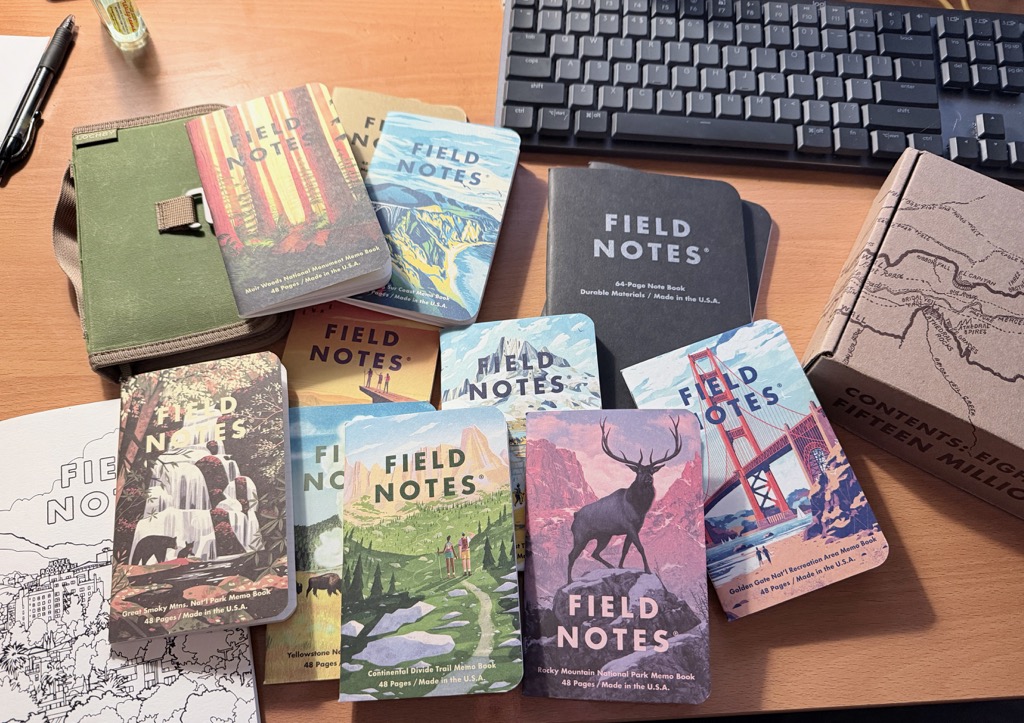
At the beginning of May, I wrote a post about how I was reconsidering my multi-decade-long goal of finding the perfect digital notebook, in favor of switching to good old-fashioned pen and paper. I still had an empty Field Notes memo book that I’d picked up during a trip to Chicago, and I resolved to use that as a test case for a journal.
As you can see from the above picture, things got a little out of hand. Even before I’d filled up the first one, I fell under the thrall of Field Notes’s marketing, and I figured if I’m going to do this, I’d better commit to it. Better to have it and not need it than need it and not have it, right?
Finding the Right Size
I got a couple of larger (A5) books with the idea that I could use them as “master” journals, for anything that needs more long-form writing or a deeper dive. They’re approximately the same size as the iPad mini and the older Moleskine I’d dug up, the only two notebooks that I’ve gotten any traction in as an adult. I have yet to use them, though, and am currently having trouble seeing a good use for them yet. A side effect of having this blog is that any long-form ideas bouncing around in my head usually go directly here without having a notebook as an intermediary.
I also got a couple of the same size with blank pages1in the “Cityscapes” series, for Field Notes aficionados, with the goal of using those purely as sketch books to practice drawing. Those I can at least see myself using, even though I haven’t yet. They could ideally be a replacement for how I typically use Procreate — start a drawing, get frustrated that I’m not better at drawing, have it annoy me every time I see it in the Procreate library, delete it so I don’t have to look at it.
But for me, the size that’s “stuck” is the memo book (A6, the size you most likely think of if you’re familiar with Field Notes at all). I’ve been using that Chicago one as a daily tracker for the past month. Not really a diary, since I don’t go into much depth. Not a planner, since I tend to write stuff down after the fact — so far, the trend has been that writing down what I plan to do that day all but guarantees that I’ll end up not doing it. So it’s just a list of what I did each day, even if that turns out to be almost nothing.
There is a whole sub-genre of YouTube videos about the life-changing magic of journaling and bullet journaling and organizing and planning, with tons of people eager to share their perfect system. For me, it hasn’t been “life-changing,” at least not yet, but I’m definitely into it. I’ve filled up my first memo book and already started on a second.
Semi-Precious and Semi-Permanent
At that rate, I should exhaust my current supply of memo books as early as… 2029. In addition to all the ones visible in the above picture, I might have splurged on a box set of all of the National Parks editions. Who’s to say? What even is money to the unemployed man, when you get right down to it?
You could argue that this is far too many notebooks, especially for a man of my age, who should’ve started doing this 20 years ago if at all. You could point out that Field Notes are a bit overpriced for what they are. The aura comes from effectively marketing to hipsters and collectors. The paper isn’t that great. There are much more cost-effective options from competitors, much less no-name brands you can get anywhere.
To that, I say:
- They’re very pretty, and
- Shut up.

That’s why these hit the sweet spot for me, in ways that were unexpected enough to be counter-intuitive.
My old Moleskine makes the most sense, practically. Plenty of pages with lots of space on each page. A place for everything: I’ve got notes from a decade ago intermingled with stray game ideas from the last couple of weeks. It’s basic black and perfectly utilitarian, so I shouldn’t have any hesitation opening it up and using up the pages. That’s what it’s for.
Meanwhile, the memo books seem like a nightmare for actually finding anything once I’ve written it down. They’re hostile to doing a deep dive on anything, since you quickly run out of space on a page. A book you use daily might only last a month or so. And the covers are so pretty — and they’ve got this aura of “collectibility” around them now — that it seems like wasting one to fill it up with something as mundane as “Wednesday: I had a ham sandwich for lunch.”
In practice, for how I use them at least, all of those turn into positives. The smaller size encourages me to use it for whatever, without being intimidated by a larger blank page. Having several of them means I don’t need to be that precious about each one. Being limited to 48 pages means I’ve got enough space for a month’s worth of stray nonsense, but I also get the sense of completion that comes from finishing one.2The community of Field Notes fans even started a ritual called “Staple Day,” where they share photos when reaching the halfway point of a memo book, revealing the staples in the binding.
And last month, every day when I opened my journal, I saw the plain cover with the stars from the Chicago flag, and I remembered going on that trip with my fiance. Every day this month, I get a look at that fantastic painting of the Golden Gate Bridge, and invariably remember my time living in San Francisco.
And each of them, I’ll associate with memories of the month I spent using them. It’s a neat and for me unexpected combination of being pretty enough to enjoy using them, but not so precious that I don’t want to sully them. The size becomes a feature, too — instead of being A Big Book of Everything, the limited life span of a memo book means it’ll forever be associated with a very specific time.
Last month, I went to see a production of my friend’s play at CalArts, and I wrote some notes about it on one page, and stapled my copy of the program to the other. That’s now a permanent part of that specific notebook, waiting for whenever I choose to dig back through the completed and archived books.
It gives everything the feeling of semi-permanence, which I like a lot. I already realized that I’ve been drawn to digital ever since I was an adolescent, to the point of feeling low-grade anxiety any time I’m doing something without undo and delete. It always seemed obvious that digital notebooks and, especially, the iPad mini, would be the best of all worlds, since you have infinite space, infinite tools, and the easy ability to correct mistakes.
But in practice, that appeal turns out to be false. As I mentioned with Procreate earlier, I hate having bad drawings around, so I delete them. I hate having dumb ideas lying around, so I erase them. I don’t take advantage of near-infinite storage, because the mistakes disappear. It’s a fixation on perfectionism that doesn’t result in my gradually getting perfect, but just stagnating. Having to start over from scratch each time, essentially, because I’ve gotten rid of all the various imperfect, amateurish, ugly attempts that I should be keeping around so that I can build on them.
It would’ve been a hugely valuable lesson years ago, to realize that it’s not simply that my journals and sketchpads don’t need to be perfect. It’s best when they’re not! You want to hide the process from whoever’s going to be seeing the end result; for myself, the process is the whole point. And it’s silly to be uptight about messing up a page and not being able to undo, since there are several more pages that are chances to get it right.
Straying Into Other Fixations and Sub-Cultures

I was fully aware that getting into notebooks brought with it the danger of getting really into pens. I couldn’t help but dip my toe into it, but at least as of right now, it sure feels like I’ve gotten it out of my system. It’s a whole sub-culture for some people, but I don’t feel that same “oh hang on, this could get dangerous and expensive” pull as I do for other burgeoning hobbies.
I did buy exactly one fountain pen, out of curiosity. It’s a Pilot Metropolitan “Retro Pop,” which I think is mid-range as far as fountain pens go, but is the most I’ve ever spent or plan to spend on a writing implement.3Apart from an Apple Pencil, I guess, which didn’t seem as indulgent for some reason.
I’ve never owned one, and the closest I’ve come is having some dip pens with nibs back when I was a teenager. I hated them, hated the mess, hated the feel of the nib on the paper, quickly decided it wasn’t for me. This is entirely different. About as easy to use as a roller ball or gel pen, and using it just feels like it’s naturally improving my handwriting.
They’re not suited to Field Notes paper, though, so I don’t see its becoming a daily-use thing. I did also get a couple of gel pens that have regularly been mentioned by the same type of people who tend to talk about Field Notes — the Uniball Zento pens — and while they’re nice, especially the “Flow” model with its part-metal body, I’m still drawn to the old dependable Pilot G-2. (The Uniballs dry faster and aren’t as prone to smearing, but the Pilot just feels smoother and seems to last longer).
And as long as this is turning into a product round-up, I got a “Mini Field Journal” from Lochby, which is the brand that gets most often recommended on YouTube. I like it so far, and am glad I chose it instead of the alternate smaller version that zips closed instead of using a clasp. It does defeat part of the main purpose of Field Notes, which is that they’re small enough to fit in a pocket. But it can carry multiple at a time, and for me, it’s especially useful for always having a pen handy.
The other journaling-adjacent sub-culture that frightens me is scrapbooking. I’ve accumulated years and years of ephemera — pamphlets, theme park tickets, concert tickets, stickers, brochures, zines — that is currently scattered in various containers all over the house. Not enough sentimental value for me to do something with them, but too much sentimental value for me to just throw away. I liked the idea of just stapling stuff into my daily tracker memo book, but a lot of the stuff is just too big.
Mead is hitting me right in the Gen X nostalgia by re-releasing the Trapper Keeper. Although my much-beloved Empire Strikes Back one from middle school disappeared long, long ago, I kind of like the idea of having a shamelessly garish retro one full of stuff from mostly-forgotten vacations past.
I’ve never felt drawn to washi tape or metallic colored markers, and I honestly don’t see that changing now that I’m in my 50s. But I do have, for instance, a brochure from the tram tour we took in Hong Kong, and it’d be nice to have a place for it that isn’t “crumpled up in a box somewhere.” Watch this space for updates!
The Best System Is No System
I get the impression that anyone who talks about Field Notes as much as I’ve been doing here is obliged to share with you the system they’ve devised for using them. How to set up a new one with numbered pages and an index and post-it notes and customized pockets, or how to arrange each page with the week’s to-do list as well as a habit planner.
Unfortunately, I’m nowhere near that organized, and I suspect that if I’d try to put so much process into the process, I would’ve abandoned it already. But the current version of my non-process:
That journal holds two (or more) pocket-sized notebooks, so I have one as my daily tracker, and one that’s just an unorganized “everything you need to write down in a notebook.”
In the main book, I just use the right page of each two-page spread to make a list of whatever I did that day. Disappointingly often, there’s not even enough to fill a page, so I’ll put two days on the same page. The left page I turn sideways and use for any miscellaneous stuff from the day that didn’t fit into a list. Quotes or memorable details from whatever movie or TV show I’m watching, a health update for my senior cat, more detailed notes on a play, whatever.
I’m not even sure that writing everything down has helped with my memory retention. But I have noticed that it’s nice simply as a slow-down ritual. Purposefully doing something that’s not strictly necessary, and doing it in the slowest and most methodical way possible. I’ve had journaling apps for years, after all, and I could’ve been typing all kinds of rambling paragraphs and lengthy tangents, but I haven’t. Even — especially? — when the subject is my own life, I just want to see a bullet-point list of the key things.
And another advantage of small memo books is that you don’t have to be tied to a system, and you can figure it all out as you go. You can have special-purpose books, unorganized catch-all books, project-specific books, whatever. The initial draw for me had nothing to do with journaling, and was just me looking for a way to brainstorm and think through a game idea. Having a small, 48-page memo book completely devoted to a single game seems like the perfect scheme4Since none of my game ideas are all that complex, anyway. Nobody’s making the next Civilization in a memo book., and a perfect document to archive afterwards.
Of course, the key to that is having enough memo books that it never feels like an overwhelming number of blank pages, but also never feels like you’re in danger of running out. So clearly, obviously, there’s only one correct next step for me: to sign up for the quarterly Field Notes subscription boxes.
Comments
2 responses to “Semi-precious Paper”
I have two things for you.
The Notebook; A History of Thinking on Paper, by Roland Allen, is an accessible book about the subject in question and might give suggestions for other ways to use your notebooks if you’d like. I’m a notebook keeper (I have a couple, and sketchbooks, I’ve been working on being better at drawing these past couple of years myself).
I am very fond of the MUJI USA Gel Ink Cap Type Ballpoint Pen .38mm. It’s very precise, so it works very well in the smaller Field Notes notebooks. (I do also use a Waterman fountain pen that was a gift back in the 90s on a daily basis, too, but I have no idea what model, and I use it in a Huhuhiro journal that is like a Moleskine. It has been in daily use for more than half of my life! What a champ of a pen.)
Thanks for the suggestions, Brett.