My hyper-fixation of the moment: paper notebooks. Like almost all my hyper-fixations, I’m in the “thinking about it” and “buying stuff” phase, which tends to be where the process stalls out before being forgotten.
But right now, it has the dual-pronged appeal of starting down the road to being better organized (and a more fully-realized human being, one step closer to achieving my ultimate Buddha status), and discovering a whole weird subculture that I’d only been vaguely aware even existed.
It’s also spinning me off into thoughts about convenience, speed, and impermanence,1And the current state of app development as well things I wouldn’t have thought that much about until I entered middle age.
Fossils Tell of Long Ago
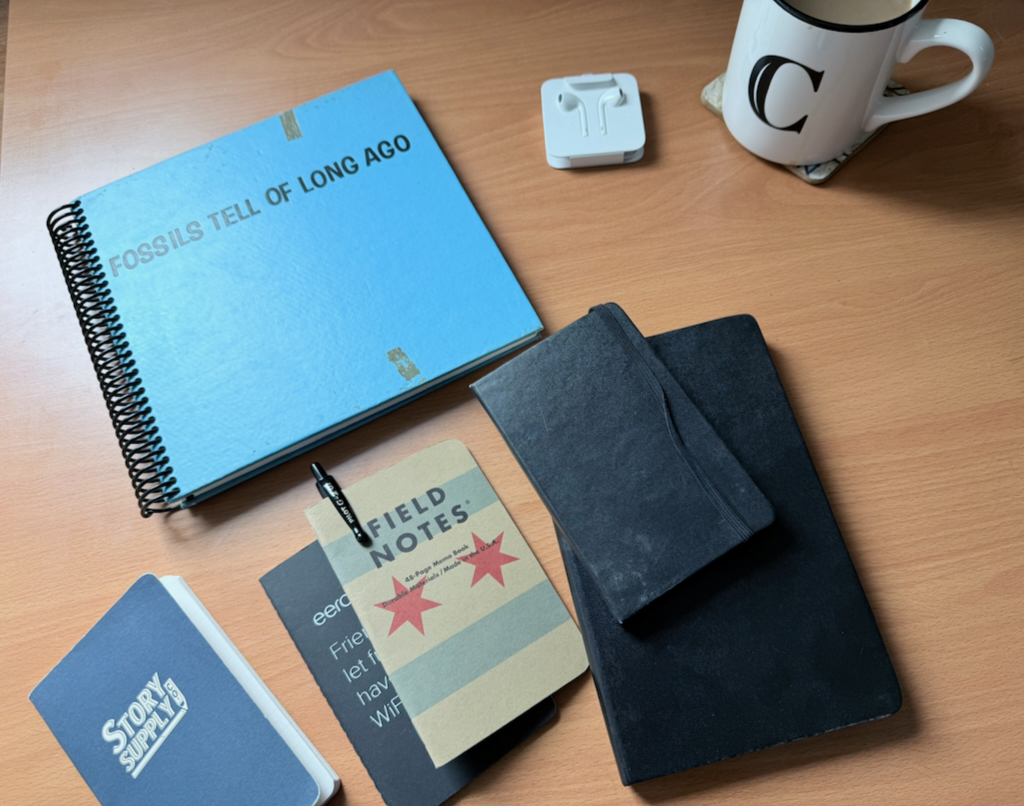
The attraction of a paper notebook is nothing new; I’ve started down this road several times over the years. The featured image with this post is a photo of all the notebooks that I’ve got nearby, not counting the ones stashed away in boxes.
I’ve been drawn to the idea of having a personal notebook — as opposed to the big spiral-bound binders I had all through high school and college, which were strictly for school work and nothing else — since 1989.
I know the exact year, because it was entirely due to Indiana Jones and the Last Crusade and seeing Dr. Jones’s overstuffed Grail notebook. Those movies romanticized fedoras and bullwhips2And casual racism, but I was swept away with thoughts of carrying around a big black book full of sketches and mysteries and secrets.
When there was a surge in popularity around Moleskine notebooks, I was intrigued. They look like the one in the movie! With the elastic strap and everything, and a pocket in the back waiting for me to overfill it with things. I’d be able to write meaningful accounts of my adventures, draw sketches and diagrams of interesting artifacts, and use it to store ephemera collected on my travels to exotic places.
The pocket-sized Moleskine in the photo above has nothing in it, apart from a single IP address, and a drawing of a couple of triangles.3I was most likely trying to remember how the dot product works, since I always forget. The rest is as blank as my memory of the period in my life when I bought it.
In fact, almost all of the notebooks in that photo are empty. It’s never stuck.
The exception is the bigger Moleskine; apparently, I made a go of it around 2007, according to the dates I wrote. And it’s honestly a treasure. It’s filled with notes from brainstorming sessions at Telltale for the last episode of Sam & Max and the start of The Walking Dead. There are also notes from meetings at Imagineering, pages where I was practicing Japanese kanji characters, and a page where I’m factoring some sort of equation. I have no idea what that was for, and I’m pretty sure I’ve entirely forgotten how to do that anymore.
The largest book in that photo was a really great and thoughtful gift from some friends. Its cover says Fossils Tell of Long Ago, and it came from a small company called Ex Libris Anonymous, which still exists, I was very happy to confirm today. They repurpose vintage books into journals, interleaving blank pages into the originals. Mine is wonderful, still having the pocket in the back for the Pierce County Library (wherever that is) library card, and several of its pages have crayon scribbles from a child who was engaging with photos of ancient fish dying.
It’s so wonderful, in fact, that I’ve always been reluctant to actually use it. Any mark I made inside would sully it. It’s permanent — undo and delete have been a crucial part of my life since I was 12 — and it would follow me around for the rest of my life, like a regrettable tattoo.
Even with the cheaper, more utilitarian books, it’s a similar problem: I can see how many pages are there, which means they’re finite. If I’m going to be writing anything in them, it has to be important enough to ruin one of those pages forever.
The Crushing Reality of Digital
So clearly the answer would be a digital notebook, and that’s what I’ve been fixated on perfecting ever since.
Videos of the Apple Newton made it seem magical. I wasn’t drawn to the idea of faxing meeting invites to my pleated pants-wearing coworkers, but I did love (and still do) the idea of scribbling out a word to delete it, or drawing a straight line to start a new page. And like everybody else online, I was enchanted by the concept video of the Microsoft Courier project, which suggested a device that wasn’t just magic paper, but an always-connected organizer that could seamlessly collect literally anything you wanted.
Now it’s 2026, and a lot of those concepts are actual reality. Scribble with an Apple Pencil is surprisingly good, with great handwriting recognition and, yes, the ability to scratch out a word to delete it. The built-in Notes app is excellent, and there is definitely no shortage of other notebook apps available.
GoodNotes is my favorite of the moment. It’s getting a little bloated, and the subscriptions and the AI “features” are intruding on it just like everywhere else. But combined with the Pencil and the form factor of the iPad mini, it does 90% of what I’d been imagining from those early concepts and ads for pen-based computing.
But not 100%. There’s still the tiniest bit of friction where I want the notebook to work a specific way — to read my mind, essentially — and they’re still too tied to reality. I want it to clean up and structure my writing as if I’d typed it, recognizing titles and headers and lists. Almost all of them require a separate phase of converting handwriting to text.
One of the best I found at that specific aspect was originally called Nebo, but is now called MyScript Notes. It’s excellent as using machine learning for the stuff it’s good at, which is treating writing and typing as interchangeable. Its overall organization doesn’t work like I’d like it to, though, and the intrusion of Bad AI has invaded on it as well.
Plus there are all the little nuisances of app developers trying to stay afloat and competitive in 2026. Every single one of these apps is constantly giving me “helpful” popups when I’m trying to just get an idea down.
Overall, I’m still just looking for magic paper that intuits exactly what I want to do, and organizes stuff exactly in the way that makes sense to my brain.
Cardamom

Every year Apple holds a WWDC, there’s the implicit promise that we live in an age where it’s possible to do exactly that: use all of the full-featured frameworks to build an app that works exactly the way you want it to.
I don’t want to suggest that they’re completely counter-factual or even misleading about it; the focus is still on building stuff to sell in the App Store. But their example videos all focus on building an app to serve a specific and very special-case problem. “Here’s an app I’m working on to teach about the solar system.” “I made this app to help my kid practice his handwriting.” “This app helps people running an organization of food trucks.”
It reminds me of the days of HyperCard, where people would create their own special-purpose stacks for whatever niche application they could come up with. They weren’t designed to sell; they were designed to be useful. And they’d make it into user groups and shareware collections for the benefit of the three or four other people in the world who might also find it useful.
So I’ve long had an idea simmering of making my own perfect note taking app. It’d be a combination of the existing notes apps along with something like, well, HyperCard.4Which is, as I’ve mentioned before, the single best application ever created. It doesn’t exist yet, and honestly, it’s unlikely that it ever will. But I’ve been using existing, inferior, general-purpose notebook apps to brainstorm the process.
My initial idea was that there’d be a blank canvas onto which you could write text or draw diagrams, as that initial capture phase. Then you could draw a rectangle around relevant sections, and the app would whisk all of it away into a perfectly-structured card that would be dated and searchable. It would be able to infer titles, headers, lists, etc by text size and placement. And you could set up an overall structure for your cards by drawing connections between them like a graph or mind-mapping diagram, or nest cards within each other via hyperlinks.
That version is too ambitious for my skills. It’s amazing how much Apple’s PencilKit gives you “for free,” but a lot of features that are just basic table stakes for a useful app — drawing and shape recognition, multi-tap gestures for undo and redo, etc — seem to require the developer to train their own ML models.
So I’ve modified the idea to be a more hybrid approach. Presenting card templates kind of like Keynote’s slide templates, letting you write into the existing fields. Of course you’d be able to design your own templates. And there’s still that blank space capture area, letting you lasso individual elements and then drag them into the right place on one of the templates.
That’s where the idea is currently stuck, though. Only a couple of years not working with iOS, UIKit, and/or SwiftUI on the regular has meant that my skills have already gotten rusty. Every time I run into even the smallest bit of friction while trying to get a test app going, it makes me question the value of an app that only I and maybe a few other people would find actually useful.
Is it yet another case of my programmer brain spending more time trying to automate a solution than it would take to just do it more simply?
Back to Physical and The Joy of Clutter
Which all unrolls back to why I thought this was an interesting enough topic to blog about in the first place. It’s made me reconsider what exactly I value about this whole idea of “being organized,” and whether I’m prioritizing the wrong things. Not just immediately and practically, but in the larger sense.
How much time have I spent belaboring the process of doing the thing, that would’ve been better spent just doing the thing? A big part of the appeal of digital is that it pays dividends from repeated time savings — even just slapping a date on everything for you, so you don’t have to remember to do it by hand. And even more time savings later on, where everything is collected in one place, and it’s all quickly and easily searchable.
But I wouldn’t be searching in 2026 for notes on games I worked on in 2007, even if I had been storing them digitally at the time, so they might as well have been lost had they not been written down in an under-used notebook.
Some small aspect of that does carry over into digital notebooks. While looking at GoodNotes, I found a notebook I started sometime within the past two years with ideas for a murder mystery novel.5Looking back on them now, I see they were all just awful. I don’t remember writing any of it, but apparently it preoccupied me for a couple of days. I can’t imagine anything in there being directly useful now, but still, having it also seems somehow invaluable.
Part of the appeal of keeping everything digitally is that I’ve got near-infinite space and infinite undo. I can freely delete words, pages, entire notebooks, entire notebook apps. I’m not suggesting that there were nuggets of pure gold in there that have been erased forever. I am saying that I’d still like to be able to be reminded of them from time to time.
And while I’ve been making a half-hearted effort to get organized and declutter around the house, I keep finding boxes full of years’ worth of paper stuff. Tickets, pamphlets, stickers, maps, patches, buttons, pins, all the ephemera that I’m just sentimental enough to want to keep, but not enough to actually organize. I’m never going to be one of those people who gets into scrapbooking6Record scratch, “hey gang, life update, you’re probably wondering how I got here,” as I hold a pair of those scissors that makes scalloped edges. But I am one of those people who wishes I’d taken the time to staple it to a page of a notebook, along with a message for my future self, now that I’ve become my future self.
My attitude to stickers has always been the same as my attitude towards blank notebook pages: I don’t want to waste them! I’ll wait until I have the perfect place to put it, just like I’ll wait until my thoughts are organized enough to write them down permanently. My parents worked their asses off to make sure I never wanted for anything, and yet I still live like I grew up during the Depression. Wary of ruining all of this pristine paper that I might someday need to repurpose into shoes.
Boxes full of unused stickers and notebooks still full of blank pages are such an obvious visual symbol that even I can pick up on what the universe has been trying to tell me. Instead of fretting over finding the perfect place to put a sticker to represent its significance to me, how much better would it have been to just put it in a notebook. Along with a message like “I got this when my fiance and I went on to the Alternative Press Expo.” Or “my husband got me this sticker along with a zine about how raccoons are cool, because he knows how much I love tanuki.”
Writing It Down To Remember It Now
Two of the notebooks in the above photo are pocket notebooks I picked up from the same shop in Chicago. One’s from Story Supply Co in collaboration with 826 literacy programs, and the other’s from Field Notes.7The third was “welcome to the company” swag from a place that laid me off, so screw them. Still, I carry it in my bag always, because what if I’m somewhere cold and need emergency shoes? They’re completely empty, just waiting to spring in the life as soon as I have something worth writing in them instead of just typing into my phone.
Even empty of everything but unfulfilled potential, they’re still somehow appealing. Because they’ve been moved back and forth between messenger bags, and taken on all kinds of trips — just in case I need to write something down! — they’ve got years of wear that make them look weathered and time-tested. It gives them the facade of being well-loved, unlike the cold truth of neglect that’s contained within.
And even empty, they’ve got memories attached to them. I remember that trip to Chicago, and I think I remember the shop where I bought them.
It made me think of the motto associated with Field Notes: “I’m not writing it down to remember it later. I’m writing it down to remember it now.” Which is true, and it’s a crucial part of their branding that’s earned them such an aura of loyalty among their devoted fans.
It’s a pithy way to describe exactly the thing that’s been paralyzing me for years: being too precious about notebooks, needing them to be meticulously organized, to contain only the things meaningful and eloquent enough to stand the test of time. Being so concerned about being able to find things later that I completely fail to capture them in the moment.
I frequently see videos of people on YouTube evangelizing the notebook or the process that changed their entire life!, often as a “collab” with some notebook manufacturer with a discount link in the description, or sometimes just an indoctrination video to the cult of bullet journaling.
I don’t doubt that it’s extremely useful for some people! But when I see them happily spreading out their colored pens and highlighters and post-it notes and colored tabs and tools to make notches into certain pages, or developing a legend to show their organization system for tracking ideas and tasks from “capture” to “organized” and then migrating them into a more permanent journal, or starting their week by hand-writing a calendar full of icons and spaces and page numbers indexing into elsewhere in the book… I instantly shut down. That’s what computers are for!
For me, at least, trying anything like that approach would just be a case of trading one intrusive process for a different one. Still concentrating on the process itself, at the expense of the thing the process is supposed to achieve.
And for me, the Field Notes memo books come the closest to feeling like they could help dispel my tendency to be too precious about the process and just embrace chaos. Unlike something with the Moleskine/Grail Journal format, they seem to reject any attempt to think of them as Important Books. They’re small and they’re meant to be used. Phone numbers, addresses, random quotes, doodles, moments of profound insight, all mixed together. Simultaneously ephemeral and permanent.
Because as much as I like their slogan, I think it’s only half right. Yes, it’s most important for getting it down and capturing it in the moment. But it’s also going to be around to remember it later. How much of it will make any sense out of context? Probably not much, but not zero. Meanwhile, how many dumb things have I written into a digital notebook, and then deleted because they’re dumb? Would the me of today still think they’re dumb?
How many nuggets of pure gold did I put onto Twitter, only to have it now be completely lost to time because of shitty people? Probably none! But there’s the chance that I said something worth remembering once or twice on there, but now I’ll never remember it.
Several years ago, I read someone draw a direct line between the technological sophistication of a medium and how long it lasts. In short: there still exist clay tablets with messages written thousands of years ago, while I have CD-ROMs from the 90s that have already degraded enough to be unreadable.8Not to mention the various media formats that I no longer have any way to read. Just the other night, I found a box with DV tapes of vacation footage inside. Near some now-useless Zip discs, and a Sony memory stick.
We’ve already seen how companies have made much of the web completely suck, and how streaming services have made so much entertainment suck. It seemed like it would bring about a golden age where we have all the world’s knowledge at our fingertips no matter where we are, as well as access to every movie or TV series we could possibly want, all on demand. That sure didn’t happen!
So I figure the best time for me to start keeping physical notebooks would’ve been 20 years ago, and the second best time is right now. If nothing else, carrying a notebook everywhere means I’ll always have a pen on me.
(I’m sure that my beloved Pilot G2 pens will always been sufficient, and there’s no chance of this also turning into a hyperfixation on different pens and inks. Because how could that even happen?)
Comments
2 responses to “Person of Note?”
FWIW, here’s my approach: Write it all down, immediately, wherever and however.
I’ve distilled this to three major places:
– Apple Notes (within folders when possible)
– Notecards on my desk. (I’m using Analog and really like them like I would the investment in a personal trainer.)
– Field Notes (for when I’m on the go and remembered to bring them and a pen.)
All this said? It is mostly the act that I appreciate.
Reference back to these artifacts is mostly met with confusion.
I’m not “writing it down to remember it now.” — I’m writing it down to be reminded later that I wasn’t clear enough. And that can simmer for an entire lifetime until it rears its ugly head enough that it finally sinks in.
Right on! I think the capture is the most important part, even though so much of the emphasis seems to be on organizing it later.
And a big part of why the digital notebooks have always had such a draw for me is that the act itself of writing it longhand makes it “stick” more than typing.
It’s funny you mention Analog (which I hadn’t heard of) because it’s a reminder of how completely subjective it all is, and how there’s no technique that’ll work for everybody. Just looking at all those cards gives me low-grade anxiety! Even though I can immediately see the appeal of having them up-front and visible, and of the aesthetic satisfaction of having special-made tools to organize them, I’ve got an almost visceral reaction to it as a reminder that my brain just doesn’t work that way!