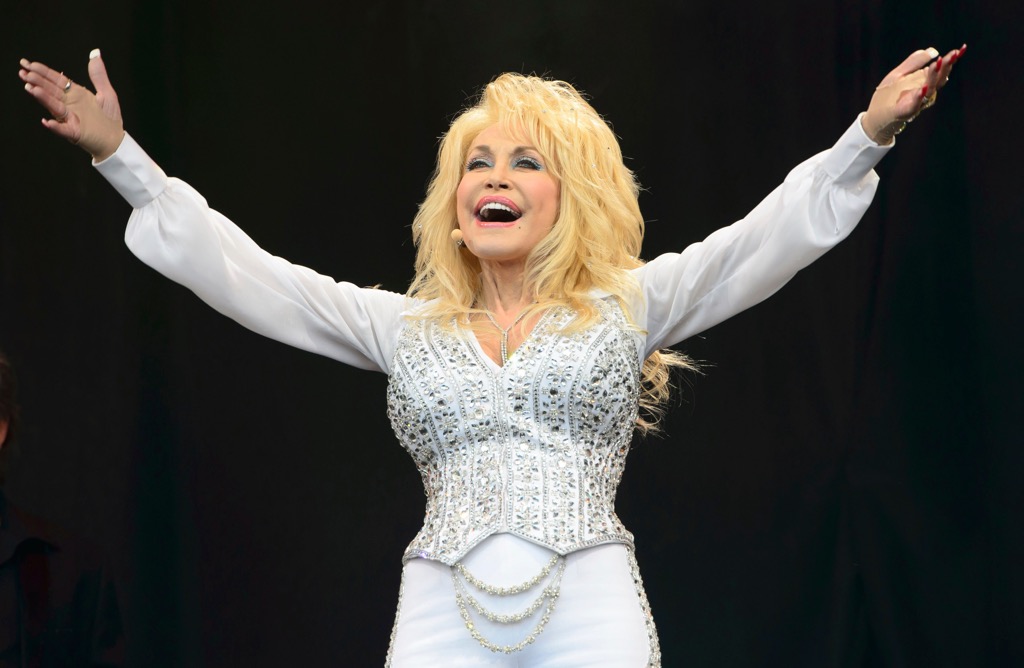
When Dolly Parton passed away this week, I joined the people online celebrating what a special person she was. I thought I was being a little bit controversial by suggesting that looking at her life and the way she lived, it made me understand why Catholics want to bestow sainthood on exceptional human beings.
“Controversial” only because I know how important her faith was to Dolly, and even after a long life as one of the most famous celebrities in the world, she had a steadfast devotion to her religion. She would famously joke about herself, and some of her self-effacing one-liners would become as closely associated with her as her hit songs. But I never saw her diminish or try to talk down her own talent, because she saw those as gifts from God.
But it didn’t take long at all for me to see that my bold claim was neither that controversial nor that original, and there’s even a ton of “Saint Dolly” merchandise already available, with images of her from just about every stage of her career. She was universally beloved, because she always seemed to be the personification of light and joy. If you weren’t a fan of her music, you might’ve been a fan of her movies and TV appearances. Or her philanthropy. Or her books. Or her theme park. Or her talk show appearances. Or her outspoken support of LGBTQ people. Or even her baking products.
I can’t claim to be an expert on her career, by any means. I didn’t even know the story behind “I Will Always Love You” until I saw it re-enacted on Drunk History. I just knew the basics that got repeated over and over as part of The Social Media Version of Dolly Parton, which sound like the Chuck Norris memes, except they’re all true. She wrote “Jolene” and “I Will Always Love You” on the same day! She funded the Moderna COVID vaccine! She produced Buffy the Vampire Slayer! She founded The Imagination Library and has donated millions of books to children! She’s poured money into Pigeon Forge and the surrounding area to help pull people out of poverty!
To be clear, it’s not like I wasn’t aware of Dolly Parton. Seeing 9 to 5 in a theater is one of my earliest memories of seeing a “grown-up movie,” and I loved it. I’ve just never been a fan of country music — and she identified enough as a country singer/songwriter strongly enough to decline an invitation to the Rock & Roll Hall of Fame — so I only knew the hits. I still know most of the lyrics to the hits by heart, but I’d be lost on the deep cuts. And I only know her other movies, like Steel Magnolias and The Best Little Whorehouse in Texas, from general cultural diffusion and relentless advertising.
It was more like she’d always been a presence, and I just took it for granted that she always will be.
Sometime in the 2010s, it seems like she transformed from “extremely likeable celebrity” into something more. Through her various media appearances, you could tell that she was a uniquely good person.
I finally had what felt like an epiphany in 2020. It had been the worst year of my life to date — and a lot of the country was feeling the same way — and I probably just needed a hero. Somebody to make me feel hopeful again. And she had stepped up to deliver that to millions of people. Behind the scenes, with stuff like the aforementioned COVID vaccine, and likely plenty of other philanthropic works that weren’t as heavily publicized. And also as a performer.
But when I read that take now, I feel like I was still under-selling it. I have to wonder if Dolly preferred it when people underestimated her, since it meant she could work her magic without much interference. It’s not that she didn’t care what people thought; she loved her fans, and never stopped working for them/us. It’s more that negative opinions of her had nothing to do with the real her. And through everything, she showed over and over again that she always knew herself, knew what she was capable of, and had nothing to prove to anyone.
Dolly as Media Icon
You can see it in this clip from Stephen Colbert’s show, where she effortlessly and joyfully glides between celebrity chat, personal chat, talking about her husband, talking about her faith, promoting her book, promoting her album, singing a song that made Stephen cry, teasing him for crying, and then reassuring him and making him laugh again.
The thing that stood out to me then — and it still does — is how she brought such a sense of authenticity and sincerity to absolutely everything. I think it’s partly a huge generational shift, one that feels alien to me as a TV-obsessed Gen X-er. How does she do that, without having to draw a clear line between what was “real” and what was for show?
I developed whatever version of media literacy I have during the shift from the Variety Show era to the Reality Show era. Dolly first rose to fame via a variety show, made guest appearances on multiple others, and even had her own. That style fell out of favor over the course of the 80s and into the 90s, since it seemed too old-fashioned, corny, and maudlin, even though they were showcases for some of the most multi-talented people ever to do it.1Seriously, when you watch some of the performances on Hee-Haw now, it makes you wonder why we only remember the corny stuff. Instead, there was this new obsession with always reminding the audience where the cameras were, going behind the scenes, and ditching fake performances on sets in favor of showing you the real thing. Being earnest and sincere was out, being post-modern and self-referential was where it’s at.
Instead of being confounded by that, and doomed to irrelevance, Dolly Parton seemed to embrace it. She’d always been self-referential, making all the jokes about her body, her wigs, her clothes, and her make-up before anybody else got the chance to try and use them against her.
My favorite was “I don’t mind dumb blonde jokes, because I know I’m not dumb, and I know I’m not blonde.” It became one of her best-known and most often-repeated catch-phrases, and part of the reason it’s such a great gag is because it softens the impact of the main point: she’s one of the wisest and most savvy people you’ll ever meet. Underestimate her at your own peril.
So she had no problem with a generation that was trying to make sense of authenticity, and trying to draw a clear line between sincerity and performance. Because she was always performing, and she was always sincere. There was never a whiff of embarrassment or awkwardness about the fact that she was on camera, giving you the version of her that she wanted, promoting herself, and trying to sell you something, because that’s what everybody on camera is doing. She was always up front about the fact that she was a business woman, but because she was so fearlessly genuine, there was never a hint that being a business person on camera was manipulative or fake. It’s easy to be honest if your business is always doing the right thing.
Dolly as Drag Queen
Her public persona being so rooted in performance, and in her appearance, has gotten a lot of people making the observation that she was doing drag the whole time. It’s a comment she made herself, when she said in response to a question that if she’d been born a man, she’d probably have been a drag queen.
And the wigs, the make-up, the dresses, and all the rhinestones were part of that public persona for decades. Even over the past decade or so, when she couldn’t make an appearance in person, she was always seen sitting somewhere against a tasteful photographer’s backdrop, next to a table with a bouquet of flowers on it. She was acutely aware of how she was perceived, and she always put the effort into making a good impression.
It’s a good reminder that she was a pioneer in treating gender as a performance. Especially as she became more outspoken about progressive causes like LGBTQ rights. “Became” not in the sense that she caught up with the times, but in the sense that she started publicly talking about the way she’d always lived her life with tolerance and kindness, after she saw that it had become politicized. She was always well aware that her public image was dominated by signs of her femininity — two signs in particular — but that was part of her costume. Or, considering how seriously she took her role as a performer, her uniform. It wasn’t her, in the sense that she was rock-certain that her true talents had little to do with her appearance.
But I think calling it “drag” isn’t quite accurate, since it was her, to some degree. She really liked the tight clothes, the sparkles, the flowers, the butterflies, and all the pink and white. In countless interviews, she repeated her “origin story,” of how she and her friends modeled themselves after the woman that everyone called the town tramp, because they thought she was so pretty. There was no sense of irony. And the commentary was simply not to judge the quality of a person by their appearance.
I don’t want to be dismissive, because I know that there are all kinds of drag. It’s certainly not all ironic, or a commentary of femininity (or masculinity) or queerness, and it’s often a sincere expression of wanting to be beautiful. But there is a connotation that it’s something that can be put on and taken off. I never once saw Dolly out of her “costume,” even at her most casual. Even when she felt she needed to make a video reassuring fans that she was okay after a health scare, she went to the effort of looking the part of Dolly Parton.
Dolly as Feminist and Advocate
I like seeing the comparisons to drag, though, because it emphasizes how Dolly was ahead of her time in standing for feminism and progressive causes in general. Embracing her femininity and defying all the people who would use it against her. Coming out on top because of her strength, her self-confidence, her humility, and her kindness.
9 to 5 is overtly feminist, but it’s also about worker’s rights.2I saw a clip from an interview with Conan O’Brien, where Jane Fonda pointed out — along with commenting how Dolly was one of the most amazing people she’d ever met — that with all the advances of women’s equality since 1980, it’s even worse now in a lot of ways, because of unchecked corporate power, consolidation, and the lack of accountability. I’ve never seen The Best Little Whorehouse in Texas, but it’s clearly about body autonomy, freedom, and a rejection of prudishness. Steel Magnolias is right there in the title; it’s about the strength and resilience of southern women.3I only recently learned about a movie from 2012 called Joyful Noise, so I can’t say anything about it one way or the other, but it had Queen Latifah, Dolly Parton, and Keke Palmer, and I don’t know how they managed to make that movie without its exploding just from having that many uniquely charismatic powerhouses all in the same place. But it always felt like the version of her in movies was a fictionalized sliver of the real person. She always seemed to choose parts that would align as closely as possible with her values, and always seemed to play a character that was an aspect of her.
Because the real person was so much more interesting than any character someone would create. And the statements she’d make about feminism, strength, autonomy, and kindness were ones she’d already made, by example.
There’s so much just packed into that story about Porter Wagoner and “I Will Always Love You.” For those of us who think of her as having always been famous, it’s easy to hear that she was on that show for eight years and not really appreciate the full impact of that. Being a beautiful woman surrounded by the boys club of not just television in the 60s and 70s, but specifically country and western television, where “conservative values” were so deeply entrenched. I have to imagine what it would’ve been like, seeing that you’re probably one of the smartest and most talented people in the room, if not the most talented, and surrounded by misogyny that’s so old and so ingrained that it probably wasn’t even malicious most of the time. It’s just the way things were.
And she came out on top by being good. Not just uniquely talented, but a good person, refusing to let all of the pressure and the unfair treatment chip away at who she was. That’s not just me indulging in a hyperbolic eulogy; it’s facts. When met with a demanding and unfair contract negotiation, she says she went back and wrote a heartfelt song, because that’s how she best expressed herself. And while she’d have been more than entitled to respond with anger, she recognized what was at the root of all of it, how personal feelings could’ve gotten too entangled with the business. She responded with love, and an explanation that it was time for her to go.
Back when I knew nothing about the background of the song, and didn’t know that Dolly was married to the love of her life who adamantly stayed out of the public eye, I’d thought that it was a song about romantic love. Knowing the real story makes it even more powerful. Dolly said frequently that “I love everybody,” and it wasn’t naive, or selective, or dishonest in any way. It was about loving the core of a person, that part of God’s spirit that lives inside us all, as she described it, and remembering that even as they were treating you unkindly.
Which isn’t weakness. Just the opposite, in fact. You can’t be kind and loving in the face of unfair treatment without being strong. You can’t respond to a patronizing interview — as Rob Harvilla explained in this article4Although the original clip is no longer available on YouTube — with grace and empathy unless you have the absolute conviction that you have nothing to feel defensive about, and the understanding of where patronizing and unkind attitudes are actually coming from.
Dolly was so self-effacing and joyful that it’d be easy to get the impression that she didn’t take herself seriously. But it’s probably more accurate to say she didn’t take her persona seriously; she was always mindful of what was actually important. Her work ethic, the values she lived by, and the values she’d fight for and defend.
And part of that means that she was well aware, even back in her 20s, of the monetary value of her beauty, her talent, and her intelligence. We tend to think of that as being mercenary or manipulative, so we (all of us, but women in particular) over-correct into diminishing ourselves, and letting unscrupulous types take advantage of us. And it’s feminism when a woman can thrive in an environment where everyone is telling her to know her place, because she never forgets the basic fact I deserve to be here.
Over the past week, CNN and The New York Times ran headlines in their obituaries claiming that Dolly was universally beloved because she was “neutral” or “apolitical.” That’s so blatantly false that it’s practically libel. Even the most charitable interpretation is that they simply don’t understand her, because they just can’t wrap their head around the concept of a southern Christian woman having progressive values. They can’t understand how you can be kind and compassionate without sacrificing your core values. That you can be joyful and laugh off criticisms and allegations not because you don’t take anything seriously, but because you can distinguish truth from irrelevant nonsense.
And that she was universally beloved not because she was silent about what she believed, but because what she believed was simply and undeniably true.
Dolly as Rich and Famous
In short, Dolly could be a shrewd and savvy business woman without sacrificing her authenticity or her integrity, because she seemed to always be aware of a simple fact: her wealth wasn’t the same as her worth.
In the week of memorials, I’ve also seen a quote from Julia Roberts talking about filming Steel Magnolias and, on a difficult day, asking Dolly how she could always maintain her joy and her high energy, even as everyone around her was hot, tired, and miserable. She says that Dolly told her, paraphrased, “When I was little, all I wanted was to be rich and famous. Now I’m both, and I never forget that.” Roberts says that she never forgot that, either, and anytime she was inclined to complain about something being difficult, it was the first thing that came to mind.
So when you look at all of her philanthropy, including the Imagination Library, of which she said she was the most proud, you can make the simple conclusion that she was “one of the good ones,” living in comfort and wealth and fame and always remembering to give some of it back. And that’s true, but it’s yet another aspect of Dolly Parton that goes deeper than that.
She’s not one of the multi-millionaires that we’re surrounded with, who was born into privilege. She worked uncommonly hard for everything she got. She set her goals, she achieved them, and then kept on working. The reason she always seemed to exist on the periphery of my consciousness, as “extremely likeable celebrity,” for my entire life is that she never coasted. She was always working.
Whenever I see celebrities hawking a new liquor or cell phone service or restaurant or whatever, I always wonder, “How much more money do you need?” A lot of the time, it’s not purely mercenary, of course; it’s helping out a friend or business associate by lending their fame and name recognition. But there’s more often this unshakeable sense of its being a miserable existence, having everything that a normal person would ever need to live comfortably, but its still never being enough.
You never got that impression with Dolly, because the wealth was always something to enable good works, not vice versa. She was always making albums, collaborating with just about every artist imaginable, because she knew her fans wanted them. She made a theme park, and frequently promoted it, not just as a brand-building business opportunity, but as a way to bring money back to the place she was raised, and to genuinely educate people about the Smoky Mountains. Hell, even her cake mixes made people feel better about using a product they would’ve been using anyway, and I imagine helped fund getting books to children.
Especially in the second half of her life, she seemed to live it according to another wise truism: “With great power comes great responsibility.” She was always on, always performing, not because she was fake or self-promoting, but because she’d spent years seeing over and over again just how much it helped people. Again, you can see it in that Colbert interview: it was her job was to make people happy, to feel some catharsis, and make them feel hope when times were tough.
That’s a huge part of why it never felt insincere, even when we could so clearly see that she was on camera and performing. The whole point of performing was to spread that joy, serenity, and hopefulness.
Saint Dolly
If I’d been really paying attention to Dolly Parton’s career and her life story, I probably would’ve been able to understand sooner just how exceptional she was. And if I knew more about Catholicism, I probably would be better able to make a more legitimate case for real sainthood.
But the reason I’m writing this is because I would’ve looked at all the facts and concluded simply that she was an extremely likeable and universally beloved celebrity. And I might’ve just said, “oh, that’s nice,” dismissing it as just the kind of things people say in obituaries and memorials, when I heard one account after another, from people who got to meet her in person, who always said that it was exceptional to talk to someone who had such grace and kindness. Like they had been given the chance to come into contact with a truly extraordinary person.
And even then, it feels important to look at that in context of everything else in her career and her life story. If you were dead-set on standing there with arms folded, wondering why everyone was making such a big deal about a celebrity passing, you could say that Dolly Parton was born into privilege, in that she was talented and uncommonly beautiful. But that would require ignoring the lifetime of work she put in. Years of touring, countless television appearances, filming movies, running multiple businesses, and far too many public appearances to count, having to be Dolly even when she might not have been in the mood.
That also means that those of us who think “she was super-human!” don’t get off the hook, either. You can aspire to staying humble, working hard, knowing your worth, and treating people with kindness, but that’s not the same thing as actually living it. However best you can with what you’ve got.
Thinking about that idea of Dolly being universally beloved and practically unassailable reminded me of this video called “Welcome to Dollywood” put out by the Found Footage Fest channel. It went up in the week after her passing. I don’t think that channel has direct ties to “Everything is Terrible,” but there’s definitely a lot of shared spirit behind them. And as a fan of both, I can say that they’re dripping with the kind of Gen X/geriatric millennial mentality I was complaining about earlier. There is a feeling of genuine affection for the stuff they share, but it’s still very much driven by making fun of weird, awkward, overly earnest, or unconvincingly sincere pieces of media.
The caption does make a joke about “the thrills of Dollywood, including the high-octane broom making attraction.” But it’s impossible for me to read it as mean-spirited, or even really mocking all of the mulleted Tennesseans it shows making brooms or wooden sculptures of Jesus holding a lamb.
I can’t be certain, but I’m pretty sure that Dolly would see the humor in it, since the laid-back simplicity of it is the whole point. The craftsmanship is undeniable, even if it isn’t to your taste. And while I’ve never been to the park — and have only seen it via superenthused videos on YouTube — its mission statement couldn’t be clearer. It’s a celebration of values: talent, craft, stuff that’s hand-made and built to last, food, and music. I heard it described as Branson, MO if it had a soul, and that seems especially accurate and appropriate right now.
A lot of it is appreciating the beauty of simplicity.5And I hate to diminish a memorial of Dolly Parton with any talk of current events, but celebrating hand-made craft while we’re surrounded by generative AI seems especially important. You could say the same about her music. Her songs aren’t vacuous or treacly — even though that’s one of the most frequent criticisms I’ve seen over the years, from songs like “Love is Like a Butterfly” — but they’re not complicated, either. The ones that have resonated the most have been the ones that are more heartfelt than clever.
As with all of it, there’s a desire to meet people where they’re at. She was always telling you exactly what she’d learned, exactly what she valued, and exactly what she was all about. Somebody like me can come along6Looking better than a body has a right to and point out a constant thread through-out everything, and say wait a second, this was more than just clever one-liners on talk shows and interviews! as if it were a major discovery, when the reality is “what took you so long to get it?”
I’ve seen all kinds of tributes to Dolly that point out something good or remarkable she did, and they often have the tag-line “it’s not that complicated.” And that’s true! But just because it’s not complicated doesn’t mean that it’s easy. She was famous for saying “it takes a lot of money to look this cheap,” and it takes a lot of work to make being a successful person who’s genuinely good look so straightforward and easy. The idea that “she came by it natural” instead of the fact that she never stopped putting the work in.
On top of just celebrating her life, we can be better people too, if we believe in ourselves and what we stand for, and we put in the work. What else is sainthood, and religious faith in general, even for, if not that?
In the video statement that Dolly Parton’s family released after her passing, the most poignant part was when they said she can finally take off the rhinestones, and lie down and be comfortable on a cotton bed. It’s a nice reminder that passing isn’t just losing someone, but a chance for them to rest. And when it’s about someone who spent most of her life performing, it’s a reminder that “performance” doesn’t always mean “artificial,” like my generation tends to think. It means something you do for others.
Comments
One response to “Dolly Parton and Aspects of the Divine”
Thanks for the read! And thanks for the links!
I went down a rabbit hole after her death thanks to a video essay from Lindsay Ellis (was on YouTube, now only on Nebula). Then I listened to the Dolly Parton’s America podcast series. I highly recommend both of them if you want more Dolly stories.
I ended up buying 8 music tracks. Never was a listener before. 😊