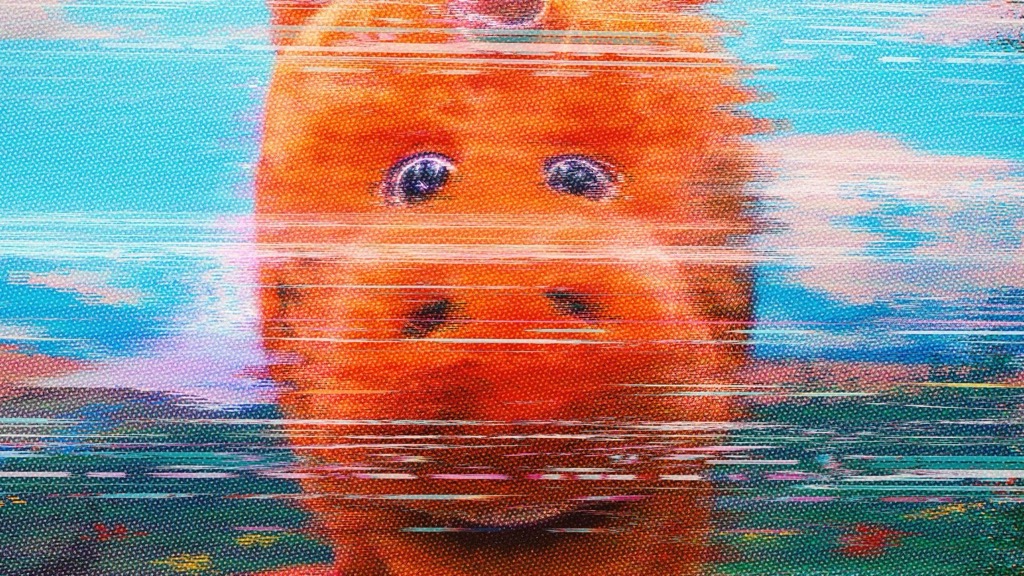
I only knew about the movie Buddy from the Dead Meat channel, so all I knew going in was that it was a horror movie about a Barney-style children’s show, written and directed by Casper Kelly, who made the “Too Many Cooks” short for Adult Swim.
And that is exactly what Buddy is, full stop. If you liked the short and the premise sounds like something you might like, you will probably like it. I didn’t even know who was in the cast, so I kept being pleasantly surprised with “oh, I didn’t know they were in this! I like them!” moments.
The idea of kids’ show horror feels like pretty well-worn territory at this point (apparently it’s even gotten a sub-genre label “mascot horror”), even though it’s difficult to think of any stand-out examples. Buddy might end up being the stand-out example.
So it didn’t feel quite as daring or completely out of left field as it might have pre-Five Nights at Freddy’s, but it did feel to me like what the whole sub-genre should’ve been like from the start. I think I respect what it’s doing more than I really loved it, but it’s still an easy recommendation. Anything more than that would be a spoiler, and I highly recommend going in as unspoiled as possible.
For years, I thought that the same people were behind “Too Many Cooks,” “Unedited Footage of a Bear,” and “This House Has People In It.” They all ran as shorts on Adult Swim, but the last two were from an entirely different team.
And warning, Insufferable Guy on the Internet Take incoming: “Too Many Cooks” was the most popular and the one that went viral, but I like the latter two a lot more. I even prefer the way WandaVision used a lot of the same ideas. They all went darker and were more surprising and confusing. Even realizing that the gag in “Too Many Cooks” was that it just kept going and going, I still felt like I got the joke after a few minutes, and spent the rest thinking, “Yep, this is still happening.”
So the beginning of Buddy was a lot of fun, since it did pretty much exactly what I expected it to do, and then kept going in a way that actually built on it, instead of simply repeating it. There were so many iterations, in fact, and it kept refusing to transition into the world outside the show, that I started to wonder if it were ever going to break out of the show like I’d expected.
The remarkable thing is that it didn’t really feel like it needed to: it had already developed a story and expanded on it enough — my favorite was Wade yelling at the replacement child “You just got here!” — that it could’ve kept going without feeling like it was repeating itself, but actually exploring the world that it had created.
And when it does finally break out, it felt as if it had established enough stuff to keep me guessing. Was this one of the children now living in the real world as an adult? Was one of her kids going to be the next one pulled into the show? Is she going to be the one who upends the nefarious scheme that’s trapped these children? Or is she the cause of it?
Buddy has a commitment to forward momentum that stories this surreal often lack. I felt like I was constantly being shown a new constant of this universe, and left wondering “what happens next?” It felt like being in a writer’s room and wondering how to keep building and expanding on the story, with the cardinal rule being “no take-backs, no resets.”
I think ultimately, that’s what I liked best about it. I kept expecting it would hit the point where it stopped building its lore, and started resolving the story and wrapping everything up. But it was more as if it kept going, showing things that felt like explanations, but weren’t really.
It’s often more of a black comedy than a horror movie, and the violence and gore are light enough that I wouldn’t have been surprised if it were rated PG-13. (It’s rated R). What makes it horror is that sense of denying the audience a resolution or an explanation.
If I were in film school, I might try to make a high-minded interpretation of the ending as being a metaphor for growing up and losing your innocence and sense of wonder, realizing that there are no happy endings, and realizing that our whole existence is essentially being dropped somewhere that doesn’t make sense and that we can’t explain.
But Buddy doesn’t really need an explanation, and it doesn’t need to “mean” anything. It’s weird, occasionally laugh-out-loud funny, and it fully commits to taking a premise and running with it.
Leave a Reply