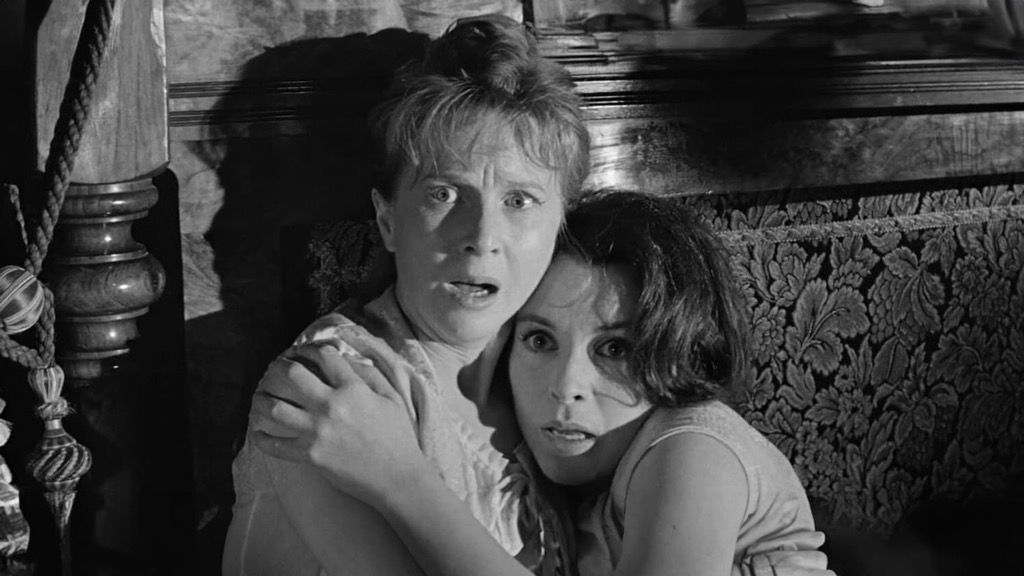
I’m not certain that I’ve ever read The Haunting of Hill House by Shirley Jackson; it’s possible I did and entirely forgot about it. I have a vague memory of reading the first chapter in high school English, because the phrase “some houses are born bad” has always stood out. That idea of a place that is not just haunted by horrible events that occurred there, but is a place of evil itself. The past tragedies are the symptoms, not the cause.
I do know that I have seen three adaptations of the source material: Mike Flanagan’s series The Haunting of Hill House, which uses the book as inspiration and adds in elements of sprawling Stephen King multi-general stories, and Lake Mungo‘s unsettling depiction of ghosts as lurking in our periphery, unstuck in time. I saw the awful 1999 adaptation, which misses the point entirely but nailed the casting of Catherine Zeta-Jones as Theo. And I’ve now twice seen the 1963 classic by Robert Wise, starring Julie Christie and Claire Bloom.
For spooky season, I rewatched the 1963 version, convinced that now that I’m more mature and refined, I’d be better able to appreciate all of the nuances that I missed years ago. After all, it’s almost universally beloved. And it’s regularly listed as one of the all-time classic ghost story movies, along with The Innocents. I finally watched that one last year, and I did come away from it with a greater appreciation for the existential horror of a ghost story, in a way that would’ve probably been completely lost on me even a decade ago.
But I still just don’t like The Haunting. And the only thing that’s changed from the first time I saw it and didn’t like it: I think I have a better understanding of why I don’t like it. It’s a case of going into an adaptation with the right ideas, but choosing the wrong way to execute on them.
The 1999 version feels even more dated than the original, since it is 100% a millennial Hollywood take on how to adapt psychological horror to a movie. All of the subtext is made text, and all the scares are made explicit, complete with turn-of-the-century CGI guaranteeing that just about everything in the house is animated at some point.
So credit to the original for understanding that what makes the story special are those moments of inexplicable horror. Characters unable to explain exactly why they are so terrified, but it’s all-encompassing and overwhelming. The irrational certainty that something is going to do even worse than kill them, but swallow them, making them eternally a part of itself. It recognizes that the modern attempts to give a psychological explanation of the fear of ghosts, calling it a fear of the unknown, misses the more primal terror of a ghost story: the fear of being forever trapped in a place, eternally walking it alone, disconnected from both humanity and the afterlife.
But The Haunting does this mostly via voice-overs. Eleanor is constantly looking, haunted, off into the middle distance while her inner monologue takes over the soundtrack. We hear her loneliness and her desperation to escape and find a group of people where she can fit in, and we hear that gradually turn into madness. And isn’t that supposed to be how books work? To describe scenes where things like a bump in the night can go from odd to terrifying, not necessarily because of an immediate physical threat, but because of a character’s mindset?
My problem with that is that it never stops feeling clumsy. I’ve got a strong aversion to voice-overs and text scrolls1Not Star Wars though. You’re all right, bro. and other fallbacks in general, moments where filmmakers declare that they can’t think of a better way to depict something cinematically. And throughout The Haunting, it just comes across to me as a lack of confidence either in Christie’s performance, or the ability of a movie to depict a character’s mindset without explaining exactly what they’re thinking. I would even have preferred there to be more of Eleanor’s inner voice being more of a dialogue than a monologue, more a sense of her arguing with herself as her mental instability takes over.
Even in this movie, her introductory scene does a much better job of portraying her mindset without giving her thoughts a VO. You really understand how awful and unstable her home life is, with the condescension and the sniping from her brother-in-law and sister, the mocking from her awful niece — “Auntie Nell is blinking again!” is so effective here, but it’s a tic that is never really repeated — and most of all, the horrible children’s music that almost overwhelms the dialogue of the scene. That scene is the best at making you fully comprehend Eleanor’s mental state, in a way that’s genuinely empathetic instead of sympathetic, in a way that nothing later in the movie ever achieves.2And while I’m very pro-Mike Flanagan on here, I should mention that I also hated the voice-overs in The Life of Chuck for mostly the same reason. They just feel like Flanagan choosing parts of King’s writing that he liked a lot, and instead of adding to the movie, they detract from it.
There are other aspects that felt clumsy and dated to me as well, making The Haunting a movie that was roughly contemporary with Psycho but still feels at least a decade older. The music is as overpowering as the corniest Hammer or Castle horror movie. And even more disappointing to me is the sound design. This movie’s most terrifying scenes depend almost entirely on the sound design, and in my opinion, they simply don’t work.
The centerpiece is that first night, when Nell and Theo are alone in a bedroom when they hear a pounding sound thundering through the house. It might be the crucial scene of the movie, the whole mission statement of a story about abject, overwhelming, irrational fear of what might be just outside the door, trying to get in. But here, it just doesn’t sound right, in a way that to me suggests limitations of technology or artistry instead of being deliberately otherworldly. There’s no sense of a source to it, or anything really identifiable to make it eerie. It just comes across as someone banging on something with the microphones’ gain turned up too high, so it’s muffled and directionless.
The best scene in Willow Creek, for instance, is entirely built around a similar idea, and it’s one of the scariest scenes I’ve ever seen in any movie, actually making me squirm, remembering the moments in my life when I’ve been the most afraid of the dark, and desperately wanting it to just end.
There’s a similar scene later, where Eleanor stares at a pattern on the wall for so long that an evil face emerges from it, and she hears laughter, she becomes furious that the house is torturing a child, and she keeps being distracted by how tightly Theo is squeezing her hand. And again, I just felt that it was all undercut by the relentless VO, the sound, and the camera work. Something as straightforward as more inventive lighting could’ve done a lot to really bring out the psychological horror of seeing evil in the pattern on the wall, but this just seems like the filmmakers were content to say “see, you can make out a creepy face” and leave it at that.
Another aspect of The Haunting that makes it feel dated is the camera work. There are some moments of great cinematography in it; a key one is a distorted shot of Eleanor walking down a dark hallway, which is revealed to have been looking at her through an old mirror. But there are also what appear to be handheld zooms and other cheap camera tricks that, again, feel more like they come from The House on Haunted Hill than The Haunting of Hill House. Throughout, I was frustrated that The Haunting was telling me instead of showing me, and then disappointed when it tried to show me, but seemed to resort to using all the tricks of 1950s B-movie horror.
Whenever I have a take on a movie that runs so far counter to the consensus on it, I try and make sure to triple-check my work. So I looked at other Letterboxd reviews, to see if there were some aspect that I was missing. And because it’s a social media site in the 2020s, the comments are overwhelmed with observations on how OMG Theo is a lesbian with ESP!
And simmer down, kids. In the 1963 version of The Haunting, the subtext is so far buried that it’s rendered entirely inert. I don’t think it would’ve even occurred to me had I not seen the 1999 adaptation first, which makes it more explicit. In this version of The Haunting, Theo’s sexual or romantic orientation is given just the barest hint of a mention, when Eleanor asks if she’s married, and Theo says “no” with a look that suggests “there’s more to that answer that we won’t be talking about.”
What’s far more interesting about Theo, who’s the most interesting character in the movie, is her independence and self-confidence. She is uniquely capable of empathy for Nell, because her ESP makes her uniquely capable of instantly reading people, but she’s also everything that Nell isn’t. Stylish, self-assured, more fully realized as a person who doesn’t need anyone else to complete her or validate her. Her assumed sexuality is an aspect of that, but it’s far from the most interesting aspect.
She repeatedly describes her and Nell’s relationship as being “like sisters,” and I suppose if you’re eager, you could read it as a sly acknowledgment of subtext. But then she goes on to spend most of the movie treating Nell like an actual sister. All of the things that was missing from Eleanor’s relationship with her real sister: joking with her, letting her paint her nails, suggesting a new hair style, being with her as she experiments with alcohol. And all of the things that she got plenty of from her real sister: cruel mockery, accusations of how she treated her mother, sudden inexplicable coldness.
So looking for signs of queer subtext feels about as relevant as the videos that went through Mike Flanagan’s miniseries adaptation, looking for ghosts hiding in the background. It may be fun, and it was certainly intentional on the part of the storytellers, but it doesn’t actually mean much of anything on its own. “Look! I saw a lesbian!” is much less interesting than a character who stands both as a contrast to Eleanor and also the one most capable of understanding her. She’s also somewhat on the fringes of society, not having the traditional sorts of connections with other people. But unlike Eleanor, she’s never a victim.
Claire Bloom’s performance and her look are both excellent and perfect for the part, but I felt like she was let down by the screenplay. Her swings in behavior and random snipes at Eleanor don’t seem to be motivated by anything; it’s just that sometimes she’s kind and other times she’s cruel for no reason. Is the movie being an unreliable narrator, and showing us the version of Theo as Eleanor sees her in the moment, as her mind is breaking down? Who knows? When the movie is constantly giving us a voice-over of Eleanor’s exact mindset, adding a layer of misdirection in the form of an unreliable narrator is going to be completely lost, anyway.
Incidentally, the handling of Theo in Flanagan’s The Haunting of Hill House is one of the ways I think it’s a better adaptation, by means of veering farther from the source material. Here, in addition to the Stephen King and Lake Mungo, Flanagan adds a little Rogue from The X-Men, giving Theo distinctive gloves that prevent her from being overwhelmed by her ability to involuntarily read people with any skin contact. It’s an extremely direct and explicit image, but it also shows you exactly what it wants to show you about the character. Unlike Eleanor’s, her feeling of isolation is self-imposed, because her empathy is too much. It’s juggling some of the ideas of the original story, throwing in a few decades’ worth of pop culture, and synthesizing something new that’s faithful in concepts if not in details.
So ultimately, my take on The Haunting is that its intentions were in exactly the right place, in understanding that B-movie scares aren’t what make the story scary. But it undermines those intentions by applying too much B-movie filmmaking to it, making the end result feel even more dated than movies that preceded it.
Edited to add: While I was hating on this classic movie, I totally forgot to call out the one scene that I think works, completely and unreservedly. There’s a scene where all of the characters are in a room as the house’s evil is pounding through the halls, trying to get in, and we see the door breathing. The solid wood itself has become elastic, as something seems to be pushing its way not just into the room, but at the barrier between the supernatural and the real world.
It’s a fantastic effect, expertly done. And it’s so effective that Disney would borrow it years later for their Haunted Mansion. (But it’s undermined yet again, in my opinion, by the movie keeping all of its focus on Eleanor instead of the character that some of them should be more immediately invested in. More grounds for Eleanor being an unreliable narrator who’s trying to make everything about her, but not done strongly or consistently enough to make it land).
Leave a Reply