Or, “Mister Insurance I Gave You All The Clues”
A couple of years ago, I decided I would finally carve out some time to play Return of the Obra Dinn, which I’d been looking forward to ever since I bought it on its release.
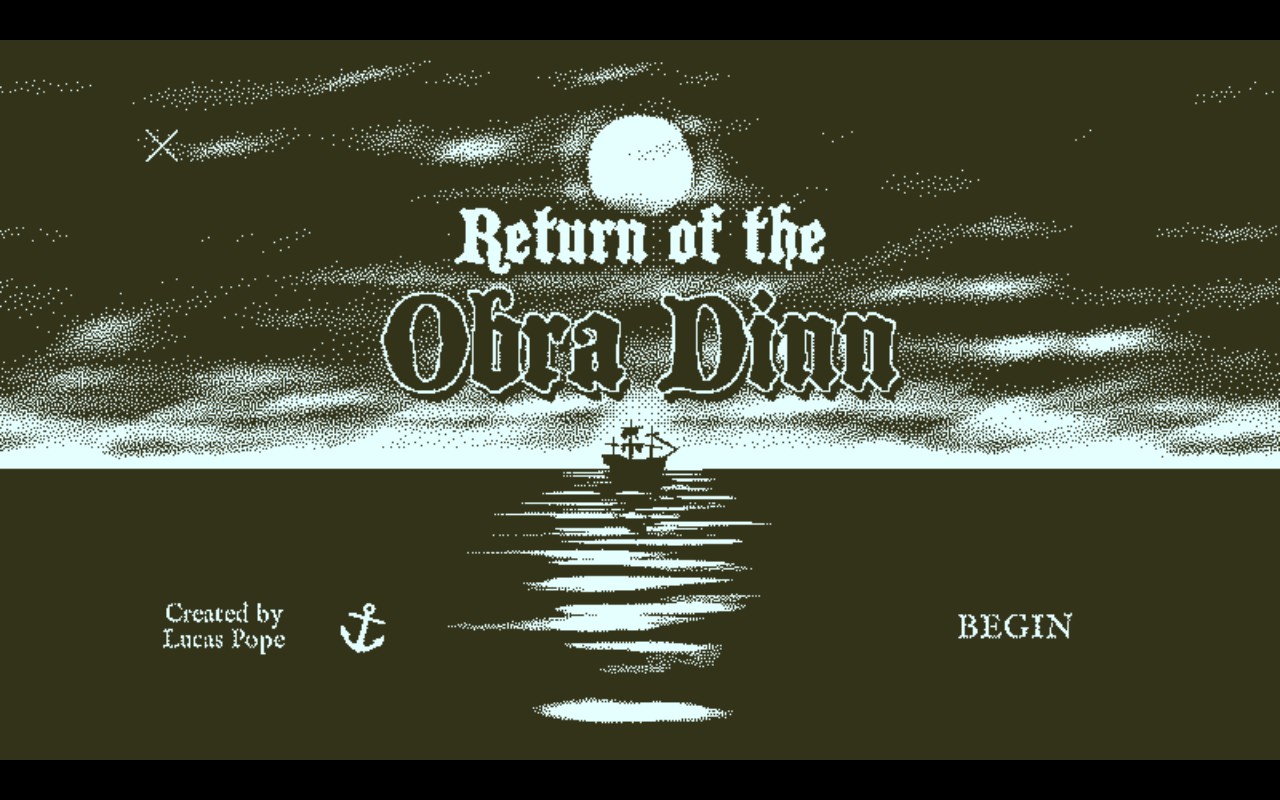
After a title screen which is perfectly evocative of games from the days of the classic Mac, I got dropped into a boat and handed a magic pocket watch and a book labeled “A Catalogue of Adventure and Tragedy.” Inside was a short introduction explaining I was an insurance inspector for the East India Company, with the job of assessing what had happened to the ship the Obra Dinn, which turned up in port after having gone missing for several years. There was a manifest of 60 crew members and passengers, multiple drawings of the crew and passengers from the on-board sketch artist, a diagram of the ship, a glossary full of nautical terms, and blank pages of a story seeming to span multiple chapters. It was evident that this wasn’t going to be a quick and casual game.
I boarded the ship and went through the first instance of its core mechanic. You find the remains of a person, your character pulls out their handy magic pocket watch, and you use it to play back the specific moment that that person died. You get a brief bit of audio leading up to the event, then you’re suddenly dropped into the scene, frozen in time at the exact moment of their death. You can freely move about, examining everything from multiple angles, to figure out the exact cause of death. Then your Catalogue of Adventure and Tragedy pops up, and you can enter the details: “<Unknown soul> was shot by <unknown person>.”
Perfectly imaginative and well-executed, just repeat that 59 more times and you’ve got a game that’ll receive universal acclaim. I decided that this would be an excellent game for Future Me to dig into, but for now I was satisfied that I knew exactly what this was. A meticulously-researched, well-written, and very dry story of intrigue on the high seas, told via a complex series of logic and deduction puzzles. The charm came in its classic Mac aesthetics and its central conceit of a magic stop watch.
As anybody who’s played the game can tell you, all of that is basically true, with one huge exception: the “very dry” part. I have to be amazed at how impatient and incurious I must’ve been back then, because if I’d just given it five more minutes, I would’ve seen how quickly the game gets really, obscenely, infuriatingly good.
I’m not going to bother with a recap or objective review of the game (since there are plenty of them out there, and I can’t add much), but I’ll just describe my favorite aspects of it. Everything I’ve mentioned so far is in the first five to ten minutes or so, and I’ll avoid spoiling anything else in the game, but if you want to go in completely cold, I recommend that. Return of the Obra Dinn quickly became one of my favorite video games of all time. It’s just a thoroughly exceptional achievement in every regard.
My reaction to the game after an hour or so of playing was that it made me really angry. The difference between now and the first time I tried playing it is that now, I’ve finally committed to making a go at independent game development. And Return of the Obra Dinn raises the bar for independent solo project impossibly high. It’s so good in every single detail that it goes past being inspiring and wraps back around to dispiriting.
Even if you’re not familiar with Lucas Pope’s other games, and especially his development journals, you could recognize this as an independent game with a small team or a solo developer. Not in the negative sense, where you’re having to make concessions because “bless their hearts, they did the best they could,” but because it so thoroughly feels like the creative vision of a developer making deliberate and conscious choices at every step. And making the right choice at every step.
The game’s vignettes and its overall presentation are so evocative that you can complete the entire story without realizing that there’s very little animation, for instance. You never actually see a character speaking. There’s a limited number of locations. Some of the significant characters, you only see once in 3D. Some significant characters have only one or two lines of voiced dialogue.
None of these feel like a limitation of resources, but deliberate choices, using exactly the right combination of drawings, audio, and 3D models to establish the characters and story. The natural inclination might have been to say that since the audio portions of each vignette are just subtitles over a black screen, and we’ve got the actors in the studio anyway, we can compensate for the limited animation by giving them a ton of dialogue. Instead, each character says exactly as much as they need to convey their character (as well as any hints or references to drive the gameplay forward), no more and no less.
It doesn’t feel like a solo project, but a project where you can look back and see that it was all made by one person. As long as that one person is preternaturally good at literally everything.
And it’s important to take the gameplay into account, because it’s perfectly integrated with the storytelling. In retrospect, this was a good game to play immediately after Her Story, since both use a similar mechanic: dropping you into an intriguing scene without sufficient context, and making the process of figuring out that context the core part of the game. But while Her Story brought that concept to the forefront and made it the entire game loop, Obra Dinn has more of a sense of being narrative driven. The game loop, along with the roughly reverse-chronological delivery of story vignettes, feels like the most interesting way to convey this story of Adventure and Tragedy.
There’s no disconnect between your actions as a player and the unfolding of the story, because your objective at every moment is to reveal more details of the story. Characters become familiar because you keep seeing them show up during key events, even before you know who they are. And that lack of knowing is intriguing, bringing them to the forefront of your mind far more effectively than a lengthy bit of exposition would have.
One character seemed to be showing up in just about every major event on the ship, and it was maddening that I couldn’t figure out who it was. Eventually, I was re-watching a seemingly unrelated scene for the third or fourth time, trying to piece together the identities of that scene’s major players, when I noticed a brief, blink-and-I’ll-miss-it-not-just-once-but-multiple-times mention of the man’s name.
My initial impression of the game was that it was going to be a very dry series of logic puzzles, but the only thing “dry” about the game is its sense of humor. I can only recall two moments of outright comedy, one with a character not able to handle the slaughter of a cow, and the other with a man meeting an extremely ignoble death. But I did get the “bad” ending, when events on board seemed to change, and I tried something just to see what happened. It concluded with reading a letter that was so drily funny I couldn’t even be mad that I’d gotten the bad ending. Especially since the game is generally forgiving, and it lets you rewind without losing any of your progress.
And the entire conceit has a deadpan humor about it. When you’re moving around within these moments of frozen time, everything is silent except for the suitably echoing sounds of your footsteps. Occasionally, there’s a piece of music that sounds almost jaunty in contrast to whatever horrific scene you’re watching. It makes you step out of your character for a moment and appreciate the absurdity: a proper English gentleman with his pocket watch in hand, silently walking around often-spectacularly gruesome scenes, dutifully writing notes into a log book.
Mentioning the sound: perfect, like everything else. The sound design is excellent, and the music is exceptional. The stinger of strings when you enter a death scene, the echoing heartbeat as you walk around the scene, the majestic tune that plays as you follow a ghostly trail towards a new set of remains. I wasn’t paying close enough attention to know whether the music that plays over the scenes is chosen randomly or is specific to each scene, but it was often just incongruous enough to work, reminding the player that this is an adventure tale, not a cliched horror story.
The title screen is obviously intended to suggest classic Mac games, but I have to wonder if the music that plays over the title was intended to call back specifically to Beyond Dark Castle. Obviously, the music in Obra Dinn is more sophisticated and elaborate than the music designed to play over a tinny mono speaker in the back of a classic Macintosh, made at the time when sampled audio was still a huge novelty, but the memory was so immediately and thoroughly called to mind that I wouldn’t be surprised to learn it was intentional.
Much like the drawings of the crew — which are used extensively, and become the main way we get to “know” them — are perfectly evocative of 19th century drawings and engravings, the relatively low-poly character models are evocative of classic games on 1-bit displays. This is a game that never could’ve possibly existed on a classic Mac, but it overwhelmingly feels like it could have.
My only very minor criticism of the game is that in a couple of cases, the game’s commitment to the 1-bit aesthetic made it a little difficult to tell exactly what was going on in a scene. Is that an explosion, or something else? In one scene, I was certain that I’d correctly identified the characters involved, but the game was refusing to acknowledge it; eventually, I went back in and saw the tiniest hint of a murder weapon. But in both cases, the game is pretty forgiving of experimentation and guessing, and it’s pretty quick to tell you when you’re on the right track.
Which is the last thing I’ll call out as a perfect detail: so much of the game feels responsive and in dialogue with the player. Cutscenes are charmingly set to the beat of the music, and visuals and sound effects make it clear what you’re doing with little need for over-explanation. When you ask for an explanation of the log book, or tips on how to play the game, a cut-scene plays out highlighting relevant sections of the book along with short lines of text, each line corresponding to an orchestral stinger. Every time you get the “Well done.” cutscene after getting three fates correct, it’s absolutely charming and satisfying.
By the end of my time with Return of the Obra Dinn, I’d gone through two complete cycles of inspiration-to-anger-back-to-inspiration. It’s just marvelous that this game exists at all, and wonderful that it’s largely the creative expression of one obnoxiously-talented person making all the right choices. I don’t think it’s hyperbolic to say that it’s a fantastic example of what video games are capable of: a novel concept in a somewhat niche genre, used to tell a story in a way that only interactive fiction can.