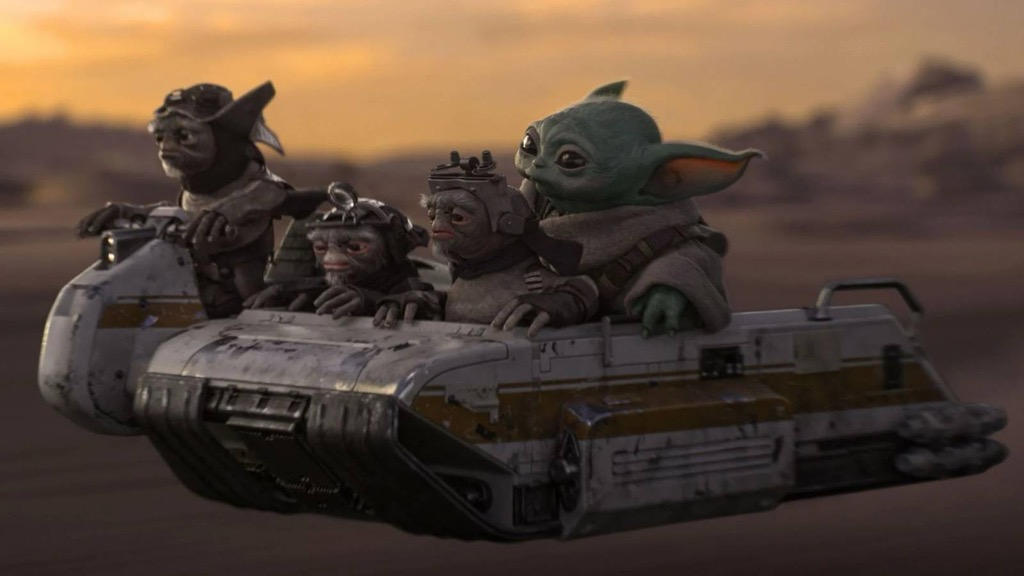
People have had a huge bug up their collective ass about The Mandalorian and Grogu ever since it was first announced. It was being put forward as the culmination and perfect representation of everything wrong with Star Wars since the Disney acquisition. There were comments declaring it a failure, and speculating on how to save the entire franchise, before it’d even reached the Friday of its opening weekend.
Several reviews talked about it as if it were a slap in the face to the very concept of cinema, especially ironic considering that Martin Scorsese voices one of the aliens.1It took me forever to realize which character he was playing, since I spent the entire scene assuming it was a voice actor doing a Woody Allen impression. The best you’d find was an exasperated, “It’s fine, I guess.” All of the reviews seemed pre-written.
But to be fair, my review was pre-written as well. I was already thinking that watching it last night would be nothing more than a formality, and my take would still be: “It’s an episode of The Mandalorian, one of my favorite television series of all time, padded to feature length and projected in IMAX. What’s the problem?”
The “problem,” as it turns out, is that The Mandalorian and Grogu isn’t really that. In a lot of ways, it is exactly the Commercial Entertainment Product that everyone, including me, expected. But it is also so much weirder than I’d expected.
The entertainment product aspects are there pretty much exactly when and where you’d expect them to be. The BD droids are never made characters, but are just seen walking in the background behind Sigourney Weaver’s character — here’s those adorable robots you can see inside Disneyland! At a gladiatorial match, Grogu’s in the audience eating a bag of colored popcorn — just like the kind you can buy at Disneyland! More than any other Star Wars production I’ve seen, it feels as if the process was flipped, and the first draft of the movie was written by a marketing team, which was then handed over to “creatives.”
And there’s just no getting around it: the script and screenplay are pretty bad. I had pre-calibrated myself to be ready for it to be under-written, and to accept that because the screenplay is simply not the point of a movie like this. But it’s not the clunky-but-memorable dialogue of the prequels, the “written by committee” patched-together feel of the third trilogy, or the corny writing of the animated series which are primarily aimed at children. It often feels like someone making an unintentional parody of a cliched action movie. It was already giving me strong “Did Strong Bad write this?” vibes even before it got to the point where our heroes have to escape a palace. “Looks like we’re gonna have to juuummmp!”
A specific example is the scene where The Mandalorian goes to visit the unsettlingly ripped Rotta the Hutt in his cell. There’s a lot of first draft-caliber dialogue2I’m being charitable here; it’s more like the placeholder dialogue you say out loud during a brainstorming session establishing the basics: he’s got one more fight before he’s done with his contract, he’s lived in the shadow of his father Jabba the whole life, he’s nothing like his father, this is his chance to make something of himself on his own terms, his life is in danger if he goes back to his aunt and uncle, etc.
None of it is particularly awful on its own, it’s just so completely inert. It’s a muscular space worm being massaged by robots and monologuing about how he coulda been a contender instead of a bum which is what he is, and it’s still so somehow devoid of energy that it drains it of any potential spark from the weirdness of it all.
But even that isn’t the worst offense. Mando returns to the cell after a short adventure, and we get basically the exact same scene play out again. The exact same ideas, said in slightly different ways. Nothing new is learned. Even more than during The Rise of Skywalker and Attack of the Clones, I started to feel resentful of how clumsy the writing was considering the obscene amount of money that must have gone into making this movie.
And it’s all made even more inert, lifeless, and surprisingly slap-dash by other choices. The editing is weird, with scenes not having a good rhythm and everything lingering on a few seconds longer than it should. There’s little sense of escalation, just one thing happening and another thing following. Mando describes the cold open adventure as “messy,” and that gets repeated several more times, as if it’s sharp action movie banter. Even Weaver’s stunt casting feels off — through no fault of her own, but simply because we’re at least a decade past its feeling like a special treat when she shows up in a project, and she’s not really given anything here to remind us of why she became so legendary.
I realized that this wasn’t the case of an episode of The Mandalorian stretched out to feature length, simply because the TV show was so much better at this stuff. Not even I would claim that its dialogue or performances were outstanding, but they were perfectly in concert with what the show was trying to do and trying to evoke: the efficient, “pure storytelling” aspect of classic TV westerns. The low-effort clumsiness of the storytelling in The Mandalorian and Grogu felt jarring because it wasn’t just clumsy, it was a waste of time.
But, all that said, here’s the thing: I still really enjoyed the movie.
It’s kind of fitting that I watched it so soon after Police Story and Police Story 2, because there’s kind of a similar thing going on. Criticizing the scripts of those movies for being corny or cliched wouldn’t be wrong, just completely missing the point, because they’re trying to do something so different that they might as well be in a different language of movie, not just speaking a different natural language. They exist as a showcase for the kinds of things that only Jackie Chan and his team are capable of doing.
And I really do believe that The Mandalorian and Grogu is the most unabashedly excessive showcase for the things that only Star Wars is capable of doing. Which is assembling some of the most talented people in the movie industry to devote those talents to making something that’s just batshit weird.
There are fairly lengthy stretches of the movie that are just a bunch of puppets walking around, almost like watching a non-verbal The Dark Crystal. There are multiple instances of giant robots or walkers that might have been stop motion animated, or just perfectly computer-animated to look like stop motion. There is a never-ending parade of all kinds of bugs, sentient aliens, and non-sentient alien creatures. There are spaceships of various designs and sizes. A mob boss has a bunch of land speeders that have the design language of old Studebakers and other classic cars.3Kind of like the Tatooine Eurotrash gang’s Vespa-inspired speeders that were a highlight of The Book of Boba Fett. There are glimpses of worm-like Hutts writing around with each other in alcoves inside a palace, engaged in who knows what. There’s a lone fisherman character who’s some kind of amphibious species4And voiced like a kindly Magical Black Man, because Star Wars gonna Star Wars, in a long scene with four different non-humanoid species of alien.
It’s all overwhelming and even relentless in throwing more stuff at you. In any other Star Wars production, I would’ve thought that it was the movie making sure that all of the items in the upcoming toy line had sufficient screen time. But here, there’s just too much of it to give that impression. It feels more like they had a surfeit of concept art — as with every Star Wars thing, which is going to generate more ideas than it can possibly execute on — and a check from Disney making it possible to put every single last bit of that concept art on screen.
It’s been so long since the first Star Wars movie that it’s almost impossible now to watch the cantina sequence with its original context in mind. At the time, it felt like a ton of weirdness crammed into one scene, with characters only on screen for a few seconds becoming immediately iconic. Is this what Star Wars is? Now, we know that they weren’t able to fully realize all of the alien ideas that went into that scene, and several of the characters were on screen for such a short time not to be evocative, but to hide how cheap the costumes were.
The Mandalorian and Grogu feels like an attempt to call back to every single method that’s been used to bring the ideas of Star Wars to the screen, from models against blue screens and mattes, to stop motion animation, to puppetry, and eventually to CGI. And for the first time, it felt not like characters and models and aliens being on screen for world-building to support some attempt at “modern myth.” It felt like all of that stuff being taken out of the background and given full focus. Not as if it’s a part of a larger production, but that the reason the production even exists is to celebrate all of this work.
I’ve lost the link, but the other day I heard an insightful observation about the concept art that ends every episode of The Mandalorian: that artwork isn’t actually concept art; it’s marketing. That’s why I love the end credits of the series so much, and why I love the series so much. Whether or not those pieces of art genuinely are used as concepts is almost irrelevant. Their primary purpose isn’t to generate ideas. They are the idea.
A huge part of why I love that series is that it’s not just nostalgic, but it feels like being transported back to exactly the time period when I was most enraptured by Star Wars. Obsessed with the movies, obsessed with television, wishing that I could see more new Star Wars on TV every week. It’s the show that I wanted back then, but which couldn’t possibly have existed back then.
It’s also when the movies were incorporating more and more of the “behind the scenes” of their production into the marketing. So people around my age at the time were extremely likely to have copies of Ralph McQuarrie’s concept art, like the prints I had hanging on the wall of my bedroom.
The “boss monster” in The Mandalorian and Grogu is like a living piece of that concept art. Even the texturing on it looks deliberately painterly. The monster itself isn’t all that interesting, honestly — not a knock on the creativity of its design, but simply an acknowledgement that we’re now so over-saturated with weird alien creatures, in pop culture in general and just within this movie, that scenes like this can’t work the same anymore. But because of how it’s presented, it’s still immediately evocative. For me, evocative of a specific piece of art with Luke Skywalker facing off against the rancor in Return of the Jedi concepts. As if the movie is demanding that we not skip over these images, but stop and really think about how much artistry goes into the creation of them.
Even if Doug Chiang, a now-famous Lucasfilm designer, weren’t pointedly included in one of the movie’s many cameos, The Mandalorian and Grogu would feel like a celebration of the entire franchise’s history of artists, which includes model makers, animators, painters, and much more.
The gladiatorial match was clearly a reference to the chess game in the first movie, even before they added layer after layer to make absolutely certain the audience was picking up on the reference. Entire animations are modeled after the brief-but-iconic ones depicted in that scene. By the end of the sequence, I felt that it wasn’t just a case of being too on-the-nose with an extended easter egg/reference, but a pointed homage to the work that had been done by Phil Tippett and his team.
While I was trying to come up with a short and pithy way to sum up The Mandalorian and Grogu, one idea was “it’s like watching a bunch of adults playing with millions and millions of dollars worth of custom-made Star Wars toys.” I still think that’s accurate, but it’s not nearly as derogatory, crass, or marketing-driven as that makes it sound. By the end of the movie, I felt like it was a genuine declaration that this was their favorite part of what Star Wars means to them.
I still haven’t watched Andor, and I’m confident that it’s as good as people are saying it is, that it executes on what it sets out to do, and I’ll probably enjoy it whenever I do get around to it. But it’s just not my “flavor” of Star Wars. I’m all about the pulp adventure side of it, and love how intensely nostalgic projects like The Force Awakens and especially The Mandalorian bypass my intellect and hit me directly in the gut. Meanwhile, the impression that I get from Andor is that it uses the setting and design of Star Wars to tell a larger story, which is intended to be more directly relevant. As its fans would say, an “adult” story.
The Mandalorian and Grogu isn’t quite my favorite “flavor” of Star Wars, either. But, even as it blatantly checks off a list of franchise requirements mandated by Disney marketing teams, it feels like an earnest celebration of somebody else’s favorite flavor. This is what Star Wars means to them, and they’re finally taking decades’ worth of work and artistry out of the background, and giving it all the money and the spotlight it deserves.
Comments
3 responses to “One Thing I Like About The Mandalorian and Grogu”
One thing I especially appreciated was that all three actors for Mando were credited in the opening credits. Opening credits are a new thing for Star Wars in general and made it seem more like a TV episode for a second, but it was particularly interesting for a franchise built on under-credited suit doubles (David Prowse struggling to get credited for being inside Vader’s suit; Ray Park trying to get accurately credited for work as Darth Maul; etc) it seemed like such an interesting statement for both the suit double and stunt double to get equal “top billing” in the opening few minutes alongside Pedro Pascal. (Which they deserved, especially with reports Pascal’s direct involvement in shooting was even less than average episode because of filming Fantastic Four at the same time.)
It feels like a very Jon Favreau thing to do, given his hard work for Marvel and Disney’s “live action remakes” (and even the Mandolorian TV show) and respect for stunt work and mocap work. It seems like a good thing if Jon Favreau is setting this sort of tone for whatever this next era of Star Wars movies will be.
Completely agree. I was initially put off by how the opening credits made it seem “off” for being not as cinematic as a big-screen Star Wars movie, but instantly was on board when I realized it was finally giving prominent credit to everyone who played Mando.
I have to say I found it completely flat, I just felt completely numb to anything here. Admittedly, never saw the TV show, and Andor turns out is way more my flavor, I guess. Even though I’ve seen the original trilogy a number of times (granted, it’s been more than a decade since I watched them), I did not pick up on any of the stuff you picked up on, though they are very much there now that you point them out to me. I did not get the sense that my audience was having a good time, except for some titters around Grogu and his band of tiny friends.
There just weren’t ups and downs, no sense that things were lost or were at stake. I think the voice performance for Rotta didn’t help — I didn’t feel like it mattered, and that’s where I should have been able to care a bit about what happened (but him being a Hutt certainly doesn’t help). When I saw The Force Awakens I said “Well, they sure put a lot of Star Wars in that Star Wars movie,” but at least it felt like there were things at stake.
The amphibious species fishing in the bayou reminded me of Sebulba (sp?), the pod racer. And of course, now that you have me reflecting on how this is touching on all people’s favorite flavors, of course what he’s doing is evoking/rhyming with Yoda and Luke about whether Luke is afraid… “You will be” becomes “You should be.” None of that landed for me.