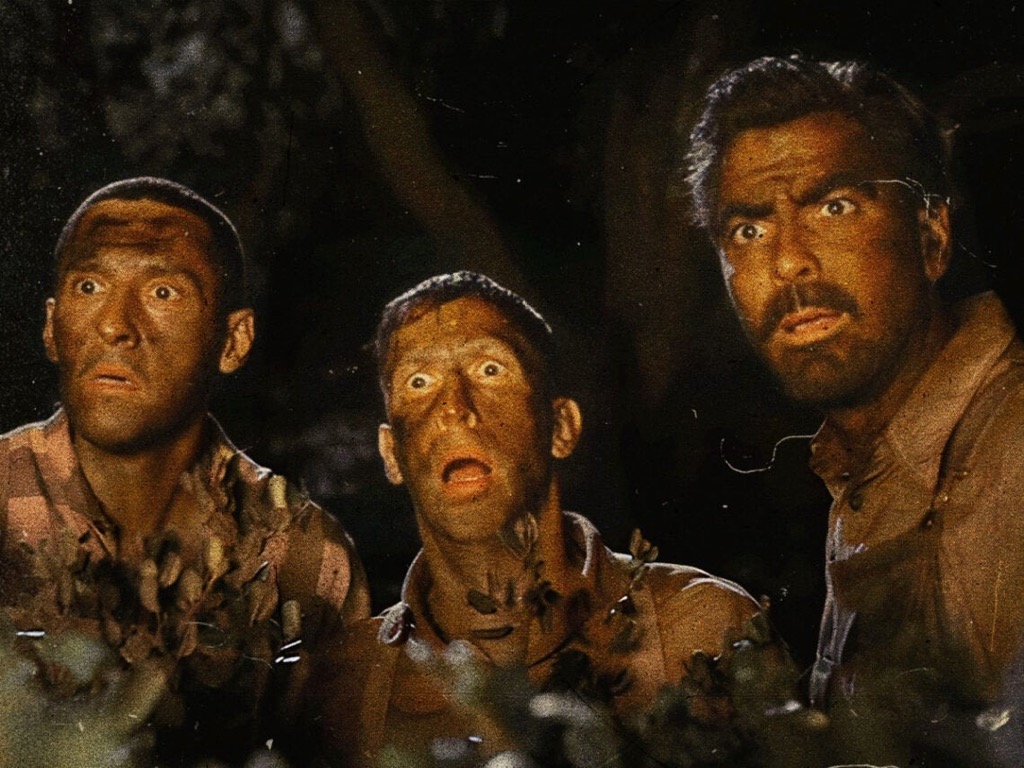
Yesterday when I was giving the definitive take on Christopher Nolan’s version of The Odyssey, I made a kind-of throwaway mention of O Brother, Where Art Thou? as a case of the Coen Brothers’ being uninterested in adapting The Odyssey so much as making fun of the pretentiousness of filmmakers who’d presume to adapt The Odyssey.
Today, I saw a good essay titled “All Coens Are Liars: O Brother, Where art Thou? and Homer’s Odyssey“ by Anise K. Strong-Morse, where she goes deeper into comparing the movie and the source material, as well as its various references to other sources throughout film history, in particular The Wizard of Oz and Sullivan’s Travels, along with the history of the southern US and bluegrass music. I recommend it to anyone who’s a fan of the movie! It provides a lot of context that I wasn’t aware of, and suggests some elements (like Everett’s hair nets) that I wouldn’t have recognized as having any possible connection to mythology.
But the most interesting part to me is the central question she uses to frame it. Basically, why did the Coens lie about never having read The Odyssey?
I feel like I should remind anybody reading this that I am a huge, verging on simpering, admirer of the Coen Brothers. To the point of deliberately avoiding interviews with them, or anything mentioning their takes on their own work. I’ve got a huge backlog of books, commentaries, and making-of featurettes scattered around on various forms of media, but I won’t go near them, just in case it ruins or even lessens my interpretations. Like Llewyn Davis says, you don’t want to find out too much about an artist, because “It ruins the mystique.”
Two of the comments they’ve made that have crept into my awareness over the years: their claim that Tommy’s hat in Miller’s Crossing is “just a hat,” and their claim that Tim Blake Nelson was the only person involved in O Brother who’d ever actually read The Odyssey.1Strong-Morse’s essay suggests that the Coens claimed they only read the Marvel Comics adaptation of it, but earlier attributes that to a critic of the movie, not the Coens themselves.
I believe the latter claim a lot more than the former, but I’m not entirely convinced of either one of them. Leaving people guessing is a key part of their whole schtick. And to be 100% clear, Strong-Morse gets this, and the title of the essay is jokingly part of her comparing them to the character of Odysseus in that they’re all tricksters. I imagine that they’re happy letting people — like me, specifically, who get a kick out of writing about things other people have made — get stuck in spirals trying to figure out what’s the “truth” or not. I don’t believe that there’s any genuine deception behind it, any more than they need people to believe that the Roderick Jaynes who edited their movies is a real person.
But I don’t think it’s nothing more than a gag, either. And the alias, the hat, and the insistence that they never read the story they adapted, are all part of the same thing. The desire to avoid this:

That’s a screenshot from the imdb entry for The Odyssey, which after the starring cast, lists “Director: Christopher Nolan” and “Writers: Christopher Nolan and 1 other.”
I don’t know that much about Nolan outside his movies, either, but it’s pretty hilarious to imagine anyone getting into a “Puppet Show and Spinal Tap” situation with Homer. I’ve got to point out that the credits for O Brother list the Coens after one of the most influential authors in the history of western literature, even though that movie is even less of a direct adaptation than Nolan’s is. It’d be silly to criticize Nolan over an imdb entry, but I think it’s okay to laugh that he wasn’t savvy enough to avoid the situation outright.
My grand unified theory of the Coens’ movies is that they’re adamantly populist, or at least anti-elitist. That post is one of the few things I’ve written on here that I’m genuinely proud of. It’s responding to an excellent essay that concluded that their movies are about flawed characters with the best of intentions, who are doomed to be punished far beyond the severity of their transgressions, all by the capricious whims of fate. I still don’t agree with that. I say that they’re punished for hubris, arrogance, and the belief that they’re somehow exceptional.
And by that measure, I think Nolan’s version of The Odyssey and O Brother, Where Art Thou? are surprisingly similar. One is almost painfully earnest and entirely humorless2Except for Robert Pattinson’s performance, I guess, and the other goes so hard in not taking itself seriously that even its title is a joking reference. But they both do basically the same thing with the main character, which is undermine his status as a clever, smooth-talking hero who gets repeatedly tested due to divine intervention. Both versions center on guys who think they’ve got everything figured out, and then spend a long time being shown repeatedly that actions have consequences.
Which surprised me for a few reasons. One is that my impression of Nolan has always been that he’s so self-serious that he’s practically the anti-Coen Brothers. Another is that as much as I love O Brother, Where Art Thou?, I have always thought of it as a couple of very smart filmmakers goofing off, without thinking much about how they might be using the format of The Odyssey for anything more than a framework for a comedy.
And the third is it’s made me soften a little on my assertion that familiarity with the source material doesn’t have much of anything to do with your interpretation of an adaptation.
I’m still adamant that movies don’t need pre-requisites. Even Marvel ones! It’s most often used as gate-keeping, to suggest that somebody’s take on an adaptation is more valid than anyone else’s, just because of their familiarity with the source material. “Here’s a detail about the Jim Crow south you might not have noticed in Sinners” is great. “Here’s everything this movie got wrong, from someone who actually read the book,” is garbage.3And of course, calling for a “historically accurate” version of a mythological story is nothing but the rantings of a desperately attention-seeking moron.
But it’s silly to claim (as I did) that familiarity with the source material is completely irrelevant, because it helps you recognize what the adaptation chooses to cut, change, or leave intact. That’s what makes an adaptation additive. And recognizing the changes makes you think about why the adaptation made those changes.
In Nolan’s Odyssey, removing the physical presence of the gods, which I think is a huge part of the original stories, emphasizes that core idea of self-determination and a clear moral code: you can’t use them as justification for your transgressions, or blame them for your failures.
In O Brother, Where Art Thou? depicting Ulysses as vain, cocky, and easily flummoxed isn’t just funny, but it undermines his own self-image as a charming, smooth-talking hero who’s always one step ahead of everyone else. He’s repeatedly shouting “Damn! We’re in a tight spot!” as if he weren’t the one responsible.4I didn’t realize it while I was watching it, but I would’ve enjoyed The Odyssey a thousand times more if just once Matt Damon had shouted, “Damn! We’re in a tight spot!”
And it makes the movie fit even more snugly into my grand unified theory: a “hero” being punished for his vanity, arrogance, and dismissing people as hayseeds and yokels. The only people who seem to hate anyone giving the high hat more than Johnny Caspar are the Coen Brothers themselves.
Maybe one day I’ll get Marshal McLuhaned, and I’ll get an email from one of the Coens saying “you don’t understand our movies at all.” (That would be kind of awesome, actually). But until then, I’m sticking with the idea that they’re very, very smart filmmakers who take an extremely precise, exacting approach5According to Josh Brolin, anyway, and who’re you gonna believe? to making movies that are ultimately all about taking yourself less seriously, and rejecting the idea that you’re better than anybody else, or more in control over your own destiny.
So whether “we never read The Odyssey” is true or not isn’t as important as why they’d mention it. It’s the same reason as insisting “it’s just a hat:” to say that they’re not the owners of your interpretation of the movie. They’re not going to claim that their work is the definitive take, or that their version of it is more valid than what you got out of it, just because they went to film school or studied philosophy. They’re not going to tell you in an interview what it means or everything it represents; that’s what the movie is for.