Book
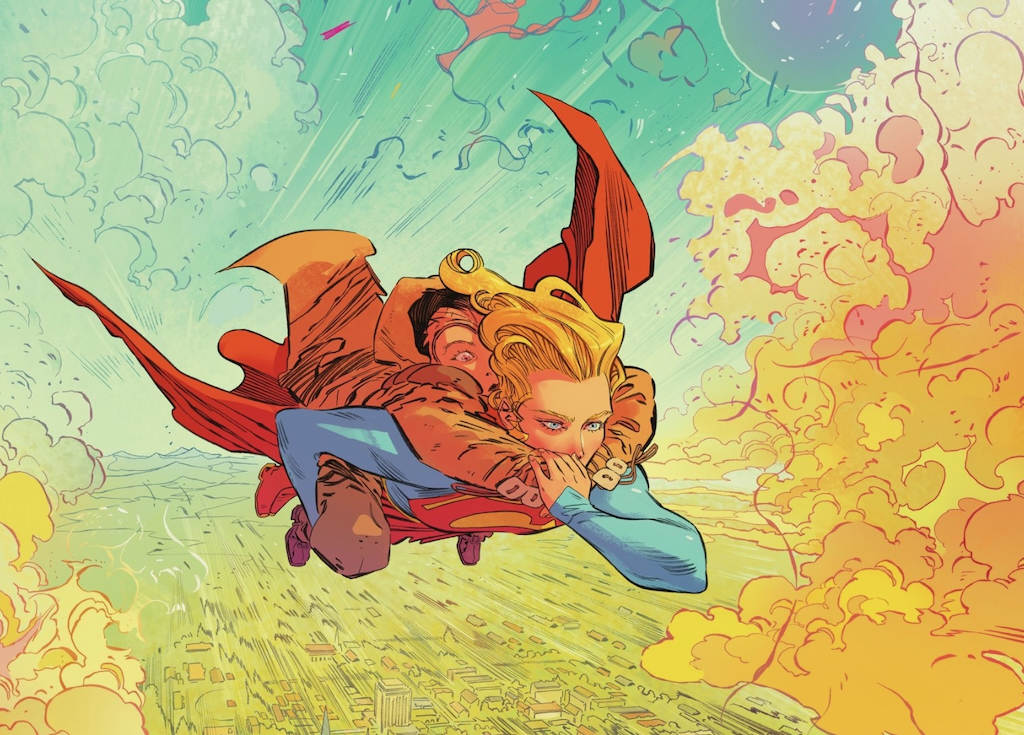
Supergirl: Woman of Tomorrow by Tom King, Bilquis Evely, and Matheus Lopes
Format
8-issue comic miniseries
Synopsis
Ruthye, a young rock farmer from a planet with a red sun, sets off on a quest for revenge to kill Krem of the Yellow Hills, the man who murdered her father. While in a bar looking to hire a suitable bounty hunter, she runs into a super-powered and very drunk young woman, who intervenes when things get violent. After Krem poisons Supergirl’s dog and steals her spaceship to escape the planet, the two young women set off across the universe to both bring the man to justice and find the cure to save Krypto.
Notes
This is the main inspiration for the upcoming Supergirl movie, which was originally titled Supergirl: Woman of Tomorrow1Which I mention to indicate how it was even more of a direct inspiration than All-Star Superman was for last year’s Superman. Even the trailers for the movie make it clear that it keeps similar story beats but makes significant changes to place it in the new version of the DC cinematic universe. The comic series is firmly set in the decades-long comics continuity.
Normally, my take on comics is that they’d be better if they stopped being so beholden to continuity. Especially a continuity that stretches back to the Silver Age, when creators weren’t all that concerned with how the story would continue past the current month, and therefore had no qualms introducing super horses, chimps, a glass-domed city from Krypton with an additional surviving cousin, or a Legion of Super-Heroes from the future.
Woman of Tomorrow is an excellent counter-example to that take, because it embraces the decades of continuity, treating them not as inconvenient things to write around, but as cool and weird ideas to explore. It’s not as extreme, but it’s a little similar to Sandman in treating comics history as an opportunity instead of a liability.
The influence of True Grit is clear, casting Ruthye in the role of Mattie Ross and Supergirl as her Rooster Cogburn. In addition to the format, it borrows parts of their characters, with a stubborn young woman convinced of the righteousness of her quest, and a more world-weary mentor who has few illusions about the inherent justice of the universe, but is still unshakably compelled to do the right thing.
It also borrows the character aspect of making Ruthye extremely loquacious, another indicator of her belief that there is such a thing as proper behavior and a correct way to do things. And it’s written as an adult Ruthye’s account of a story from her childhood, which is a fantastic device for skipping over details to add significance, and giving the story mythic proportions. Even more than that, it reinforces the overall theme of how the beliefs we hold with absolute conviction when we’re young get tempered and re-colored as we get older.
Woman of Tomorrow isn’t just a sci-fi super-hero retread of True Grit, though. It blends the premise with the weird continuity of a character originally intended to be little more than Superboy’s Teen Cousin, and finds depth in them both. What’s at the core of her character? What does it mean to have all the powers of Superman, but to have actual memories of your home planet, and were actually there to witness its destruction? And most significantly: what does it look like to have a character who can do just about anything, but is still unshakably driven to be unfailingly kind and help people, despite not having Clark Kent’s beliefs about the inherent goodness of people or justice in the universe?
I think it’s typical when talking about comics to credit the writer and the principal penciller/inker as the creators, but it would feel like an inexcusable omission not to mention the colors in this book. The story demands dozens of different alien planets, cosmic scenes, all kinds of different species, and the colors are just gorgeous.
That makes them fit perfectly with the pencils and inks, which are like a combination of intricate high fantasy art with comic book sci-fi stories — not looking quite like what we traditionally think of “DC comic book art” but also fitting perfectly. It did take me a while to get used to the distinctiveness of the style and character designs, but by the time I finished the book, I became convinced that it’s the perfect style for this, and nothing else would’ve felt right.
So far, we’ve only seen the current movie incarnation of Supergirl in a minute at the end of Superman, and trailers for the upcoming Supergirl. And that version feels like a distinct character from the one in Woman of Tomorrow: more of the edgy/punk dials turned up to maximum, for the purpose of immediately getting her vibe from a brief appearance. In this book, she comes across more as a more grounded (albeit with near-inconceivable super powers) young adult woman who’s seen far too much cruelty, injustice, and evil, and yet still chooses to be selfless and kind.
Verdict
It really is fantastic. A moving take on naiveté vs cynicism, and how being a super-hero is so much more than just your power set, but it’s presented in a way that reminds you of what the whole question really means, instead of just being used for character-based conflict.