I said that I want to go back and rewatch Widow’s Bay from the start and study exactly how it works. It’s hard for me to pin down — not “horror comedy,” just good at both horror and comedy; works like a mystery box series, but also reminds you not to fuss over the details and just have fun; using the “monster of the week” format, but ending each episode feeling like you’d seen one chapter in a continuous story.
After episode 8, my theory is that what makes the show hard to figure out is simply that it’s good at everything. It can do a take on Halloween that doesn’t just feel like reference or parody, and in fact ends up being more effective than just about any Halloween movie I’ve seen. All under 40 minutes, and while advancing two other storylines.
The more I thought about it, the more I suspected that the series is, somehow, even better than I’d given it credit for, even though that’s been “all the credit there is.” Everything that made this version of the Halloween story so intensely satisfying was character driven. It’s the culmination of a character arc for Patricia that was seeded in the first episode.
In case that seems obvious, remember that the first episode was establishing what this show even is. Introducing a town full of quirky characters. Giving us scenes that show how the characters interact with each other. Suggesting a surfeit of island lore that may or may not be explored later, or might just be a one-off joke. All while telling a story that was kind of a mash-up of The Fog and the beginning of Jaws, if the Amity Island local government had been staffed by people from Pawnee, IN.
So in the scene where Patricia is reminding Tom about the night the Boogeyman came to kill her, I thought the whole point was to make a joke introducing their characters. Patricia is a perpetual sad-sack that no one takes seriously. Tom is hapless, dismissive, and not good with people, and is always irritating even when not intentionally. And the character of Widow’s Bay itself: an island that has such a long history of ludicrously prolific horror, that everybody has gotten of numb to it and shrugs it off. It’s a smart, funny, moment; it helps establish what this series is; job done.
And as the series has kept reminding us of the Boogeyman, it’s felt plot driven. This is going to be an event that comes up at some point in the future. As the characters have gotten more established, it’s felt like the show was starting from the premise of an episode, and then showing how the characters would respond to that. “Here’s our Necronomicon/mind-control cult/Wicker Man episode,” and asking “What would it be like to put our character who needs to be liked at the center of that?”
Now, I suspect that I’ve had it flipped the whole time. That the point is showing us the characters, in particular what living on Widow’s Bay has meant for them, and then choosing horror stories that can build up those character arcs.
To put it another way: it’s like if back in the late 1970s, when they were making Halloween, they’d said, “We want to tell the story of a midwestern grandmother named Laurie Strode, who’s become such a paranoid survivalist that it’s estranged her from the rest of her family. How can we do that starting with her as a teenager, while making it look like it’s just a slasher movie where the killer is the most intriguing character?”
So I think what made episode 8 so satisfying for me wasn’t just that it was really well done (although it was), and it wasn’t even that I’ve gotten to like the character of Patricia so much (although I do). It’s that it delivered a hell of a pay-off to the town slasher story that was even funnier than it was scary, and simultaneously resolved all of these lingering story threads making up her story arc.
There didn’t need to be a series-long story excuse to show us Kris getting tasered, but including that whole scene meant that the conclusion of the episode wasn’t just a victorious culmination of the last 30 minutes, or even the last 8 episodes, but of the last 30+ years of Patricia’s story.
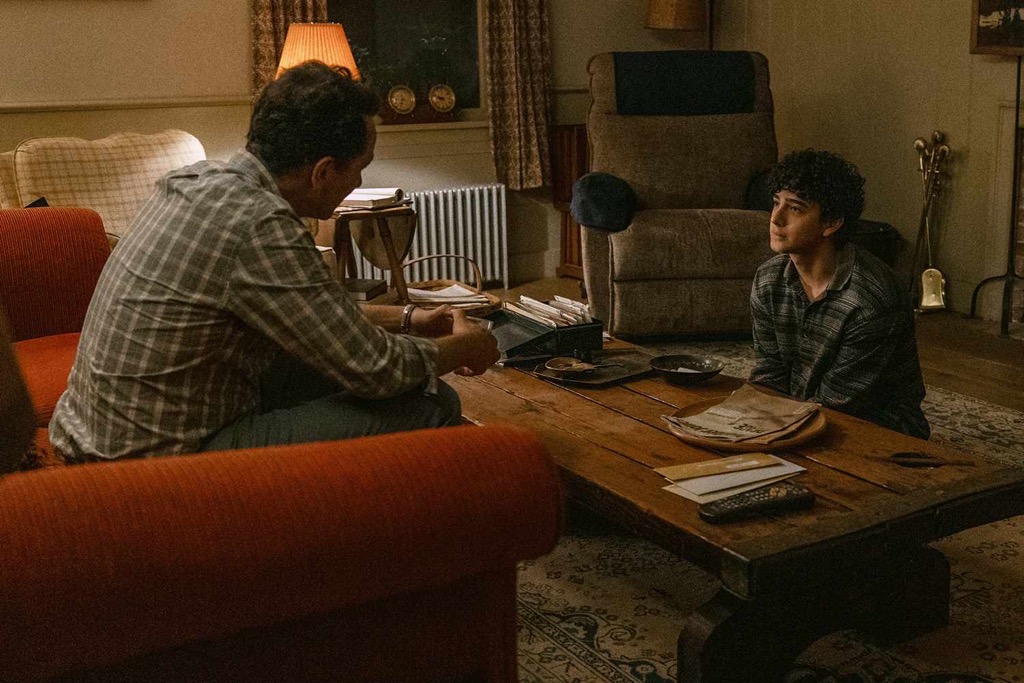
And I think it’s even more subtle with the B-story of Evan confronting Tom over the lockbox full of letters from and pictures of his mother. I already realized that the choice to end it with the two of them bonding over good memories of his mother was the best possible way to handle it, so much better than the angry shouting match I’d been expecting. It felt like a mature, best-possible ending for an entire storyline, while also quietly putting to rest a bunch of mystery-box questions like “what really happened to the mother?” and “what did Tom know?”
But I’d also kind of wanted some kind of cathartic resolution, because Evan is one of the only main characters in the series that I’ve grown to actively dislike. (Except Kris, of course. And that awful boy PJ1I learned from a podcast that the actor who plays PJ was also the one who drove the carriage carrying Sarah Westcott into town. Does it mean anything? No, it does not, because it’s not true. I’ve stopped listening to that podcast.. And obviously Kathy). Not enough that I wanted to see him get tasered. Necessarily. But enough that I wanted to see him face some kind of actual consequences. Because the entire season has been showing and mentioning his doing whatever he wants and there being no repercussions, culminating with screaming at his dad and only hearing “someday you’re going to feel guilty for saying that” in response.
It was starting to feel like a missed note in a series that otherwise never misses. Most of the stuff has been pranks or relatively normal rebellious teen indiscretions, which were at worst annoying distractions. But we’ve mostly been following the story from Tom’s perspective, and whether you like Tom as a character or not, there’s no doubting that things have been escalating and needing to be taken more seriously. So every time we’ve seen Evan’s BS making things worse, it’s impossible to think, “he doesn’t know about any of the other stuff going on.” You just think about how he’s making everything worse.
And again, thinking back to the first episode made me realize just how well it all fit together. The scenes in episode 8 were a callback to the situation in episode 1, where Tom turned tension with his son into a story about happy memories with his mother. At the time, it seemed like exposition, but it was really showing you how their relationship worked. Tom is (over-)lenient with Evan because he reminds him of his wife. He’s always sad that he lost her, and sad that Evan never got to know his mother. So he’s over-protective, even to the point of being irrational and superstitious.
There’s still another cool layer to it. Just before that scene between Tom and Evan in episode 1, the instigating event was Tom coming home and Evan smoking a joint on the back porch. Evan immediately says something like, “Do you know what this? I found it and think it might be pot.”
At the time, I just thought it’s a good line. This is a show that can have characters who are funny because of the situation as well as characters who are intentionally funny. But even that introduction did more than I realized at the time. It established that the reason Evan keeps getting away with stuff is because he’s charming. He’s not going to cross the “teenage rebellion” line too far — it’s always the kids around him that are goading him into stuff despite his reservations — but he will always reject authority, because he knows he can get away with it.
It’s a reminder that the character hasn’t been mis-handled; everything he’s done has been true to that basic idea. And having him be a basically okay kid who pushes boundaries because he’s already gotten away with it, instead of a maladjusted screw-up, keeps the tension in the right place. He’s not just there to complicate things for Tom for the sake of drama. He’s there to make the sense of threat and dread have character-based stakes. You want Tom and his son to get along and start working together, and you worry about what might happen if he tries to leave the island.
Finally, Wyck has gotten moments that back-fill his character as well. We already learned that his disdain for Tom came from believing that Tom was a coward. Now we realize that no small part of that was projecting, for something he did as a kid and never forgave himself for. He’s been haunted by it ever since, and it’s a big part of why he became an irritable crank and a drunk. It turns the scenes where he’s explaining the revenants to Tom and Patricia, or the Sea Hag to Tom, from being just funny exposition, to being every bit as character based. He takes the island’s curse dead seriously, because he’s convinced he’s seen what it can do first hand. And over the years, it’s created a kind of vicious cycle, where he gets so infuriated when people don’t take it seriously that he over-reacts, which causes people not to take him seriously.
I already loved Widow’s Bay when I was reading it as a bunch of really well-written and executed moments in service of a multi-episode, plot-driven story. Now I’ve got even more appreciation for just how much it puts into every single moment. Even bits that seem like throwaway jokes or one-offs turn out to be based in character. And you can infer years of these characters’ life histories from just a few key moments and perfectly-chosen lines of dialogue.
I still have no idea whether Widow’s Bay is a 10-episode project, or if it’s been left open to become an ongoing series. As much as I want to keep watching it forever, I’ve been leaning towards thinking of it as one season, if only because it’s felt as if it’s one story told very well. Not to mention that they’ve been wrapping up storylines and tearing through island lore and intrigue with the confidence of a team that’s not afraid to “use up” good story ideas.
Now, I’m more on the fence. That confidence feels less and less like a team that’s only written one season’s worth of story, and more like a team that’s confident simply because they know they’ll keep being able to come up with great ideas. After getting rid of the island’s founder and barreling towards a climactic finale, it could seem like everything’s on the path to get definitively wrapped up. But the series is also demonstrating how its plot is revealing more about its characters, not the other way around. I can imagine their saying, “we love these characters, even Kathy, and there’s no shortage of horror stories we can use with a bunch of interesting people on an evil island.”
I don’t think the series needs to “mean” anything, in the sense of having one theme that sums it all up. But the closest it seems that they’ve established so far came right after Wyck came into the bathroom and shot the Sea Hag. Tom asks, “Why is this happening?” Wyck responds, “I don’t know. You just… survive.” Likeable, funny people living on a ludicrously cursed island and just surviving seems to me like the kind of idea that could carry on indefinitely.